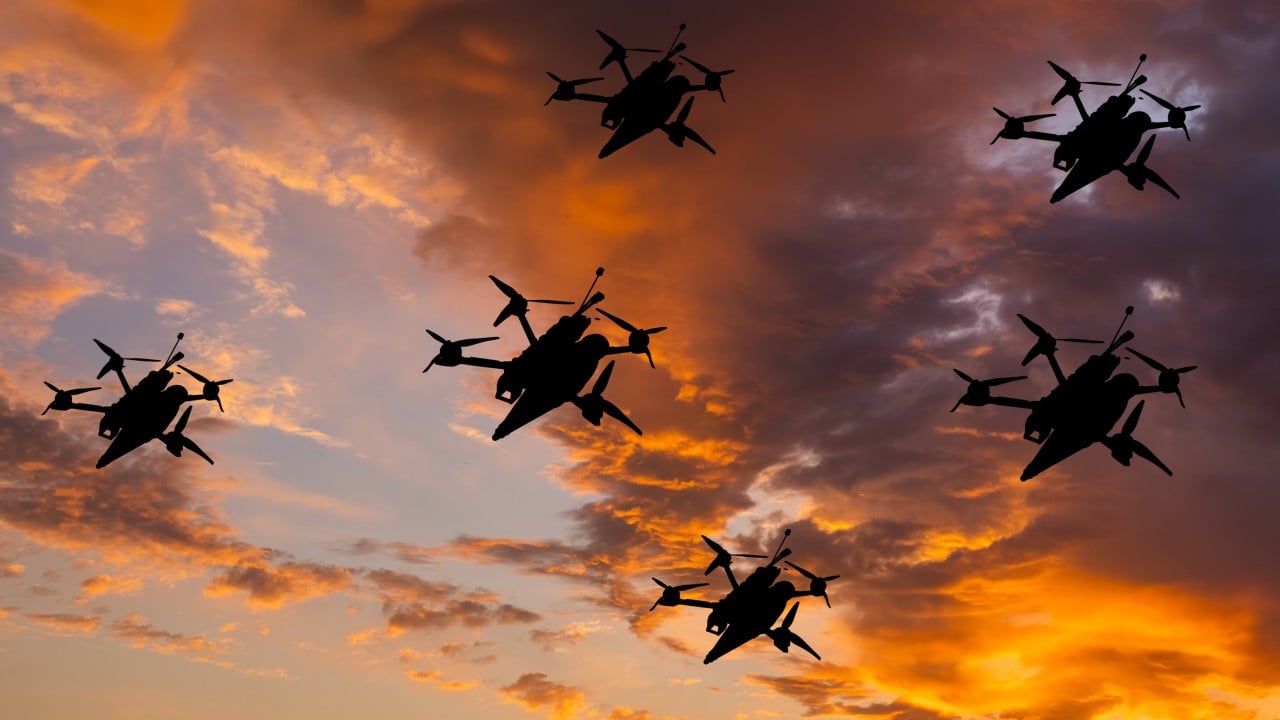
The factory floor smelled of warm circuit boards, ozone, and cheap instant coffee.
Outside, the Shenzhen night hummed with the electric pulse of a city that never fully powers down. Inside, under the unforgiving glare of fluorescent tubes, Mei adjusted her magnifying visor. Her fingers, calloused and impossibly nimble, soldered a micro-controller onto a carbon-fiber frame. It was the brain of a quadcopter. A small brain, but a hungry one.
By sunrise, Mei would complete three hundred of them. Millions of her neighbors across the industrial belt would complete millions more. The sheer scale of it looked invincible from the outside. Satellite photos showed vast complexes of corrugated steel, endless parking lots filled with shipping containers, and smokestacks piercing the smog like iron needles.
To the casual observer, this was an unstoppable tidal wave of hardware. An industrial engine capable of drowning any adversary in a sea of cheap, expendable silicon.
Mathematics tells a different story.
When strategic analysts look past the glowing corporate brochures and the impressive export shipping manifests, they find a startling deficit. Recent defense studies have crunched the cold, hard numbers of modern attrition and revealed an uncomfortable truth for industrial planners. Current manufacturing output across the Middle Kingdom meets roughly sixty percent of what a full-scale, peer-to-peer conflict would actually demand.
Sixty percent.
That missing forty percent is an invisible chasm. It is the distance between a peacetime economic miracle and the meat grinder of industrial-scale combat. It is the gap where entire campaigns stall, where frontlines collapse because the supply chain ran out of specialized microchips, high-grade batteries, or rare earth magnets two weeks before the artillery stopped firing.
We have spent decades believing that mass production equals infinite war. We look at the history books, at the Liberty ships sliding down American ways during the Second World War, at the Soviet tank factories churning out T-34s in the blinding snow of the Urals, and we assume that modern factories can pivot with the same brutal efficiency.
They cannot.
Consider what happens when a commercial drone supply chain meets a battlefield. In a warehouse in Guangdong, a factory manager named Lin can spin up a production line for a commercial aerial photography drone in forty-eight hours. The plastic is cheap. The software is open-source. The consumer demand is bottomless. Lin becomes rich, and the GDP charts tick upward.
Now, strip away the consumer frame. Replace the camera with a guidance system resistant to military-grade jamming. Replace the fragile lithium battery with a high-density power cell that will not detonate when pierced by shrapnel. Add encrypted telemetry chips that cannot be hijacked by an electronic warfare unit sitting three hills away.
Suddenly, Lin is no longer building toys. He is building munitions.
And the supply chain fractures.
Specialized components do not grow on trees. They require pristine cleanrooms, hyper-pure silicon wafers, and rare chemical inputs that are tightly controlled, heavily monitored, and vulnerable to blockade. When a conflict breaks out, the consumption rate of these specialized parts defies imagination. A single division can burn through a month's worth of inventory in a single afternoon of intense counter-battery fire and electronic suppression.
The factories do not simply speed up. They choke.
Down on the assembly line, Mei does not think about defense white papers or gross domestic product metrics. She thinks about her quota. She thinks about the dull ache in her lower back and whether her oldest daughter's school fees cleared this morning. But she also feels the quiet tension in the air. The engineers talk in hushed tones during breaks. They talk about material shortages. They talk about how the shipment of gyroscope sensors from the sub-supplier in Jiangsu was late again.
"If the machines stop, we stop," a veteran technician named Zhang told her last week, wiping solder flux from his stained apron. "And if we stop, the whole house of cards comes down."
That is the paradox of twenty-first-century manufacturing. We built a globalized, hyper-efficient machine designed to optimize profit margins, reduce warehouse overhead, and deliver gadgets to front porches in three days. We optimized for peace. We optimized for cost.
War does not care about cost optimization. War cares about redundancy. War cares about stockpiles, backup generators, redundant foundries, and raw material reserves that sit idle for years just in case the sky falls.
When you run an economy at maximum efficiency, you eliminate the slack. And slack is the exact thing you need when a missile hits a power substation or a cargo vessel gets turned around in a contested strait. Without slack, a forty percent deficit is not just a statistical shortfall. It is a hard ceiling. It is the point where the assembly line slows to a crawl because the raw materials are sitting in a harbor three hundred miles away, waiting for clearance that never comes.
We are watching the collision of two different realities.
On one side stands the myth of infinite industrial might—the belief that sheer population and sprawling concrete factories can solve any strategic problem through brute force. On the other side stands the brutal physics of modern supply chains, where a single missing component from a factory in a foreign country can halt the production of ten thousand finished weapons.
The sixty percent threshold is a warning siren buried deep inside the spreadsheets of defense economists. It tells us that the next major conflict will not be won by the nation that builds the most drones on day one. It will be won by the nation that can survive the moment its supply lines snap, the moment the rare earth minerals stop flowing, and the moment the workers in the factories look up from their benches to realize the warehouse behind them is empty.
Mei picks up another micro-controller. Her iron glows orange in the dim light. She touches it to the board, a wisp of gray smoke curling toward the ceiling.
The machine hums. The parts move. For now, the line keeps running. But out in the dark, beyond the factory gates, the clock is ticking down to a math problem no one knows how to solve.