The air does not smell like smoke until it smells like everything you own disappearing.
Smoke has a texture before it has a color. It crawls across the horizon like a bruised thumb, flattening out against the grey belly of a British sky that has forgotten how to stay wet. Down here, standing on the edge of a dry-stone wall in North Yorkshire, you can hear the heather crackle. It sounds like someone walking across a floor strewn with broken saltines. Dry. Brittle. Hungry.
We think of fire as an ancient thing, a campfire story, a hearth. But when the wind shifts off the North Sea and drives a wall of flame across parched peatland, fire stops being an element and starts acting like an organism. It breathes. It recalculates.
And standing between that living, red-eyed hunger and someone’s front door is a person in a yellow jacket designed for a different century.
The Weight of Wet Wool
Picture Sarah. This is a hypothetical scenario, but it is built from the bones of a thousand true shifts. Sarah has been a retained firefighter in a rural station for twelve years. By day, she manages inventory at a local agricultural supplier. By night, when the pager strapped to her belt screams from its holster on the bedside table, she pulls on trousers that smell of diesel and sweat, slides into heavy boots, and drives three minutes to the station.
When Sarah started, grass fires meant a few hours with a beater—a thick rubber flap on a long wooden pole—whacking at smouldering turf until her shoulders screamed.
Not anymore.
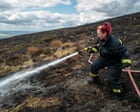
Last summer, Sarah spent fourteen hours straight on a moorland slope where the ground beneath her boots was literally cooking. The peat was burning underground, six feet deep, chewing through roots and ancient carbon caches out of sight. Her boots melted slightly at the tread. Her standard structural firefighting jacket—heavy, insulated, built to trap heat inside a burning two-story flat in Bradford—became a literal sauna.
She was drinking lukewarm water from a plastic bottle that tasted like hot PVC, her heart hammering against her ribs at a hundred and forty beats per minute, while the radio spat reports of another front jumping a firebreak half a mile away.
She was trying to fight a twenty-first-century climate threat with twentieth-century hand-me-downs.
The Shift in the Weather
For generations, the United Kingdom enjoyed a meteorological insurance policy. It rained. Often. The grass stayed green, the peat stayed damp, and wildfires were minor seasonal nuisances restricted to a few spring weekends.
The policy has lapsed.
Winters are shorter. Summers arrive with the force of an iron door slamming shut. Dried-out moorlands across Scotland, Wales, and northern England have turned into tinderboxes. We are seeing fires in places where fire trucks have never had to go—steep, inaccessible crags where you cannot roll a heavy water tender because the ground will swallow it whole.
When the Home Office and fire service leaders finally slapped the label of a national priority on equipping UK firefighters for this growing wildfire threat, it was not an administrative adjustment. It was an admission of reality.
For too long, rural brigades have made do with equipment scavenged from urban departments. They have adapted high-pressure urban hoses for low-pressure moorland water sources. They have worn heavy, restrictive breathing apparatus rigs while hiking miles across heather just to reach the head of a blaze.
Imagine trying to run a marathon in a lead-lined diving suit. That is what asking a firefighter to tackle a wildfire in traditional structural gear looks like.
What Protection Actually Looks Like
The transformation happening across brigades right now is quiet, urgent, and long overdue. It is not about flashy gadgets. It is about survival physics.
Wildfire PPE is fundamentally different from structural gear. It is lighter. It is breathable. It is designed to reflect radiant heat rather than trap internal body heat, because on a moorland fire, exhaustion and heatstroke are far more immediate killers than direct flame contact.
Think of it as moving from medieval plate armor to a runner's aerodynamic shell.
Brigades are acquiring specialized lightweight forestry helmets that do not trap sweat and fog up vision. They are distributing ergonomic web gear that shifts the weight of water bottles, radios, and fire shelters off the shoulders and distributes it across the hips. They are investing in portable high-volume pumps that can draw water from a stagnant sheep dip or a narrow stream two miles down the valley, feeding drip torches and spray units where municipal mains don't reach.
These upgrades sound administrative on paper. To Sarah, sweating through her underlayers while the wind changes direction, they mean the difference between walking off the hill on her own two feet and being loaded onto a stretcher.
The Invisible Stakes
There is a psychological toll to fighting fires that have no clear boundaries. In a townhouse fire, there are walls. There are doors. There is a beginning, a middle, and an end.
A wildfire has none of those things. It eats miles. It surrounds you.
When firefighters are poorly equipped—when their radios crackle and die because of interference from dense smoke, when their boots blister their feet three miles from the nearest road, when their jackets are so heavy they have to sit down every twenty minutes just to keep from vomiting—fear creeps in. Not the sharp, useful fear that keeps you alive, but the dull, grinding dread of inadequacy.
Equipping our firefighters properly is not just about buying better kit. It is about telling them that their lives matter as much as the timber, the sheep, the homes, and the carbon sinks they are trying to save.
The smoke is clearing over the Yorkshire moors for now. The heather is starting its slow, stubborn journey back from black stubble to green shoots. But the dry weather will return. The wind will shift again.
When it does, the people running toward the red glow on the horizon deserve more than our gratitude. They deserve the tools to meet the fire on its own terms.


