The sky over the Cariboo region does not turn red all at once. It bleeds slowly, a bruised purple that curdles into a thick, suffocating orange.
You smell it before you see it. It is the scent of a century of growth turning to cinder in seconds. It gets in your teeth. It coats the back of your throat with a dry, metallic tang that no amount of well water can wash away. When the wind shifts out near Big Bar Lake, the silence becomes absolute. The birds stop. The cicadas cut out. Even the pine needles seem to stiffen, waiting for the monster to crest the ridge.
Then comes the notice. It is never a polite request. It is a piece of paper, a digital alert, a knock on the door from a Mountie whose eyes are rimmed with red fatigue. Leave. Now.
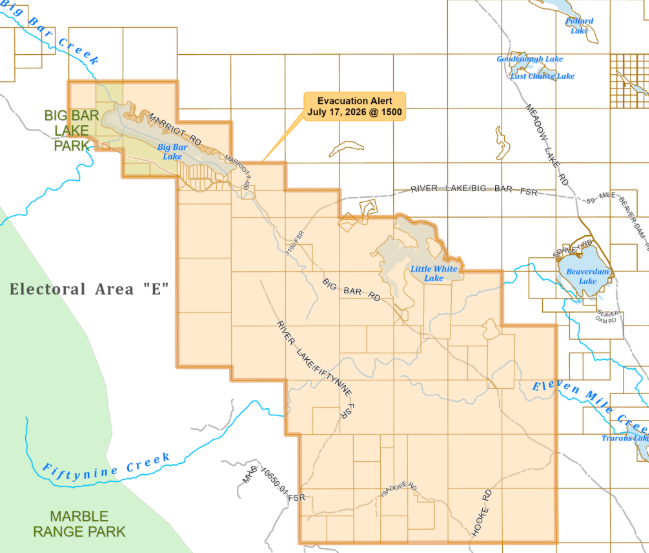
Standard news reports will tell you the facts. They will state that the BC Wildfire Service issued an evacuation order for the vicinity of Big Bar Lake due to an aggressive, out-of-control wildfire. They will give you coordinates. They will cite hectare numbers and containment percentages. But a hectare is a cold, abstract thing. It does not capture the sound of a plastic laundry basket scraping across a truck bed as you try to decide, in ninety seconds, which parts of your life are worth saving.
The Calculus of What Stays Behind
Imagine standing in a living room you built with your own hands. Outside, the smoke is thick enough to swallow the sun, turning three in the afternoon into midnight.
You have a cab-over pickup truck and a five-minute window. This is the human calculus of an evacuation order. It is a brutal, unforgiving sorting mechanism. The photo albums from the nineteen-eighties go into the backseat. The heavy oak table inherited from a grandmother stays. The wedding dress fits. The tools in the shed—thousands of dollars of steel and sweat—are left to the mercy of the heat.
People who live in the backcountry are not easily rattled. They choose the isolation of places like Big Bar Lake because they prefer the company of timber and water to the noise of Vancouver or Kamloops. They know how to handle a chainsaw, how to survive a freeze, and how to read the clouds. But an aggressive wildfire changes the rules of engagement. It behaves like a living entity. It creates its own weather, throwing embers kilometers ahead of the main flank, starting spot fires behind the lines of defense.
When the order comes, independence becomes a liability. You have to trust the flashing lights.
The Anatomy of an Out-of-Control Flank
Wildfire behavior is often described by officials in technical terms. They talk about fuel loads, relative humidity, and rank-five behavior. To understand what that actually means on the ground, think of a blast furnace with the door wide open.
When a fire becomes aggressive, it stops crawling through the underbrush. It climbs. It finds the ladder fuels—the low branches and brush—and leaps into the canopy. This is a crown fire. Once the fire takes to the tops of the trees, it moves with terrifying speed, propelled by winds generated by its own intense heat. The sound is not a crackle. It is a roar, identical to a freight train passing inches from your ear.
[Fuel Load: Dry Timber] + [High Wind] + [Low Humidity] = Extreme Fire Behavior
                                                            |
                                                   [Crown Fire Leaps Canopy]
The crews fighting these blazes are not just spraying water. You cannot put out a mountain on fire with a hose. They are playing a high-stakes game of chess, using bulldozers to scrape the earth bare, cutting off the fire’s food supply before it arrives. They burn out pockets of fuel intentionally, using fire to fight fire.
But when the wind gusts up to sixty kilometers an hour, the chess board gets flipped. The lines break. That is the moment the status changes from an alert to an order. The time for preparation is gone; the time for survival has begun.
The Long Drive South
The road out of Big Bar Lake during an evacuation is a surreal corridor. The headlights of oncoming emergency vehicles cut through the gloom like ghostly fingers. Nobody speaks. You just look in the rearview mirror, watching the column of smoke grow taller, wondering if the next time you see this road, it will be lined with black toothpicks instead of green lodgepole pine.
The uncertainty is the heaviest baggage. A house can be rebuilt. Insurance can process a claim. But the peace of mind that comes with knowing you are safe in your own bed takes decades to cultivate and only seconds to ash.
As the evacuees head toward emergency reception centers, the community shifts from a geographic location to a shared state of anxiety. In gymnasium cot-lines and motel lobbies, neighbors look at each other without their usual stoicism. The shared question is unspoken but universal.
The fire continues to push north, fed by the dry breath of a changing climate and a landscape primed to burn. The crews stay behind, facing down the heat, while the residents can only wait, watching the horizon, hoping for a shift in the wind that might save what remains.