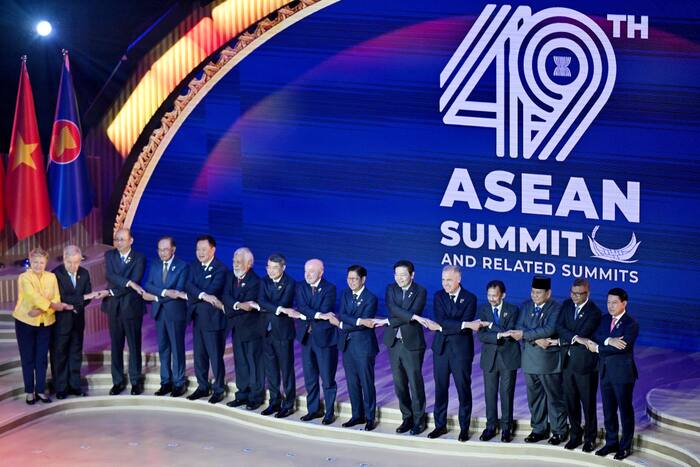
Southeast Asian leaders gathered in Metro Manila for the 49th ASEAN Summit under a familiar cloud of global instability. Host country leader Ferdinand Marcos Jr. sat down with regional heads to address conflicts ranging from violent border disputes to military rule and territorial maritime spats.
If you've followed regional diplomacy for more than five minutes, the agenda looks predictable. Myanmar's post-coup civil war is dragging into its sixth year. China and several Southeast Asian nations are still locking horns over disputed reefs in the South China Sea. Meanwhile, border skirmishes between Thailand and Cambodia have threatened to flare up despite a fragile ceasefire.
The standard media script focuses heavily on diplomatic stalemates. Pundits love to point out that the 10-member bloc lacks real enforcement power. They're not wrong, but focusing exclusively on political deadlocks misses the bigger picture. Beneath the high-stakes geopolitical drama, Southeast Asian nations are quietly pulling off practical moves that keep the region's economy humming.
Here is what really happened behind closed doors, why political fixes stall out, and where true progress is actually taking place.
The Consensus Trait Is A Double Edged Sword
Understanding why ASEAN struggles with crisis management comes down to its foundational rule: strict neutrality and consensus-based decision making. Everyone gets a veto.
When military authorities in Myanmar ignored the bloc's Five-Point Consensus peace plan, ASEAN responded by barring high-level junta representation from decision-making summits. That sounds tough on paper, but in practice, non-political representatives still sit in lower-level meetings. The military regime treats the peace plan as internal interference. Without a mechanism to enforce consequences, the bloc's official stance functions mostly as a formal declaration rather than an active lever for peace.
The South China Sea tells a similar story. China and ASEAN set a target to finalize a legally binding Code of Conduct. Negotiators reached agreement on roughly 80% of the text, but the final 20% contains all the landmines. Resolving scope, enforcement, and international arbitration rights requires unanimity that simply doesn't exist when member states have wildly different diplomatic alignments.
Expecting a 10-nation bloc operating on total consensus to act like a military alliance or a centralized legislative body is a fundamental misunderstanding of how the organization was designed.
Gridlock On Security Freezes Progress On Trade
Political observers often view regional disputes through a purely diplomatic lens. Business owners and economic strategists see something entirely different: operational friction.
When border clashes erupted along the 800-kilometer Thai-Cambodian border, displacement and security lockdowns disrupted cross-border trade routes. When maritime Standoffs escalate in disputed waters, insurance premiums for commercial shipping lines tick higher.
Every unresolved political issue acts as a hidden tariff on regional commerce. Foreign direct investment relies heavily on long-term predictability. If maritime transit channels face recurring harassment or cross-border logistics routes shut down over territorial disputes, international capital shifts toward more stable corridors. Security issues aren't abstract talking points for diplomats; they directly impact supply chains and corporate balance sheets.
Economic Pragmatism Is Moving Forward Anyway
While defense and foreign ministers clash over sovereignty, economic and energy ministers are quietly building real infrastructure.
The ASEAN Power Grid project is moving forward, establishing interconnectivity agreements that allow member states to buy, sell, and trade renewable energy across international borders. Energy security has taken center stage following global fuel shocks, forcing pragmatic cooperation even among governments that disagree on foreign policy.
Simultaneously, regional payment connectivity has expanded dramatically. Instead of routing local trade payments through standard Western intermediary currencies like the US Dollar, central banks across the region have linked their fast-payment systems via QR code frameworks. A tourist or business traveler from Indonesia can pay directly in Thailand or Malaysia using local currency transfers settled instantly.
The Digital Economy Framework Agreement aims to double the region's digital economy to $2 trillion by 2030. By creating unified rules for cross-border data flows, cybersecurity, and digital payments, ASEAN is building an integrated market of over 680 million people.
Security headlines generate clicks, but infrastructure integration builds real economic resilience.
How To Track Real Regional Progress
If you want to evaluate whether regional summits are delivering value, stop reading post-summit joint communiqués. Official statements are carefully drafted to avoid offending any single member state. Instead, focus on these three practical indicators:
- Bilateral Deals: Watch for sub-regional or direct two-nation agreements signed on the sidelines. Real policy movement often happens outside the main plenary room.
- Infrastructure Milestones: Track actual grid completions, cross-border rail connections, and regulatory sign-offs on cross-border payment rails. Physical links matter more than signed declarations.
- Chairmanship Shifts: Pay attention to which country holds the rotating annual chairmanship. Different host nations bring distinct domestic priorities and diplomatic strategies to the agenda.
As the annual chairmanship transitions from the Philippines to Singapore, expect a sharper pivot toward economic integration, trade facilitation, and supply chain security. Political gridlock over security will likely remain. But for companies, investors, and residents navigating the region, the real story is how effectively Southeast Asia builds practical bridges right past its security walls.