The air under the television studio lights is always colder than you expect. It smells faintly of ozone and expensive dust. If you stand on that stage under the intense glare of national broadcasting, the silence doesn't feel empty. It feels heavy, like water pressure at the bottom of an ocean.
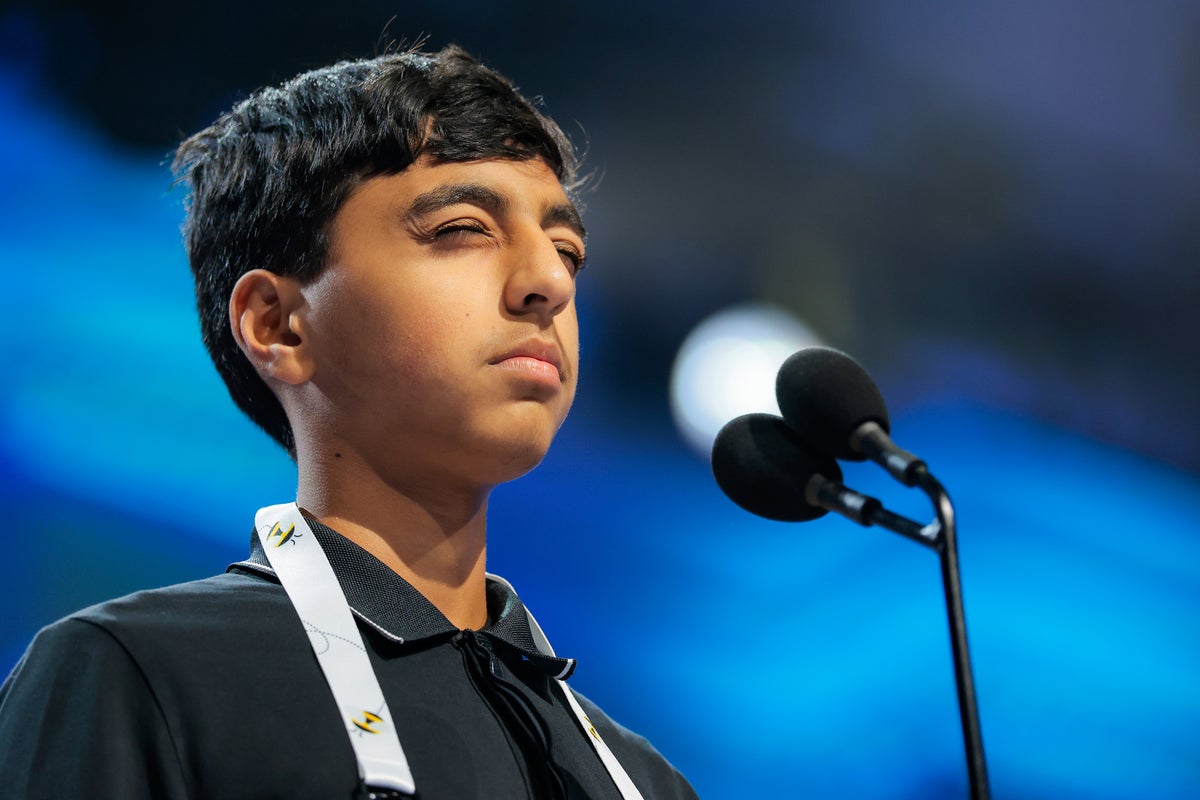
A twelve-year-old child stands in the center of that pressure. Their shoes, likely bought fresh for the occasion, look impossibly small against the polished wood of the stage. Opposite them sits a microphone that seems to grow taller by the minute. Behind that microphone is a pronouncer, a person whose job is to utter words that sound like ancient curses or forgotten spells, waiting to see if the child will break. Also making news lately: Structural Diagnostics of Spider-Man Brand New Day and Franchise Renewal Mechanics.
Most people tune into the Scripps National Spelling Bee for the spectacle. They want to see the kid who faints, the kid who dances, or the kid who asks for the definition forty-two times just to buy a few precious seconds of thinking time. We treat it like a quirky slice of Americana, a nerdy tradition sandwiched between sports seasons.
We are looking at it completely backward. More insights into this topic are explored by GQ.
This isn't a game. It is a high-stakes psychological thriller disguised as an academic exercise. It is a colosseum where the weapons are etymology and the gladiators haven't even hit puberty. When that final word is spoken, and the confetti falls, we talk about the trophy. But the real story is about the sheer, terrifying weight of a single letter, and the immense fortune that hangs on whether a child remembers a root word from sixteenth-century Prussia.
The Mirage of the Natural Born Genius
There is a common myth that the children who reach the final rounds of the National Spelling Bee are simply born with photographic memories. We like this narrative because it excuses the rest of us. It implies they possess a biological mutation that allows them to store dictionaries in their cerebral cortex.
The truth is far more uncomfortable. It is a story of brutal, unyielding labor.
Consider what it actually takes to survive until the final night. The dictionary used for the competition contains roughly 470,000 words. To put that in perspective, the average adult English speaker uses about 20,000 to 35,000 words in their entire lifetime. These middle schoolers are mastering a landscape that is fifteen times larger than the vocabulary of their parents.
They do not do this by memorizing lists. Memorization is a trap; it fails when the brain is starved of oxygen by panic. Instead, these kids become linguistic detectives. They learn how words breathe. They track how a Latin root mutated when it crossed the Alps into France, and how it shifted again when British sailors brought it across the Atlantic.
They spend six hours a day, every day, staring at Greek prefixes and obscure Arabic derivations. While their peers are discovering video games or navigating the social hierarchies of middle school cafeteria lines, these children are isolating themselves with phonetic variants. They are practicing the art of the perfect guess under pressure.
The Moment the Room Goes Cold
When the field narrows to the final two or three competitors, the atmosphere shifts. The casual viewers have gone to bed, leaving only the die-hards and the families whose entire lives have revolved around this moment for the last five years.
The prize is no longer an abstract concept. It is real. We are talking about $50,000 in cash from Scripps, plus additional thousands from encyclopedias, dictionaries, and travel contracts. For a family, that is a college tuition. For a child, it is a staggering fortune.
But watch their faces. They aren't thinking about the money. They are thinking about the abyss.
In the final rounds, the pronouncer drops a word into the room like a stone into a deep well. The competitor has two minutes. They ask for the definition. They ask for the part of speech. They ask for the language of origin. Every question is a shovel, digging into the history of human speech to find a clue.
Then comes the tracing. Watch their fingers. They write the word in the air, or on the palms of their hands, feeling the shape of the letters before they dare speak them aloud. It is a somatic ritual, a way to anchor their minds when the adrenaline is telling them to run out of the building.
One wrong letter. That is all it takes.
If you say e instead of i, a small, polite bell rings. That bell is the most brutal sound in television. It doesn't buzz or roar. It just dings. A gentle, crystalline notification that your childhood dream is over, effective immediately. You are escorted off the stage while the cameras track your tears in high definition.
The Architecture of the Winning Word
When the champion finally stands alone, the final word is rarely something common. It is usually a linguistic artifact, a word so specific and rare that it feels like it was unearthed from an archaeological dig.
The winning word doesn't just test memory; it tests nerve. It is often a word with a trap door. A silent letter, an unexpected vowel substitution, or a pronunciation that completely betrays its spelling. To get it right, the speller must ignore what their ears are telling them and trust what their historical knowledge dictates.
When the letters come out, one by one, spaced out by heavy breaths, you can see the exact moment the child realizes they've won. It isn't when they finish the word. It is usually about three letters before the end, when the internal puzzle clicks into place. The tension drains from their shoulders, their voice steadies, and they deliver the final consonants with the authority of a judge handing down a verdict.
Then, the explosion. The confetti cannons fire with a concussive boom that makes everyone jump. The trophy, massive and silver, is hoisted up. The parents rush the stage, weeping openly, processing years of early mornings, flashcards, and sacrificed weekends in a single embrace.
The Quiet That Follows the Confetti
The next morning, the champion will appear on early morning talk shows. They will be asked to spell things like the host's name or the word supercalifragilisticexpialidocious. They will smile politely, looking incredibly tired, holding a giant cardboard check for fifty thousand dollars.
But the true victory isn't the money, nor is it the brief flash of celebrity.
The true victory is that these children have looked into the eyes of a monster—the terrifying complexity of human language and the crushing weight of public scrutiny—and they did not blink. They conquered nearly half a million words through sheer force of will, intellect, and emotional discipline.
Long after the confetti is swept off the studio floor, and the giant check is deposited into a savings account, that discipline remains. The child who stood under those lights knows something most adults spend a lifetime trying to learn: if you can survive the bell, you can survive anything.