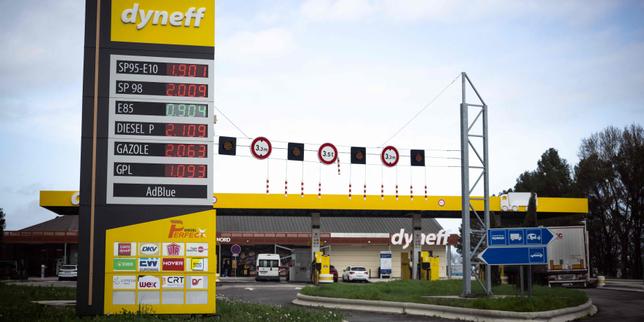
The metal handle of the fuel nozzle is always colder than you expect in the early morning. It has a specific, mechanical weight—a density that seems to increase when the numbers on the digital display start spinning faster than the fluid entering your tank. For someone with a comfortable salary, these numbers are a background hum, a minor line item in a digital spreadsheet. But for Marc, a delivery driver in the outskirts of Lyon, that display is a high-stakes countdown.
Every centime matters. Every decimal point is a decision.
When the price of diesel ticks up by a few cents, it doesn't just change the cost of a commute. It ripples through a house like a physical weight. It sits on the kitchen table between the unpaid electricity bill and the supermarket flyer. We often talk about inflation in the abstract, using grand economic terms like "purchasing power" and "market volatility," but those words are too clean. They don't capture the sour feeling in the stomach when you realize that filling the tank to reach your job means you’ll be buying the cheaper, starch-heavy pasta for the third night this week.
The Invisible Margin
Most people live within a margin. For some, that margin is a wide, lush valley. For others, it is a tightrope. When you are "très juste"—that French expression for being stretched to the absolute limit—you aren't just living paycheck to paycheck. You are living breath to breath.
Imagine a glass filled to the absolute brim with water. The surface tension holds it together, creating a slight, shimmering dome. It looks stable. You can even move the glass if your hand is steady. But add a single drop—one more tiny, insignificant drop—and the tension snaps. The water spills. The mess is immediate.
In the current economy, energy prices are that final drop.
For a family living in a rural area or a "peri-urban" zone, a car isn't a luxury or a choice. It is a prosthetic limb. Without it, you cannot reach the employer, you cannot drop the children at school, and you cannot access the affordable grocery stores that stay competitive by being located in the middle of nowhere. This is the great irony of modern poverty: it is incredibly expensive to be poor. You are forced to pay a "mobility tax" just to participate in the workforce.
The Psychology of the Centime
There is a specific kind of mental exhaustion that comes from constant calculation.
Consider a hypothetical woman named Elena. She works as a home care assistant, driving from one elderly patient to the next. Her route is fixed. Her fuel consumption is a mathematical certainty. When gas prices rise, Elena doesn't just see a higher number at the Total station. She begins to perform a frantic, internal audit.
If I drive five kilometers under the speed limit, can I save half a liter?
If I skip the heating in the car this morning, does that offset the three-cent increase?
Can I push the oil change another month?
This isn't just budgeting. It’s a form of cognitive tax. While a wealthy executive spends their mental energy on strategy or creativity, Elena is forced to spend hers on the basic physics of survival. This exhaustion bleeds into her work. It affects her patience with her patients. It follows her home, making her shorter with her kids. The price of fuel doesn't just drain the wallet; it drains the soul.
The statistics tell us that when fuel prices rise by 10%, consumption only drops by a fraction. Economists call this "inelastic demand." It sounds like a cold, rubbery term. In reality, it means people are trapped. They keep buying the gas because they have no choice, which means they are forced to cut from somewhere else. They cut the "pleasures"—the cinema ticket, the Sunday treat, the brand-name coffee. Then they cut the essentials.
The Geography of Inequality
We have built a world that assumes mobility is a given. Our cities are designed with the assumption that everyone can effortlessly bridge the gap between where they sleep and where they produce value. But the map of our towns is increasingly a map of social stratification.
The centers of our cities are becoming playgrounds for those who can afford to walk, bike, or take a high-speed tram. Meanwhile, the working class is pushed further into the "empty spaces" where the bus runs once every three hours and the nearest train station is a twenty-minute drive away.
This creates a geographical trap. The further you are pushed out by rising rents, the more you are shackled to the price of oil. You flee the high cost of housing only to be met by the high cost of distance. It is a pincer movement.
When the government discusses subsidies or "fuel checks," they often miss the human timing of the crisis. A rebate that arrives in three months does nothing for the person who needs to fill their tank on a Tuesday morning to make it to a shift that afternoon. Credit is not an option when you are already at the ceiling. The delay between the pain and the cure is where the real damage happens. That is where the "drop" spills over the edge of the glass.
The Quiet Anger
There is a silence to this struggle.
It isn't always found in the loud protests or the blocked highways, though those are the shadows that loom over every price hike. The real struggle is found in the quiet click of a calculator at midnight. It’s found in the person who stares at the pump, watching the liters go in, and decides to stop at twenty euros because they need to keep ten in their pocket for bread and milk.
We tend to look at these economic shifts as "shocks" or "trends," but for the person behind the wheel, it is a loss of agency. To be "très juste" is to lose the ability to plan for the future. How can you save for a house or an education when your financial security is tied to a conflict in a country you’ve never visited or a decision made in a boardroom half a world away?
The volatility of the market becomes a volatility of the heart.
This isn't just about fuel. It’s about the fragility of the social contract. When the most basic requirement for work—the ability to get there—becomes a source of crushing stress, the foundation of a society begins to hairline fracture. We aren't just talking about a liquid in a tank. We are talking about the oxygen of a functioning life.
Marc finishes fueling his van. He clicks the nozzle back into its holster. He looks at the total: 84 euros. He remembers when that same amount of fuel cost 65. He does the math in his head—that’s nineteen euros gone. That’s a pair of shoes for his son that will have to wait another month. That’s a leak in the roof of his budget that he can't plug.
He climbs into the driver's seat, turns the key, and watches the needle rise, but never quite as far as he needs it to go. He pulls out into the traffic, a single cell in a vast, moving organism, praying that next week, the glass doesn't finally overflow.