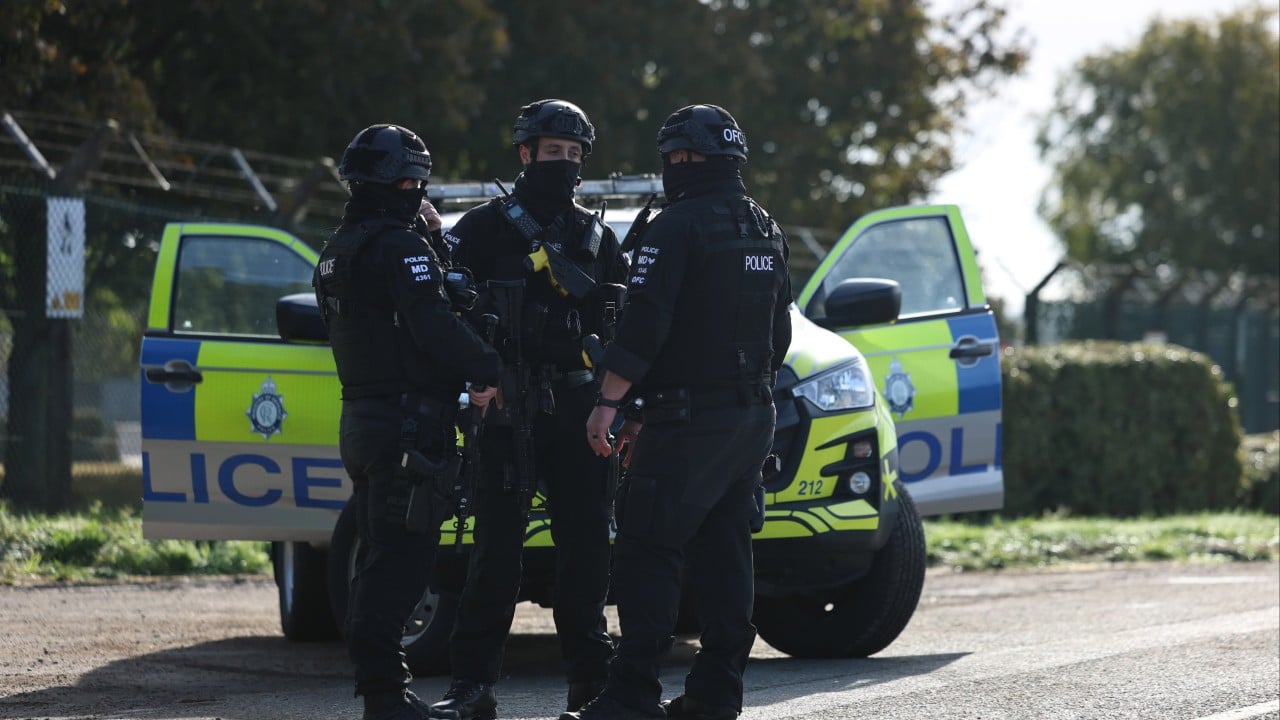
Counter-terrorism operations involving foreign state-directed threats operate within a strict calculus of risk mitigation, intelligence latency, and jurisdictional friction. The security incidents surrounding Royal Air Force Fairford in Gloucestershire expose the structural vulnerabilities inherent in protecting dual-nation military installations from decentralized, proxy-driven hostile networks. Modern statecraft relies heavily on asymmetric warfare, where regional powers deploy localized assets rather than conventional military units to probe critical infrastructure. Understanding how these interdictions function requires a systematic breakdown of operational thresholds, evidentiary burdens, and the economic friction imposed on strategic deterrence.
The threat matrix surrounding installations housing foreign assets, such as American strategic bombers stationed in the United Kingdom, relies on three distinct variables: reconnaissance depth, asset dispersion, and supply chain integrity for explosive or disruptive materials. When British counter-terrorism police detained multiple individuals following suspicious transit behavior near the perimeter, the immediate operational priority was threat containment rather than immediate prosecution. In counter-terrorism logistics, intercepting a cell during the active surveillance or logistical staging phase prevents the maturation of an attack lifecycle.
Hostile intelligence services utilizing proxy networks typically decouple command-and-control structures from tactical execution. This separation creates an intelligence paradox. While operatives on the ground may be local nationals or dual citizens, their tasking originates from external handlers who employ encrypted communication channels and digital financial architecture. Consequently, law enforcement agencies must balance the threshold for intervention. Moving too early yields insufficient evidence for long-term detention or successful statutory prosecution under legislation such as the National Security Act; waiting too long increases the probability of catastrophic asset destruction or loss of life.
The immediate consequence of such interdictions extends far beyond local arrests, triggering mandatory force-protection recalibrations. Strategic assets like long-range bombers possess high replacement costs and outsized geopolitical value. When credible intelligence links local surveillance activities to a coordinated transnational network spanning multiple European jurisdictions, host nations face immediate pressure to alter operational readiness. Aircraft redeployment serves as a risk-minimization mechanism, absorbing temporary operational degradation to eliminate single points of catastrophic failure.
Legal frameworks governing national security offenses must adapt to decentralized threat models. Traditional criminal statutes require clear intent and direct action toward a specific crime. However, modern counter-terrorism mandates intervention at the preparatory phase. Charging suspects with preparation of terrorist acts or offenses under updated national security legislation reflects a legal shift toward preemptive disruption. This shift trades high evidentiary certainty for enhanced public safety, creating downstream challenges for prosecutors who must establish a direct nexus between low-level local operatives and state-level command structures without compromising classified intelligence sources.
Future defense postures around joint-use military infrastructure will depend on the integration of automated perimeter intelligence, enhanced vetting of secondary contractors, and real-time cross-border intelligence sharing. Because proxy networks exploit the seams between domestic police forces and international intelligence agencies, closing these gaps requires hardening the weakest operational node. Security architects must treat localized surveillance not as an isolated criminal anomaly, but as a diagnostic indicator of a distributed, persistent reconnaissance campaign.