The rain in Edinburgh does not just fall. It bleeds into the grey volcanic rock of the Royal Mile, blurring the lines between the historic seat of power and the modern glass-and-steel geometry of the Scottish Parliament. Inside those walls, politics is rarely about the grand, sweeping speeches that make the evening broadcast. It is played out in the quiet posture of survival.
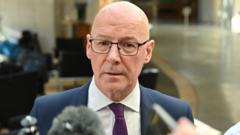
John Swinney knows this posture better than most. He has inhabited it for decades. When he stood before the cameras to decline a formal Holyrood inquiry into the actions of Peter Murrell, the former chief executive of the Scottish National Party, it was not a moment of sudden defiance. It was the deliberate execution of a political shield wall.
To understand the weight of that refusal, you have to step away from the sterile headlines and look at the anatomy of political loyalty under pressure.
The Weight of the Gavel
For months, the Scottish public has watched a slow-motion drama unfold through police cordons and blue forensic tents. The investigation into the SNP’s finances—known to the public and the press as Operation Branchform—has moved from a background murmur to a rhythmic drumbeat that threatens to shake the very foundations of the devolution era. Peter Murrell, a man who for years operated as the quiet engine room of the independence movement, now finds himself at the center of a judicial storm after being charged with the embezzlement of party funds.
When opposition parties demanded that Holyrood launch its own parliamentary probe into what happened behind closed doors, they were not just asking for a committee meeting. They were asking for a public dissection.
John Swinney’s response was swift, measured, and unyielding.
He argued that the Crown Office and the justice system must be allowed to do their work without the contamination of political theater. On paper, it is a textbook constitutional argument. The separation of powers is a foundational pillar of modern democracy. Parliament makes the laws; the courts enforce them. If politicians begin duplicating the work of prosecutors, the entire machinery of justice risks grinding to a halt.
But out on the streets of Glasgow and Dundee, where ordinary voters are trying to square their utility bills with the drama broadcast from Edinburgh, that constitutional neatness feels distinct from reality. For the person watching from a distance, a refusal to investigate can easily look like a refusal to look in the mirror.
The Two Theaters of Power
Imagine a grand theater with two stages running simultaneously. On the left stage, the legal system operates with agonizing slowness. It demands strict adherence to procedure, the careful weighing of evidence away from public emotion, and the preservation of a fair trial. It is a space where silence is often a legal necessity.
On the right stage, the political arena demands instant answers, high drama, and public accountability. It thrives on noise.
+-------------------------------------------------------+
|                 THE TWO THEATERS OF POWER             |
+---------------------------+---------------------------+
|      THE LEGAL STAGE      |    THE POLITICAL STAGE    |
|   (The Judicial System)   |   (The Scottish Parliament)|
+---------------------------+---------------------------+
| * Operates on evidence    | * Operates on perception  |
| * Moves slowly, precisely | * Demands instant answers |
| * Preserves fair trial    | * Seeks public reckoning  |
| * Rules of prejudice      | * Theater of debate       |
+---------------------------+---------------------------+
When John Swinney rejected the call for a Holyrood inquiry, he essentially chose to pull the curtain down on the right stage to prevent the left stage from being disrupted.
The danger of running a parliamentary inquiry alongside a criminal prosecution is not abstract. It is a structural hazard. If a committee of MSPs begins summoning witnesses, demanding internal documents, and broadcasting tense cross-examinations on live television, they create a minefield for prosecutors. A defense lawyer could argue that the intense, politicized coverage has prejudiced the potential jury pool, making a fair trial impossible under Scots law.
Swinney’s calculation is that the risk of collapsing a criminal trial far outweighs the political damage of being accused of a cover-up.
Yet, the human cost of this calculation is a growing sense of detachment between the governed and the governors. When institutional processes become a shield, trust begins to erode. People do not see the elegant mechanics of constitutional law; they see a political class protecting its own history from scrutiny.
The Long Shadow of a Shared History
To understand why this choice feels so heavy for Swinney, you have to look at the decades of shared history that bind the central characters of this drama. This is not a story of corporate executives shifting between faceless conglomerates. This is a story of a tightly knit movement that grew from the political wilderness into the dominant force of Scottish life.
For twenty years, John Swinney, Nicola Sturgeon, and Peter Murrell were not just colleagues. They were the architects of a political phenomenon. They lived through the intense highs of the 2014 referendum and the unprecedented electoral sweeps that followed. They spent more time in strategy rooms together than they did with their own extended families.
Now, one of those architects sits in the First Minister’s office, while another faces the prospect of a criminal court.
When Swinney speaks on this matter, his voice carries the cadence of a man who understands that every word he utters will be parsed by lawyers and weaponized by opponents. The tension is visible in the line of his shoulders. It is the burden of a leader who must defend the integrity of an institution while navigating the wreckage of personal and political alliances that defined his entire adult life.
Consider the reality of the backbencher or the local activist. For years, they knocked on doors in the driving rain, carrying leaflets bearing the party logo, fueled by a belief in a cause. They did not see the internal accounting ledgers or the governance structures managed by the central office. Today, they are left to answer the uncomfortable questions from neighbors over garden fences and at supermarket checkouts. They are the ones bearing the immediate cost of the silence imposed by ongoing legal proceedings.
The Danger of the Vacuum
When leadership chooses silence—even for the most legitimate constitutional reasons—it creates a vacuum. And in modern politics, a vacuum never stays empty for long. It is instantly filled with speculation, rumor, and alternative narratives.
The opposition parties know this. Their demand for an inquiry was never just about the legal logistics; it was about forcing the government into a position where it had to say "no." In the theater of public perception, the act of saying "no" to scrutiny is a powerful image. It allows critics to paint the administration as secretive, insular, and fearful of what might be uncovered in the light of a committee room.
This is the classic dilemma of governance during a crisis. Do you do what is legally prudent but politically damaging, or do you chase short-term political transparency at the risk of long-term institutional failure?
Swinney has chosen the path of the institutionalist. He is gambling that, in the long run, the public will respect a leader who maintained the boundaries of the law, even when it cost him dearly in the court of public opinion. It is a lonely strategy. It offers no quick victories, no applause from the gallery, and no easy soundbites for the evening news.
The Unseen Horizon
Outside the Parliament building, the tour buses continue to roll past, and the daily life of Edinburgh moves along its familiar tracks. The tourists taking selfies in front of the unique oak beams of Holyrood are largely unaware of the quiet crisis of faith occurring inside.
The decision to deny a parliamentary inquiry may successfully protect the integrity of Operation Branchform. It may ensure that the judicial process runs its course without political interference. But it cannot halt the deeper transformation occurring within Scottish politics. The era of unquestioned trust, where a political movement could carry its followers forward on the sheer momentum of an ideal, has drawn to a close.
What remains is a landscape where every institution is viewed with a degree of skepticism, where every defense of process is met with a demand for deeper transparency, and where leaders are judged not just by the goals they chase, but by the shadows they leave behind.
As the evening light fades over Salisbury Crags, the windows of Holyrood reflect a dark, unsettled sky. The building stands firm, a monument to the power of devolution, but the true strength of any parliament is never found in its architecture. It is found in the unwritten contract between the people and those who sit on the benches inside. Right now, that contract is being tested, line by line, in the heavy silence that follows a refusal to look back.