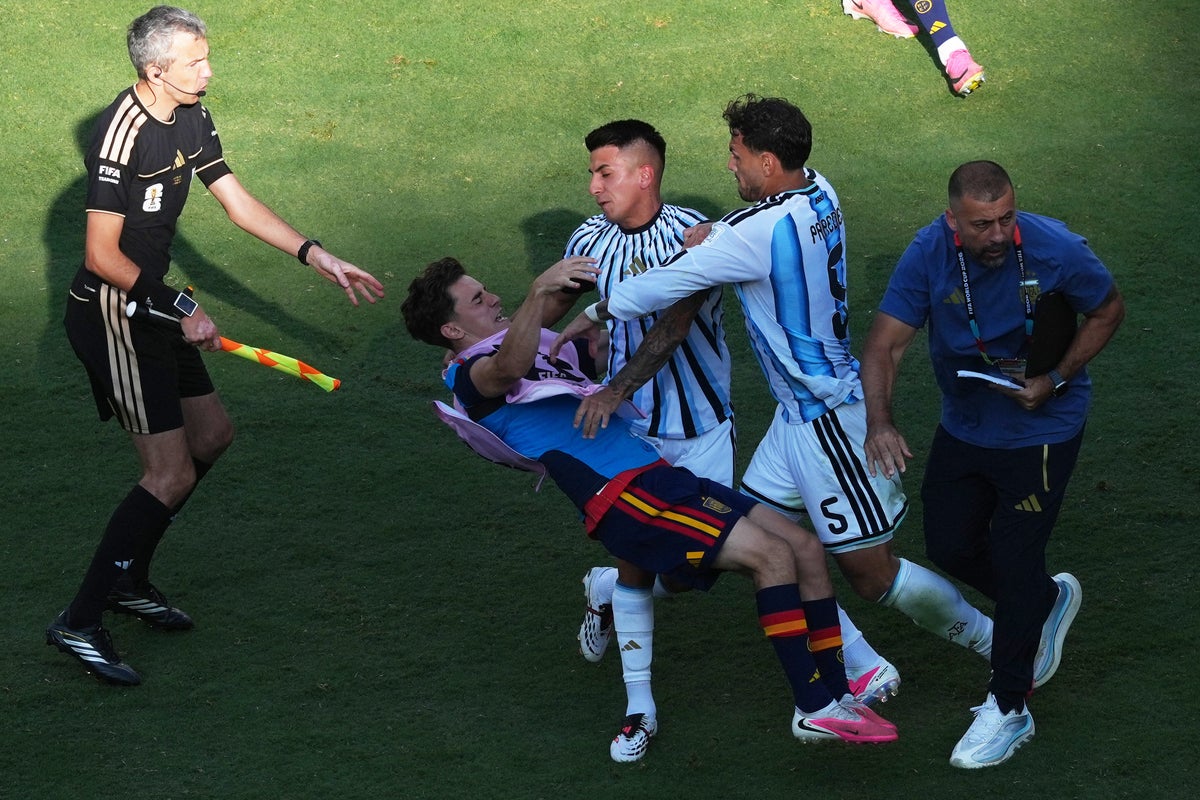
Domestic sports journalism regularly diverges from global physical realities when national prestige intersects with competitive failure. The post-match environment of the 2026 FIFA World Cup final between Spain and Argentina at MetLife Stadium provides a textbook study in narrative isolationism. While international observers documented multiple on-field altercations, physical confrontations involving Leandro Paredes and Thiago Almada, and a subsequent disciplinary investigation by world football's governing body, major Argentine press outlets framed the squad's conduct as exemplary, labeling the group "polite and respectful."
Understanding this divergence requires analyzing the structural incentives of domestic media, the mechanics of cognitive reframing in sports reporting, and the tactical leverage of physical escalation in elite tournament play.
The Cognitive Reframing Mechanism in Domestic Reporting
Domestic media outlets operate under a dual mandate: providing event coverage while preserving audience engagement and institutional access. When an athletic result threatens national sporting identity, coverage shifts from empirical recording to protective reframing.
The Defensive Reporting Taxonomy
- The Insular Isolation Fallacy: Physical confrontations involving key players are classified as "unfortunate isolated incidents" rather than systematic behavioral escalation. This isolates individual infractions from broader organizational patterns.
- Moral Inversion: Conduct that triggers international disciplinary review is reframed as moral fortitude or emotional authenticity under pressure.
- Externalization of Fault: Officiating performance is positioned as the primary catalyst for competitive breakdown. Secondary historical narratives or unassociated controversies regarding officials are mobilized to undermine the legitimacy of the outcome.
In the case of the post-match sequence at MetLife Stadium, coverage published by major domestic outlets focused on long-term characterization over real-time empirical actions. By defining the team's overarching disposition as "polite and respectful," media organizations establish an ideological baseline. Any empirical evidence contradicting this baseline is systematically minimized as anomalous noise rather than diagnostic data.
Tactical Physicality and the Cost Function of Escalation
In elite knockout football, game state dictates behavior. Physical friction is rarely accidental; it serves as a calculated mechanism to disrupt systemic opponents who depend on rhythm and positional fluidness.
[Systemic Game State] ──> [Positional Frustration] ──> [Tactical Friction] ──> [Post-Match Escalation]
Spain’s tactical victory in the 2026 final hinged on territorial control and extended possession phases managed by central midfield anchors. When high-pressing schemes fail to yield turnover opportunities, defensive structures frequently resort to micro-confrontations designed to fracture match continuity.
The Three Operational Stages of Match Friction
- In-Game Boundary Testing: Repeated tactical fouls targeting key creators, designed to test the referee's threshold for booking discipline.
- Psychological Provocation: Verbal exchanges and physical posturing during dead-ball situations to bait reactions from younger opposing players.
- Post-Whistle Disruption: Confrontations initiated immediately following full-time to neutralize the opponent's celebration phase and shift post-match narrative focus toward conflict rather than tactical defeat.
When midfielder Leandro Paredes initiated physical contact with Spanish players following the final whistle, the action reflected an established structural response to competitive failure under peak pressure. The failure of match officials to issue real-time red cards during the post-game scuffle created a regulatory vacuum, which FIFA's Disciplinary Committee subsequently moved to address under Article 36 of its disciplinary code.
The Institutional Divergence: Domestic Framing vs. International Scrutiny
The gap between domestic media narratives and international regulatory action highlights two completely different evaluation frameworks.
| Metric / Dimension | Domestic Media Framework | International Disciplinary Framework |
|---|---|---|
| Primary Objective | Protect team prestige and maintain public trust | Enforce competition integrity and standard rules |
| Data Source | Cultural identity, historical achievements, curated quotes | Official referee reports, video reviews, prosecutor findings |
| Interpretation of Physical Friction | Isolated passion and national pride | Potential breaches of disciplinary regulations |
| Handling of Officiating Decisions | Questioning official neutrality and external history | Formal review of protocol adherence |
The commercial survival of domestic media relies on serving a consumer base that demands validation. Admitting systemic behavioral breakdown during a World Cup loss creates audience friction and alienated fanbases. Consequently, editorial decisions prioritize emotional resonance over objective assessment.
Conversely, governing bodies evaluate actions through standardized regulatory language. When FIFA appoints a Disciplinary and Ethics Prosecutor to examine post-match conduct, the proceeding relies strictly on video evidence, referee logs, and delegate reports. The institutional outcome—potential suspensions or national federation fines—operates entirely independent of domestic editorial framing.
Strategic Direction for Football Federations and Managing Bodies
National football federations facing intense media protectionism must build clear operational separation between public relations and athletic discipline. Relying on favorable domestic press to buffer against international disciplinary consequences creates a false sense of security that results in severe structural penalties down the road.
Federations must implement mandatory post-match cooling-off protocols that physically separate squads from opponents and broadcast personnel immediately following high-stakes losses. Reducing immediate player proximity mitigates post-whistle altercation risk, preempts multi-match international suspensions, and removes the necessity for domestic media outlets to construct implausible defense narratives.