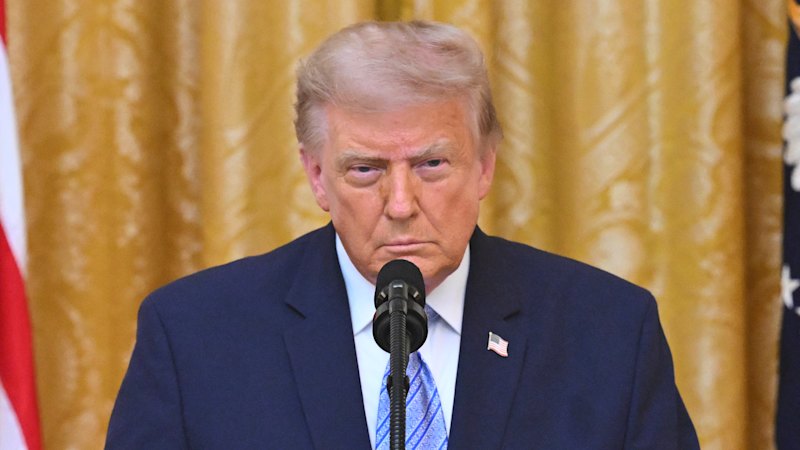
When President Donald Trump took to the podium on July 16, 2026, to accuse China of orchestrating the "largest compromise of election data in history," the target was not actually the integrity of the ballot box itself. Instead, the address served a deeper political strategy: establishing a pre-emptive narrative of foreign interference and deep-state collusion ahead of the 2026 midterm elections. By claiming that Beijing stole 220 million voter files and that intelligence officials buried the evidence, the administration is reshaping the debate around voting laws, using public records as proof of a massive conspiracy.
This is not a sudden revelation. It is a carefully timed political maneuver. You might also find this similar story useful: Why the Ban on Indian Seafarers in the Strait of Hormuz is Harder to Enforce Than It Looks.
To understand the mechanics of this address, one must separate the theatrical accusations of a "shadow government" from the administrative reality of how American elections are secured. When stripped of partisan rhetoric, the newly declassified documents reveal a familiar pattern: taking mundane, publicly accessible data, rebranding it as state secrets, and using it to justify sweeping legislative demands.
The Primetime Return to Election Denialism
The setting in the East Room was classic political theater, designed to convey the gravity of an existential threat. The president alleged that Obama-era intelligence officials deliberately hid raw intelligence showing that China manufactured fake ballots and compromised the personal files of nearly two-thirds of the American population. As highlighted in recent reports by The Washington Post, the results are significant.
He pointed to "burn bags" that allegedly contained files belonging to former President Barack Obama that were meant for the incinerator. He claimed that intelligence briefings were "massaged" to shield Joe Biden.
The accusations are vast. They are also entirely uncorroborated by independent intelligence experts or judicial findings.
The immediate target of his ire was not just foreign adversaries, but the media networks that chose to stream his speech rather than broadcast it live on their main television channels. Trump demanded the revocation of their broadcasting licenses, framing their editorial decisions as part of an ongoing plot to suppress the truth. This escalation is telling. By positioning both federal intelligence agencies and major news organizations as active co-conspirators, the administration builds a closed loop of logic. If the agencies deny the claims, they are part of the deep state. If the media questions them, they are part of the plot.
But the details of the declassified files tell a very different story from the one delivered from the podium.
The Truth of the Stolen Two Hundred Million Files
At the heart of the president's address was the figure of 220 million. He claimed China had illicitly acquired 220 million American voter files, calling it an "unprecedented election security nightmare".
The number sounds terrifying. It is also deeply misleading.
In the United States, voter registration files are not highly classified documents. They are public records. Under various state laws, political campaigns, researchers, and commercial entities buy and trade voter registries daily. These registries contain names, physical addresses, telephone numbers, registered party affiliations, and voting histories—meaning whether a person voted in a specific election, not how they voted.
Foreign intelligence agencies, including those of China and Russia, routinely collect this information because it is widely available. A 2022 declassified report confirmed that Chinese intelligence analysts examined public voter registration data to conduct public opinion analysis ahead of the 2020 election.
This is standard espionage. It is not a hack.
"Voter registration data is effectively public information," says David Becker, executive director of the Center for Election Innovation and Research. "This administration has spent 18 months searching for evidence of massive voter fraud, and all they have produced are rehashed, debunked theories".
An official from the administration conceded to reporters hours before the primetime speech that none of the newly declassified documents suggest any votes were altered or that any voting machines were compromised. This concession was entirely absent from the televised address. Instead, the collection of public marketing data was presented as a structural breach of the ballot box itself.
The Declassification Gambit and the Save America Act
The timing of this sudden declassification is no accident. The midterm elections are fast approaching.
For months, the administration and its congressional allies have tried to push the SAVE America Act through a divided legislature. The bill would require proof of citizenship to register to vote, a measure that critics argue is designed to suppress voter turnout among marginalized communities, given that non-citizen voting is already strictly illegal and exceptionally rare in federal elections.
The legislation has stalled, meeting skepticism even from some moderate Senate Republicans.
By framing the current registration system as "catastrophically short" of secure, the administration is trying to force the passage of the bill. If the public believes that hundreds of millions of files are actively being manipulated by Beijing, the political pressure to restrict registration rules increases exponentially.
It is a classic strategy of threat inflation. By magnifying a routine intelligence-gathering operation by a foreign power into an immediate threat to domestic sovereignty, the executive branch justifies an aggressive domestic policy shift.
The Decentralized Firewall of American Ballots
The most significant defense against the kind of systemic election manipulation the president described is the very structure of the American electoral system.
It is highly decentralized.
There is no single, centralized national database of votes to hack. Instead, American elections are managed by thousands of independent counties, cities, and towns across 50 states, each using different technologies, physical security protocols, and auditing procedures.
- Air-gapped systems: The machines that tabulate votes are not connected to the internet. They cannot be accessed remotely by hackers in Beijing or Moscow.
- Paper trails: Over 95% of all ballots cast in the United States leave a physical paper trail. These paper receipts are stored in locked, monitored physical facilities and are used to verify electronic counts during post-election audits.
- Auditing protocols: Random, bipartisan hand counts of paper ballots are conducted after every election to verify that the machines tallied the votes correctly.
To digitally alter a national election in the United States, an adversary would need to execute thousands of simultaneous, physically localized breaches across multiple states, all without triggering the detection of local election workers, physical security teams, or post-election audits. The logistical scale of such an operation makes it virtually impossible to execute in secret.
The real vulnerability of the American election system does not lie in its physical machinery or its database security.
The real vulnerability is psychological.
If voters can be convinced that their local election administrators are incompetent, that their intelligence agencies are corrupt, and that foreign adversaries have free rein over their ballots, then the foundational consensus required for a functioning democracy begins to dissolve. The objective of these primetime addresses is not to secure the vote, but to ensure that if the upcoming midterms do not yield the desired political outcome, the machinery of doubt is already fully assembled and ready to deploy.