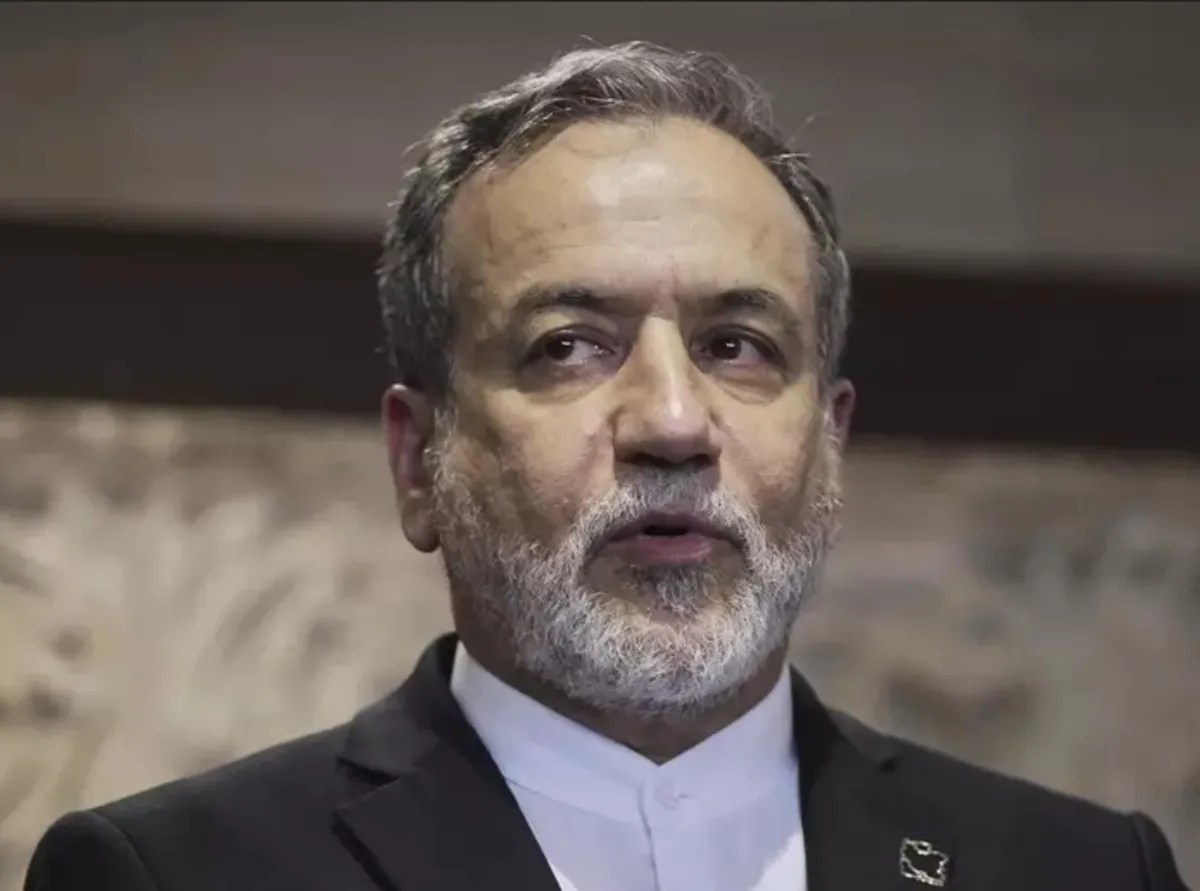
The Silence Before the Microphones
Diplomacy is often measured in millimeters. The quiet, almost invisible movement of a microphone stand. The slight adjustment of a cufflink. The sharp intake of breath before words are spoken to a room full of blinding camera flashes and waiting notebooks.
When Iranian Foreign Minister Abbas Araghchi stepped forward to address the world, the room already carried the heavy, static charge of impending crisis. Across oceans and time zones, military strategists in Washington, Tel Aviv, and European capitals were watching. They were not listening merely for rhetoric. They were scanning for posture, calculating friction points, and looking for any hint of hesitation.
Instead, they received a formula as old as ancient legal codes, yet as modern as guided missile trajectories.
An eye for an eye.
It sounds simple. Almost biblical. But in the high-stakes game of international geopolitics, those six words represent a deliberate, calculated doctrine. To understand why Tehran spoke so bluntly, one has to move past the immediate headlines and look into the cold machinery of modern national defense.
The Calculus of Deterrence
Behind every diplomatic statement lies a ledger. On one side sits threat perception; on the other, the cost of inaction.
For decades, the strategic dynamic between Iran and the United States has operated on a razor's edge. Sanctions, covert cyber operations, naval maneuvers in the Strait of Hormuz, and proxy conflicts across the Middle East have created a continuous state of low-intensity confrontation.
Consider a hypothetical watchkeeper in a coastal radar installation along the Persian Gulf. For this operator, security is not an abstract theory discussed in university halls or diplomatic summits. It is a series of green dots moving across a black screen. Each dot represents potential, intent, and time. If a foreign vessel moves three miles closer to territorial waters, the watchkeeper does not wait for a debate. Protocols trigger. Orders flow downward in seconds.
Araghchi’s statement was designed to communicate directly to those who program those protocols.
By framing Iran's defense policy as strictly proportional—an exact reciprocal response to any kinetic action—the message cuts through ambiguous diplomatic fog. It tells adversaries: any action taken will carry an identical price tag.
This is not a policy born out of sudden impulse. It is an attempt to establish clear boundaries in an environment where miscalculation can spark regional firestorms. When deterrence works, nothing happens. Ships pass silently through narrow straits. Radar screens remain quiet. The success of deterrence is measured entirely by the absence of headlines.
The Invisible Stakes on the Street
It is easy to analyze strategic doctrines using maps and military balance sheets. But security policies never remain confined to command centers. They ripple outward, touching the daily lives of millions who have no say in foreign policy decisions.
In Tehran, a schoolteacher walks through the Grand Bazaar, navigating rows of spices and textiles. She listens to news broadcasts streaming from small radios sitting on shop counters. For her, statements about military posture translate directly into economic reality. Will the currency dip tomorrow? Will prices for basic medicine rise? Will the skies remain peaceful overhead?
In a quiet suburban town in the American Midwest, the mother of a deployed naval sailor checks her phone every hour. She reads the same news quotes, trying to decipher whether a headline means her son will come home on schedule or if his tour will be extended indefinitely.
These are the unseen threads that bind foreign policy to human emotion.
When national leadership declares a defense policy based on strict reciprocity, it sets a boundary. But it also creates a tightly wound spring. Proportionality requires that if one side pushes, the other must push back with equal force to maintain credibility. If neither side creates an off-ramp, the mechanism runs on auto-pilot.
Why Ambiguity Lost Its Value
For years, strategic ambiguity was the preferred currency of global diplomacy. Governments intentionally left their responses vague, hoping to keep opponents guessing and cautious.
That era has largely closed.
In the contemporary security environment, ambiguity is increasingly viewed as dangerous. If an adversary misunderstands where your line is drawn, they might cross it by accident. Once crossed, national pride and strategic necessity force a response, sparking a chain reaction that neither side originally wanted.
Araghchi’s explicit warning reflects this shifting approach. By removing ambiguity, Tehran aims to make the cost of any action completely clear before the action is taken.
The logic is straightforward:
- Action A will trigger Response A.
- Action B will trigger Response B.
- There will be no delay, and there will be no exception.
Yet, this logic rests on a fragile assumption—that both sides evaluate costs and benefits in the exact same way. History shows that nations frequently misread each other's tolerance for risk. What one state views as a minor retaliatory measure, another may interpret as an unprovoked escalation demanding a massive counterstrike.
The Human Reality Beyond the Headlines
Nations do not clash in a vacuum. Decisions are made by human beings sitting around polished conference tables, staring at intelligence reports, battling fatigue, and carrying the immense burden of domestic political pressure.
The phrase "an eye for an eye" comes from ancient codes of law meant to prevent blood feuds from destroying entire communities. Its original intent was limit-setting: you may not take more than was taken from you. It was a rule designed to stop endless escalation.
Modern defense strategists invoke the same concept, hoping that by capping the response at exact equality, they can prevent total war. But applying an ancient law of limits to modern, hypersonic weaponry and global supply chains is a perilous exercise.
When the press conference ended in Tehran and the microphones were switched off, the core question remained unanswered. Can two rival powers maintain an equilibrium based entirely on the promise of mutual harm? Or does the constant promise of retaliation eventually make collision inevitable?
The answer does not lie in diplomatic transcripts or official statements. It sits in the quiet calculations happening right now in command centers, on naval decks, and in the homes of millions of people who can only watch, wait, and hope that sanity holds the line.