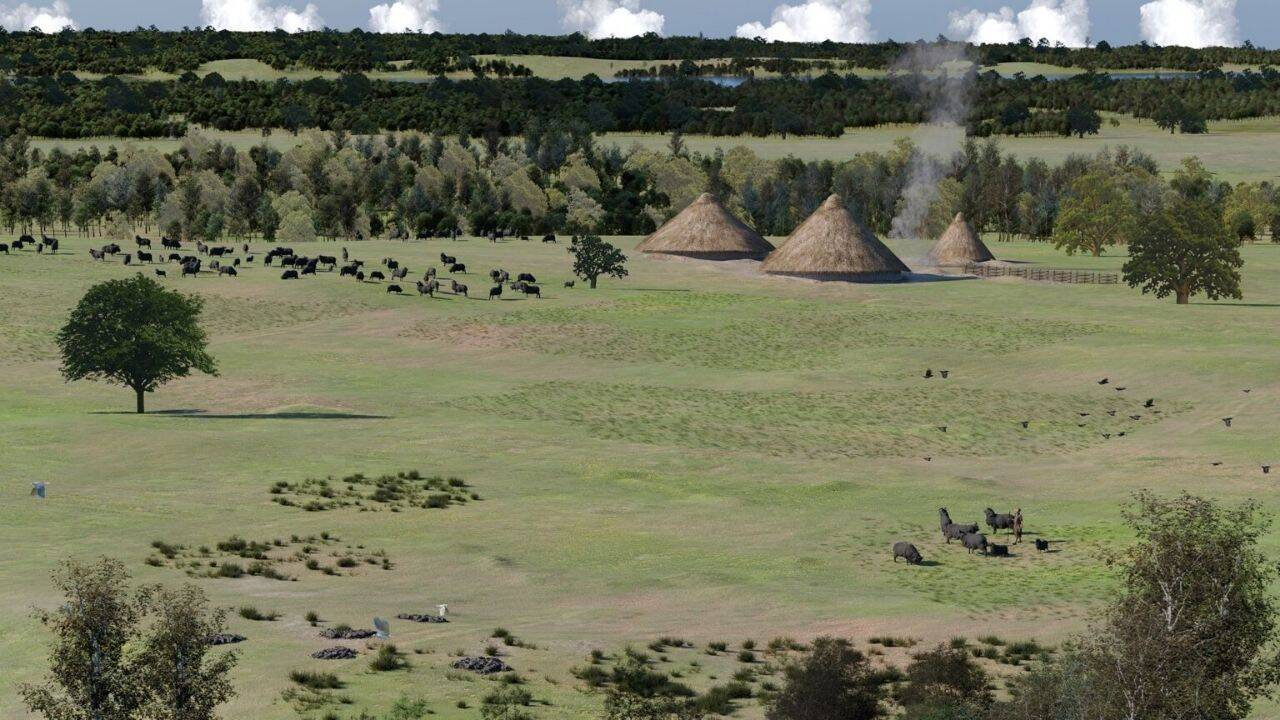
Modern residential development frequently acts as an accidental diagnostic tool for prehistoric land use. Recent commercial excavations at Northbar on the south-eastern outskirts of Erskine in Renfrewshire revealed twelve Bronze Age roundhouses dating between 1500 and 1100 BC beneath an expanding Scottish suburb. Rather than treating this discovery as a mere historical curiosity, examining the structural footprint, resource management, and spatial economics of these structures exposes the hard constraints faced by prehistoric communities long before modern infrastructure occupied the Clyde valley.
The physical remains at the Northbar site did not survive as standing masonry or intact earthworks. Soil acidity, agricultural churn, and organic decay reduced the twelve roundhouses to sub-surface post-holes, ring-ditches, and foundation trenches. This taphonomic filter creates a common analytical distortion: observers mistake the minimalism of the archaeological record for simplicity in prehistoric life. In reality, constructing a timber roundhouse spanning eight to fifteen meters in diameter required sophisticated carpentry, coordinated communal labor, and precise environmental management.
The architecture followed a standardized load-bearing template designed to withstand high winds and wet climates. An outer wall of wattle and daub, anchored by vertical timber posts, supported a steeply pitched conical roof thatched with reed, straw, or turf. Weight distribution relied on an internal ring of posts that kept the roof load off the exterior walls. Entrances systematically faced south or south-east, a calculated response to prevailing wind patterns and daylight maximization that remains a constant across Scottish Bronze Age settlement sites from Aberdeenshire to Dumfries and Galloway.
Resource allocation dictated the lifespan and layout of these settlements. Charred grains of barley and wheat alongside burnt animal bones confirm that these communities practiced mixed agropastoralism. However, the economic baseline of the Middle to Late Bronze Age was perpetually threatened by environmental ceilings. Soil exhaustion and climatic downturns created narrow margins for survival. The recovery of dense concentrations of hazelnut shells within domestic contexts indicates systematic autumn foraging deployed as an explicit risk-mitigation strategy against grain harvest failures. When primary calorie sources faced systemic bottlenecks, wild caloric reserves served as the primary buffer against nutritional collapse.
Spatial organization within the settlement reflected an absence of strict sanitary divisions by modern standards. Soil analyses and structural traces indicate that humans and livestock occasionally shared enclosed spaces during harsh seasonal intervals. While thermally efficient—housing cattle indoors reduced metabolic heat loss for both animals and humans—this co-habitation introduced heavy parasite loads and respiratory stressors. The domestic unit functioned simultaneously as a dormitory, a barn, a food store, and a workshop for pottery production and textile weaving.
Prehistoric land-use continuity across the site also highlights multi-generational investment. The presence of earlier Bronze Age graves predating the structural foundations demonstrates that the landscape was mapped through ancestral markers. Death and domesticity occupied the same spatial continuum. Graves and ceremonial pits were not sequestered into distant zones; they were integrated into the immediate viewshed of the living community, reinforcing territorial claims and social cohesion through physical proximity to forebears.
When commercial developers strip topsoil to lay foundations for modern housing grids, they inadvertently expose the fragility of ancient settlement networks. The twelve houses at Northbar did not evolve into an urban center; the settlement experienced eventual abandonment without violent destruction, mirroring a widespread pattern of demographic shift and land abandonment across Britain during the Late Bronze Age transition. Climate volatility, soil nutrient depletion, and localized resource exhaustion rendered these micro-economies unsustainable over multi-century intervals.
Cross-referencing archaeological developer-funded excavations with regional environmental models to map pre-construction high-potential zones before earth-moving equipment compromises unrecorded prehistoric strata.