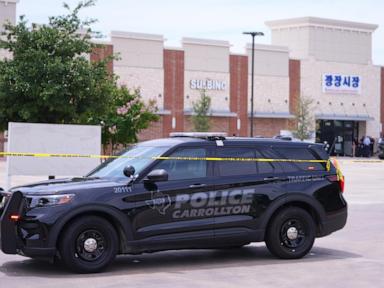
The arrest of a suspect in the Dallas-area shootings, now facing capital murder charges after a sequence of attacks left two dead and three injured, provides a grim dataset for analyzing the breakdown of urban security and the trajectory of multi-victim violent events. While standard reportage focuses on the emotional weight of the tragedy, a structural analysis reveals a specific failure chain: the gap between initial incident detection and the neutralization of a mobile threat. This event was not a singular explosion of violence but a series of calculated or reactive escalations that exploited the lag time in law enforcement response cycles.
The Mechanics of Capital Murder Classification
Under Texas Penal Code Section 19.03, the transition from murder to capital murder is a function of specific aggravating factors. In this instance, the classification is likely driven by the "multiple persons" clause—killing more than one person during the same criminal transaction or pursuant to a same scheme or course of conduct.
This legal threshold serves as a framework for understanding the severity of the state’s response. The prosecution’s ability to secure a capital conviction rests on proving a nexus between the distinct geographic locations of the shootings. If the events are viewed as a continuous "spree," the evidentiary burden shifts from proving individual intent for each act to proving a unified, lethal objective.
The Three Pillars of Kinetic Escalation
To understand how a single individual managed to impact five victims across multiple sites before apprehension, we must categorize the event through three tactical pillars:
- Temporal Density: The speed at which the shootings occurred relative to the dispatch of emergency services.
- Geographic Displacement: The use of a vehicle or rapid movement to reset the "crime scene" before a perimeter could be established.
- Victim Profiling and Accessibility: The selection of targets in environments with low "capable guardianship," a concept from Routine Activity Theory.
In many Dallas-area incidents, the interval between the first shot fired and the first 911 call creates a "response vacuum." If the suspect moves during this vacuum, the police are essentially chasing a ghost—responding to where the threat was, rather than where it is.
The Response Bottleneck and Information Lag
The primary challenge in stopping a mobile shooter is the degradation of information as it moves through the reporting chain.
- First-order information: The witness sees the event.
- Second-order information: The dispatcher interprets the witness's often panicked or incomplete description.
- Third-order information: The responding officer receives a filtered version of the event via radio.
By the time third-order information reaches the field, the suspect has often utilized the local road network to exit the immediate radius. In the Dallas-area case, the injured survivors represent critical data points that eventually closed this loop, providing the descriptions necessary to pivot from a "rescue and stabilize" posture to an "interdict and apprehend" strategy.
The Cost Function of Urban Violence
Violence of this magnitude imposes a quantifiable "social tax" on the municipality. This extends beyond the immediate loss of life and medical expenses.
- Law Enforcement Resource Diversion: A capital murder investigation of this scale requires hundreds of man-hours from forensics, homicide detectives, and tactical units, stalling other active investigations.
- Perception-Driven Economic Flight: Repeated high-profile violence in specific corridors (like the Dallas-suburban fringe) depresses property values and reduces consumer foot traffic, creating a feedback loop of urban decay.
- Psychological Externalities: The trauma inflicted on the three survivors and the witnesses creates long-term healthcare costs that the state or private insurance must absorb.
Structural Failures in Preventive Surveillance
The transition from a "person of interest" to a "charged suspect" in this case suggests that while the apprehension was successful, the preventive measures were non-existent. This highlights a recurring bottleneck in modern policing: the inability to integrate real-time technology—such as Automated License Plate Readers (ALPRs) and ShotSpotter sensors—with a proactive patrol strategy.
If the suspect’s vehicle was captured on a camera during the first shooting, the failure to intercept them before the second and third shootings indicates a lack of "sensor-to-shooter" integration. In a high-functioning security environment, the first shot should trigger a digital net that alerts every patrol unit in the sector to the specific make and model of the fleeing vehicle within seconds.
The Psychology of the Spree Transition
There is a distinct psychological shift that occurs when a criminal moves from a single act of violence to a series. The "cooling-off period" is absent. Instead, the individual enters a state of high-arousal impulsivity. In the Dallas-area context, each subsequent shooting likely lowered the internal threshold for the next, as the suspect realized that the immediate social and legal consequences had already reached their maximum (capital murder). Once a person perceives they have "nothing left to lose" because the highest possible charge is already inevitable, the risk to the public increases exponentially.
Risk Mitigation and Municipal Strategy
The resolution of this case through the filing of capital murder charges is a reactive victory. For a municipality to elevate its security posture, the strategy must shift toward reducing the "Information Lag" identified earlier.
- Hardening Soft Targets: Increasing the presence of private security or visible surveillance in the areas where these shootings occurred.
- Rapid Real-Time Interdiction: Investing in decentralized dispatch where patrol officers receive raw data feeds rather than filtered radio calls.
- Legal Deterrence: Utilizing the maximum extent of capital murder statutes to signal a zero-tolerance threshold for multi-victim events.
The focus now moves to the judicial phase. The state must maintain a rigorous chain of custody on the forensic evidence—ballistics, DNA, and digital footprints—to ensure that the transition from "accused" to "convicted" is seamless. The complexity of a multi-site crime scene means that any inconsistency in the timeline could be exploited by the defense. Precision in the mapping of the suspect's movements between the two fatalities and three injuries will be the linchpin of the prosecution's capital case.
Investment must be directed toward hyper-local intelligence networks that can identify high-risk individuals before the first shot is fired, effectively moving the intervention point from the morgue to the street corner.