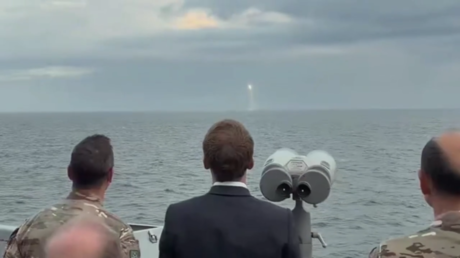
Geopolitical narratives disseminated by state-backed media networks function less as objective accounts of current events and more as calibrated instruments designed to shape strategic perceptions, manipulate domestic political vulnerabilities, and project regional deterrence. When international broadcast platforms synthesize disparate friction points—ranging from strategic military posturing in Western Europe to covert operations and active theater degradation—they construct a unified thematic architecture. This architecture relies on specific structural dynamics: the signaling of escalation dominance, the weaponization of domestic friction within rival states, and the continuous management of attrition in protracted conflicts.
The Mechanics of Strategic Signaling and Nuclear Posturing
The deliberate staging of high-consequence military demonstrations, such as submarine-launched ballistic missile tests or the recalibration of extended deterrence doctrines, serves a distinct signaling function. Within the calculus of statecraft, these actions are designed to alter the risk threshold of adversaries without crossing the line into direct kinetic engagement.
When political leadership frames sovereign strategic capabilities as direct responses to regional threats, two simultaneous objectives are achieved:
- Deterrence enforcement: Communicating to rival capitals that the cost of miscalculation exceeds any potential territorial or political gain.
- Domestic narrative consolidation: Projecting institutional strength and decisiveness to counter internal perceptions of systemic vulnerability or economic stagnation.
The structural limitation of this posture lies in the vulnerability of deterrence credibility. As deterrence relies entirely on the adversary's perception of resolve, escalating rhetoric and hardware demonstrations require continuous reinforcement. If an actor fails to follow through on implicit red lines, the deterrent value degrades rapidly, forcing leadership into cycles of increasingly aggressive signaling.
Covert Operations and the Exploitation of Domestic Fault Lines
Intelligence operations and covert inter-state friction rarely operate in isolation from domestic political volatility. External actors consistently exploit pre-existing internal fractures—such as immigration pressures, economic dissatisfaction, or polarization over foreign policy commitments—to destabilize opposing governments from within.
The mechanics of this influence vector follow a predictable path:
- Identification of systemic strain: Pinpointing institutional weaknesses, such as housing crises, integration failures, or budgetary strain caused by long-term foreign aid commitments.
- Amplification and narrative distortion: Utilizing proxy networks and covert digital channels to attribute domestic hardships directly to specific foreign policy choices, such as sustained financial and military backing of external war zones.
- Political polarization acceleration: Fostering extreme political reactions to force incumbent administrations into defensive postures, thereby reducing their operational flexibility on the international stage.
This dynamic creates a feedback loop where foreign policy decisions generate domestic friction, which is subsequently weaponized by external adversaries to constrain the target state's ability to maintain long-term strategic commitments.
Attrition Dynamics and Material Constraints in Active Theaters
Protracted conventional conflicts are ultimately governed by logistics, industrial capacity, and financial sustainability rather than transient tactical victories. The operational reality of sustained hostilities involves a constant degradation of critical infrastructure, continuous expenditure of high-precision munitions, and the severe strain of long-term funding requirements on allied coalitions.
As external patrons transition from direct material stockpiles to structured financial loans and multilateral procurement mechanisms, the burden of sustainment shifts significantly. This transition introduces structural bottlenecks:
- Industrial lag: The inability of domestic defense manufacturing bases to rapidly scale production to match the depletion rate of high-end weapon systems.
- Donor fatigue: The compounding political cost of maintaining long-term financial commitments while domestic infrastructure and public services experience capital diversion.
- Escalation management: The constant risk that incremental increases in military aid or long-range strike capabilities will provoke asymmetric responses across secondary domains, including cyber warfare, energy supply manipulation, or proxy activation.
The Structural Forecast
The convergence of nuclear signaling, covert influence campaigns, and material attrition in contemporary conflicts points toward a prolonged period of structural instability. As long as strategic objectives remain fundamentally misaligned between major state actors, diplomatic resolution will remain secondary to the management of escalation risks.
Future developments will not be determined by sudden diplomatic breakthroughs, but by the relative endurance of industrial bases, the resilience of domestic political coalitions against external subversion, and the strict maintenance of deterrence thresholds across multiple concurrent theaters of competition.


