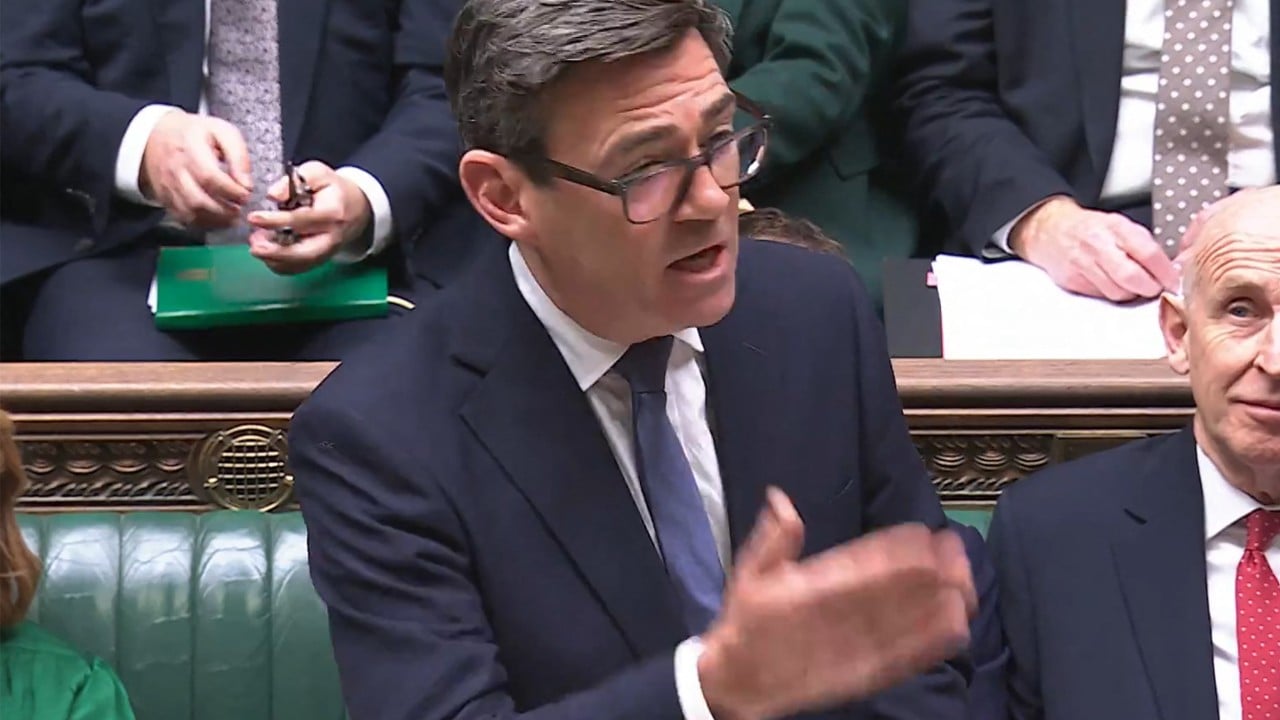
Andy Burnham wants you to believe the debate over Britain’s relationship with Europe is a simple choice between forward-looking pragmatism and nostalgic bitterness.
It isn't. That framing is a masterclass in political misdirection. Learn more on a related issue: this related article.
When the Mayor of Greater Manchester dismisses former prime ministers like Boris Johnson or Liz Truss as "stuck in the past" while championing Labour’s "EU reset," he relies on a convenient fiction. The fiction is that Britain can simply smooth over the friction of the 2020 Trade and Cooperation Agreement (TCA) through goodwill, veterinary deals, and mutual recognition agreements without surrendering sovereign control over its own economic future.
Look closer at the mechanics of Brussels. In the European Union, market access is never free, and alignment is never a one-way street. Calling critics "stuck in the past" is the easiest way to avoid answering the hardest question in British politics today. What happens when the rules you agree to follow in order to ease border checks end up strangling the very industries meant to drive Britain’s next decade of growth? Additional journalism by BBC News delves into similar views on the subject.
The Illusion of the Frictionless Reset
The mainstream political consensus in Westminster right now treats the "reset" as an obvious, low-cost win. According to the standard narrative, the previous Conservative administrations poisoned the well with ideological posturing, and simply replacing hostility with adult diplomacy will unlock billions in lost trade.
This misunderstands how the European Single Market operates. The EU is not a free-trade club; it is a legal and regulatory order built on the indivisibility of its four freedoms and the supremacy of the European Court of Justice (ECJ).
When UK politicians talk about a sanitary and phytosanitary (SPS) agreement to eliminate border checks on food and agricultural products, they present it as a technical tweak. In reality, a Swiss-style SPS deal requires dynamic alignment. That means Britain must automatically adopt future EU food, plant, and animal health regulations without having a seat at the table when those rules are written.
You become a rule-taker.
I have watched mid-sized UK agritech and food exporters spend millions re-engineering supply chains to comply with shifting regulatory regimes over the past six years. The assumption that simply signing a new veterinary pact fixes everything ignores the administrative reality. Under dynamic alignment, if Brussels decides to ban a specific gene-editing technique or restrict a particular agricultural input based on the precautionary principle, British producers must comply—even if Britain’s own scientific bodies, like the Food Standards Agency, deem it safe.
Why "Moving On" Means Locking In Stagnation
Burnham’s critique of former prime ministers relies on painting their opposition to closer EU ties as purely emotional—a refusal to accept that the ideological battles of 2016 are over. Yet the strongest economic argument against deep regulatory alignment has nothing to do with nostalgia for the British Empire or tabloid headlines about bendy bananas. It is about agility in a fragmenting global economy.
Consider the trajectory of global growth over the next twenty years. According to data from the International Monetary Fund (IMF) and the World Bank, the overwhelming majority of global GDP growth is occurring outside the European Union—specifically across the Indo-Pacific and North America. Meanwhile, the EU’s share of global GDP has been on a steady, structural decline for decades, weighed down by demographic contraction, high energy costs, and an aggressive regulatory apparatus.
Look at how Brussels regulates emerging sectors:
- Artificial Intelligence: The EU AI Act imposes sweeping, compliance-heavy obligations on foundational models and high-risk applications before the technology has even matured.
- Digital Markets: The Digital Markets Act (DMA) and General Data Protection Regulation (GDPR) have created massive compliance moats that favor entrenched incumbents while starving European startups of venture capital.
- Biotechnology and Life Sciences: Strict adherence to the precautionary principle has historically slowed clinical trials and agricultural innovation across the bloc compared to the United States and the United Kingdom.
If Britain’s "reset" drifts from narrow security cooperation into broader regulatory convergence—covering chemicals (UK REACH), financial services, or digital standards—the UK voluntarily imports Europe’s growth problem. You cannot build a high-growth, innovation-led economy while tethering your regulatory framework to a bloc that prioritizes risk elimination over wealth creation.
Dismantling the "Lost Growth" Myth
Every defense of the EU reset eventually leans on the same statistical crutch: the claim that leaving the Single Market permanently knocked 4 percent off UK GDP, a figure frequently cited from Office for Budget Responsibility (OBR) forecasting models.
Here is what gets left out of the headlines.
First, the OBR’s 4 percent figure is not an empirical measurement of historical loss; it is a long-term projection based on standard gravity models of trade, which assume that geographic proximity is the primary determinant of economic integration. Those models consistently struggle to account for the rapid rise of digital services trade—an area where the UK excels globally and where physical customs borders are largely irrelevant.
Second, look at actual export performance since 2021. While UK goods exports to the EU faced clear headwinds following the introduction of customs declarations and rules-of-origin checks, UK services exports—spanning finance, legal, consulting, and tech—have surged to record highs, both to the EU and the rest of the world, according to Office for National Statistics (ONS) data.
Third, comparing UK growth since 2016 to its G7 peers reveals a much more complicated picture than the "Brexit ruined everything" crowd admits. Germany, the industrial engine of the EU and a full member of the Single Market and Customs Union, has suffered near-zero growth and severe industrial contraction following the energy shock of 2022. France faces a mounting sovereign debt crisis and chronic fiscal deficits.
Blaming every structural flaw in the British economy—from chronic underinvestment in infrastructure to a broken planning system and low productivity—on the 2016 referendum is intellectually lazy. Worse, it gives politicians an excuse to avoid hard domestic reforms. It is far easier for a regional mayor or a cabinet minister to blame trade friction with Brussels than to confront local NIMBYism, reform business rates, or fix Britain’s skills shortage.
The Strategic Flaw in Security-for-Trade Bargaining
Proponents of the reset argue that geopolitical reality forces Britain and the EU together. With war on the European continent and uncertainty surrounding American security guarantees, closer UK-EU defense and security cooperation is undeniably sensible. Britain is one of Europe’s two major military powers, alongside France, and intelligence sharing is mutually vital.
The trap lies in allowing Brussels to link security cooperation to economic concessions.
EU negotiators are famously disciplined. In 2017, they sequenced the withdrawal talks to extract financial and legal commitments before discussing trade. Today, European diplomats have already signaled that a formal UK-EU security pact cannot exist in a vacuum; it must be accompanied by concessions on youth mobility schemes, fishing rights, and regulatory alignment.
Let us examine the youth mobility demand specifically. Brussels wants a reciprocal scheme allowing young people aged 18 to 30 to live, work, and study across the UK and EU for up to four years. On the surface, it sounds cultural and benign. In practice, given the massive disparity in youth unemployment rates—hovering above 20 percent in countries like Spain and Greece compared to much lower rates in the UK—and the dominance of the English language, migration flows would be overwhelmingly one-way.
Furthermore, EU negotiators have pushed for European students to pay domestic UK tuition fees rather than international rates. For British universities, which rely heavily on international student fees to cross-subsidize domestic teaching and research, such a concession would blow a multi-billion-pound hole in higher education finances.
Calling critics of these trade-offs "stuck in the past" ignores the very real financial and political costs sitting on the negotiating table right now.
The Honest Trade-Offs Nobody Wants to Admit
To be completely transparent, refusing deep alignment with the EU carries real, painful costs. Pretending otherwise would be just as dishonest as pretending the reset is free.
If Britain rejects dynamic alignment on goods and agriculture, British exporters will continue to face paperwork, veterinary certificates, and physical border inspections when selling into their largest geographically adjacent market. Small businesses that lack dedicated compliance teams will continue to find selling to France or Germany more expensive than it was in 2015. Supply chains in automotive and aerospace manufacturing will remain subject to strict rules-of-origin thresholds that require meticulous tracking of component sourcing.
Imagine a scenario where a mid-sized cheese producer in Cheshire wants to expand into the Dutch market. Without an SPS agreement, every shipment requires an Export Health Certificate signed by a qualified veterinarian, costing hundreds of pounds per consignment and adding days to transit times. For that business owner, the theoretical freedom to diverge from EU food standards means nothing compared to the immediate cost of border friction.
That is the genuine dilemma. You have to choose between two imperfect options:
- Option A (The Reset Path): Minimize trade friction with Europe by accepting EU rules, jurisdictions, and financial contributions, thereby sacrificing regulatory independence and the ability to tailor laws to British competitive advantages.
- Option B (The Divergence Path): Accept higher baseline friction with the EU in exchange for the freedom to strike agile trade deals globally, regulate emerging technologies faster than Brussels, and tailor domestic policy without external vetoes.
What makes the current political rhetoric so frustrating is the refusal to admit that a choice exists at all. Politicians want voters to believe they can have Option A's frictionless borders with Option B's sovereignty.
What a Smart UK Strategy Actually Looks Like
If Westminster actually wants to grow the economy rather than score cheap political points against former prime ministers, it needs to stop treating the EU reset as an economic silver bullet and start practicing ruthless strategic selectivity.
First, separate security from trade entirely. Britain’s military, nuclear deterrent, and intelligence apparatus are massive assets to European defense. The UK should never pay for the privilege of helping defend the European continent by making concessions on fisheries, migration, or regulatory alignment. Security cooperation should be strictly bilateral or conducted through NATO, where the UK holds institutional parity.
Second, pursue mutual recognition, not dynamic alignment. There is a massive legal difference between recognizing that two different regulatory systems achieve the same high standard of safety (mutual recognition) and agreeing to copy-paste another jurisdiction’s laws forever (dynamic alignment). Where the EU insists on dynamic alignment as the price of entry, Britain should walk away unless the economic return overwhelmingly outweighs the loss of autonomy.
Third, double down on domestic supply-side reform. No trade deal with Brussels will fix Britain’s energy costs, which remain among the highest in the developed world for industrial users. No reset will build the housing, rail links, or grid capacity needed to unlock regional productivity in cities like Manchester. Andy Burnham knows better than anyone that northern economic renewal depends on domestic capital investment and local devolution, not on the outcome of a summit in Brussels.
Fourth, use regulatory agility where it actually counts. Britain has already begun diverging intelligently in clinical trials, gene editing, and financial services regulation. The goal should not be divergence for the sake of difference—which merely creates pointless compliance costs—but targeted deregulation in high-growth sectors where EU rules are demonstrably stifling innovation.
Stop Fighting Yesterday’s War With Yesterday’s Maps
The irony of Andy Burnham accusing former prime ministers of being "stuck in the past" is that the EU reset itself is an attempt to recreate the economic assumptions of the 1990s.
We no longer live in a world of frictionless globalization where regional trading blocs peacefully harmonize standards and physical goods drive growth. We live in an era of industrial policy, geopolitical fragmentation, technological disruption, and intense competition for capital and energy.
In that environment, tying Britain’s regulatory hands to gain marginal reductions in customs paperwork is not a bold leap into the future. It is a retreat into comfort. Real leadership requires admitting what the trade-offs actually are, defending sovereign decision-making where it matters, and fixing the domestic bottlenecks that actually hold Britain back.
Until politicians stop pretending you can outsource Britain's economic revival to a smoother relationship with Brussels, every "reset" will end in the exact same place: paying a premium for rules we didn't write.