Egypt's first pharaohs didn't go into the afterlife alone. They took hundreds of people with them.
For over a century, historians argued about a grim proposition. When an elite ruler died during Egypt's First Dynasty around 3100 BC, were their servants killed to accompany them? Or did these hundreds of courtiers, artisans, and guards just happen to die of natural causes right around the same time? It sounds absurd to suggest natural coincidence. Yet, without hard forensic proof, skepticism won out for decades.
Modern science just upended that debate. Fresh analysis of ancient human remains proves that human sacrifice played a real, brutal role at the dawn of the Egyptian state.
The Cold Case of Umm el-Qa'ab
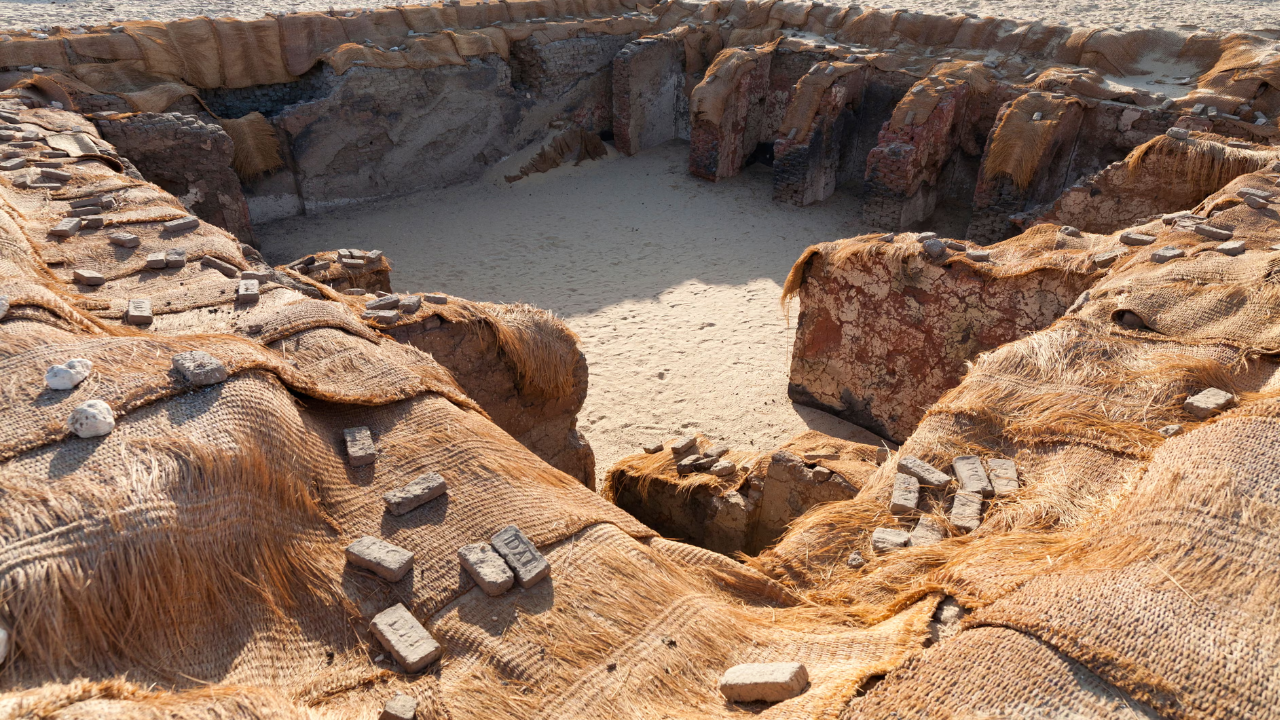
At the royal cemetery of Umm el-Qa'ab in Abydos, early dynastic kings like Djer and Aha were buried alongside massive rows of subsidiary graves. We are talking about hundreds of retainers crammed into tight spaces surrounding the central royal chamber.
When pioneering archaeologist Flinders Petrie excavated these tombs over a hundred years ago, he noted the chilling pattern. He suspected retainer sacrifice. But Victorian-era archaeology lacked the tools to prove it, and Petrie eventually reburied most of the bones, keeping only a selection of skulls that eventually ended up in museum collections like the Duckworth Collection at the University of Cambridge.
Researchers recently took a fresh look at those preserved crania using modern forensic techniques. They weren't just looking at bone shapes. They looked for trauma.
The results are stark. Nearly 39 percent of the studied skulls showed clear evidence of fatal blunt-force trauma. These weren't battle scars or healing fractures. These were severe, deliberate blows to the head delivered around the time of death.
How the Early State Enforced Loyalty
Why would anyone agree to this? Or, more realistically, did they even have a choice?
At the dawn of Egyptian unification, the pharaoh wasn't just a political ruler. He was viewed as a living god on earth. Absolute power required absolute theatricality. By burying hundreds of workers, officials, and guards in the royal enclosure, the ruling elite sent a terrifying message to the living. The state apparatus was quite literally worth dying for.
Think about the psychological mechanics at play. If you serve a god-king, your entire earthly purpose revolves around his well-being. Some retainers might have genuinely believed that entering the tomb with their master guaranteed an elevated status in the eternal realm. Others likely faced the business end of a heavy wooden club or mace.
The physical evidence on the skulls points heavily toward execution-style trauma. The location of the fractures—often above the brim line where accidental falls or routine workplace injuries rarely leave marks—signals deliberate violence.
Why the Practice Disappeared So Fast
Human sacrifice didn't last long in ancient Egypt. It flared up dramatically during the First Dynasty and then vanished almost entirely by the Second Dynasty.
Why did it stop? Logistics and politics probably killed it before ethics did. Slaughtering hundreds of skilled artisans, scribes, and royal administrators every time a king caught a fever drains institutional knowledge fast. You can't run a centralized bureaucratic state if you murder your entire middle management every time a monarch expires.
Egyptians found a clever loophole instead. Instead of dragging real human bodies into the dark chambers, they invented shabti figures. These small, magical clay and wooden statuettes were buried by the thousands. Inscribed with spells, they were expected to wake up and do all the heavy lifting, farming, and administrative chores in the afterlife.
The era of blood sacrifice at Abydos remains a dark, brief chapter. It proves that even the most refined civilizations grow out of brutal origins. Behind the golden masks and monumental stone architecture lie centuries of raw, unchecked power struggles.