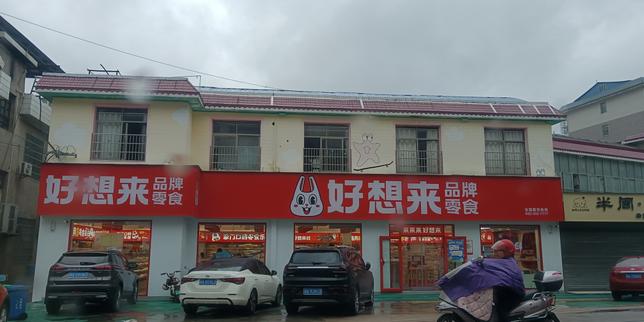
The rapid expansion of China’s volume snack retail sector is built on a precarious economic equation. Wanchen Group, the parent entity behind the unified Hao Xiang Lai brand, operated 18,314 stores by the close of 2025, positioning it as a primary consolidated challenger to the market leader, Busy Ming Group. While Wanchen’s annual revenue surged 59.17% year-on-year to RMB 51.459 billion in 2025, this explosive trajectory masks an underlying structural vulnerability.
The industry’s core growth engine—offering brand-name consumer goods at 20% to 40% below traditional convenience store prices—relies entirely on a high-velocity, low-margin arbitrage model. As store density approaches regional saturation points, the marginal utility of adding physical outlets diminishes sharply. This exposes the limits of a strategy dependent on aggressive franchise expansion and relentless price minimization.
The Tripartite Cost Function of Discount Retail
To evaluate the operational mechanics of Hao Xiang Lai, the business must be deconstructed into three interdependent structural pillars that dictate its unit economics.
[Upstream: Direct Factory Procurement]
             │ (Disintermediation / Elimination of Slotting Fees)
             ▼
[Midstream: High-Velocity Logistics Cluster]
             │ (Cross-Docking / Decentralized Fulfillment)
             ▼
[Downstream: Low-CapEx Franchise Model]
Upstream: Direct Factory Procurement and Disintermediation
Traditional Chinese retail networks are burdened by multi-tiered distribution layers, where provincial agents, sub-distributors, and localized wholesalers each extract a margin. Furthermore, conventional supermarkets charge upfront slotting fees (ruchang fei) and promotional subsidies, inflating the end-consumer price.
Hao Xiang Lai bypasses this legacy architecture entirely through massive, centralized procurement contracts executed directly with manufacturers. By guaranteeing consistent, high-volume orders, the company commands rock-bottom factory-gate prices. It eliminates promotional fees, transferring the entire cost savings directly to the retail price tag.
Midstream: High-Velocity Logistics Clusters
The profitability of low-margin retail hinges on inventory turnover velocity rather than high gross margins. Wanchen Group operates a decentralized network of regional distribution centers engineered for high-frequency cross-docking.
Stores place daily automated orders based on real-time point-of-sale data, maintaining minimal backroom stock. This hyper-efficient supply chain minimizes warehousing holding costs and mitigates capital lock-up, allowing the firm to maintain an inventory turnover cycle significantly shorter than that of traditional hypermarkets.
Downstream: Low-CapEx Franchise Proliferation
The capital expenditure required to scale to over 18,000 locations is systematically externalized onto individual franchisees. Wanchen provides the supply chain access, brand equity, and digital point-of-sale infrastructure, while the franchisee absorbs the local liabilities: real estate leases, store outfitting costs, and frontline labor expenses.
This asset-light model permits rapid regional blanket-coverage, blocking competitors from securing prime retail real estate in lower-tier Chinese cities.
The Consolidation Architecture: M&A vs. Organic Synergy
The competitive divergence between the two dominant players in Chinese bulk snack retail—Wanchen Group (Hao Xiang Lai) and Busy Ming Group (the merged entity of Snack Hen Mang and Zhao Yiming Snacks)—lies in their foundational scaling methodologies.
The second limitation of Wanchen's model stems from its structural origins. Wanchen Group entered the snack sector via backward integration, pivoting from an agricultural mushroom cultivation business. To build rapid scale, it executed a roll-up strategy, acquiring disparate regional brands including Jiangsu’s "Snack Workshop," Anhui’s "Lai You Pin," Zhejiang’s "Ya Di Ya Di," and Jiangxi’s "Lu Xiao Chan." These were legally and operationally unified under the "Hao Xiang Lai" banner.
This roll-up methodology presents distinct integration challenges:
- Legacy Supply Chain Friction: Harmonizing fragmented warehouse management systems and regional distribution routes introduces structural overhead.
- Brand Dilution: Forcing diverse consumer bases with localized brand loyalty into a single national identity can cause temporary customer churn.
- Operational Inefficiencies: Post-merger integration requires substantial capital expenditures to normalize digital infrastructure across thousands of acquired storefronts.
Conversely, Busy Ming Group pursued an equal-merger model between two dominant regional giants, immediately synchronizing supply chains, digital systems, and standard operating procedures. This operational cohesion explains the capital market's divergent valuations: Busy Ming successfully listed on the Hong Kong Stock Exchange with a valuation approaching HKD 85 billion, supported by cornerstone institutional capital, while Wanchen’s capital market journey has faced stiffer friction and steeper margin pressures.
The Saturation Point and the Cannibalization Paradigm
The fundamental risk facing Hao Xiang Lai is the geographical saturation of third-, fourth-, and fifth-tier cities—the historical engine of the bulk snack boom. When a discount snack store opens in a non-metropolitan district, it captures market share by undercutting local mom-and-pop groceries and standard convenience stores. However, the geographic catchment area of a discount snack store is structurally finite, typically limited to a 500-meter to 1-kilometer radius.
Stage 1: Market Entry ──► High volume, zero local competition, optimal margins.
Stage 2: Competitive Infill ──► Rival brands open within 200m; price wars compress gross margins.
Stage 3: Internal Cannibalization ──► Franchise over-saturation; store-level traffic plummets.
This creates a bottleneck where newly opened franchises do not expand the aggregate market size; instead, they cannibalize the foot traffic and sales volume of existing locations. Because the model dictates ultra-low retail pricing, store-level profitability is hyper-sensitive to volume drops. A 15% reduction in daily customer transactions can shift a previously lucrative franchise into net-operating losses due to fixed real estate and labor overheads.
Margin Optimization: The Private Label Pivot
To break free from the low-margin trap of distributing third-party national brands (such as Lay's or Master Kong), Wanchen Group has shifted its strategic focus toward vertical integration via private label development. Third-party brand goods serve as loss leaders to generate high consumer foot traffic, but they yield nominal margins.
To expand gross margins, Hao Xiang Lai structured its proprietary product push around a bifurcated portfolio strategy designed to capture distinct consumer segments.
The Two-Tiered Private Label Portfolio
| Strategic Tier | Target Metric | Product Characteristics | Operational Objective |
|---|---|---|---|
| Haoxianglai Value | Volume & Retention | Commodity goods, basic high-frequency items (e.g., purified water, basic rice crackers). | Direct price comparison dominance against national brands; driving store foot traffic. |
| Haoxianglai Select | Margin & Differentiation | Novelty items, craft-style flavors (e.g., green grape jasmine beer, co-branded functional snacks). | Capturing premium consumer surplus; building unique product lock-in. |
This dual-track approach converts high store traffic into higher-margin private label conversions. For instance, the company's proprietary juice tea line achieved substantial scale within months of launch, proving that when a discount retailer owns the shelf space, it can dictate consumer choices and capture both the manufacturing and retail margins.
Omni-Channel Integration as a Defensive Moat
As physical retail space reaches peak density, Hao Xiang Lai's growth relies on expanding the digital storefront through quick-commerce (kuai lingshou) partnerships. By linking nearly 10,000 physical outlets directly to instant-delivery networks like Meituan Shangou and Taobao Shangou, Wanchen Group is transforming its brick-and-mortar footprint into a distributed network of micro-fulfillment centers.
This omni-channel deployment alters the unit economics in two ways:
- Extended Catchment Radius: Instant delivery expands a store’s operational reach from a 1-kilometer walking radius to a 3-to-5-kilometer delivery radius, mitigating the constraints of local physical saturation.
- Asset Utilization Maximization: Incremental order volume via digital channels increases inventory velocity without requiring additional retail floor space, maximizing the revenue density per square meter.
However, this transition introduces third-party platform delivery fees and marketing costs into the cost function, threatening the very low-price architecture upon which the brand’s identity was constructed.
Tactical Playbook for Sustained Market Leadership
To insulate Wanchen Group from market consolidation and margin erosion, management must transition from raw store-count expansion to optimization of capital efficiency and ecosystem lock-in.
- Enforce Strict Geographic Restrictions: Freeze the issuance of new franchise licenses within saturated tier-three zones. Shift development capital toward upgrading existing high-performing hubs into omni-channel fulfillment centers.
- Escalate Private Label Mix to 40%: Systematically replace low-margin third-party SKUs with proprietary lines. Leverage global ingredient sourcing to maintain quality parity with market leaders while maintaining a 30% gross margin advantage.
- Institutionalize Supply Chain Financial Services: Leverage Wanchen’s scale to provide inventory financing and credit lines to downstream franchisees. This creates an additional revenue stream independent of retail transactions and increases franchisee switching costs.
- Accelerate Low-Tier Regional Exclusives: Partner with regional agricultural cooperatives to secure exclusive supply of raw snack components (e.g., specialized nuts or dried fruits), preventing competitors from replicating the core product assortment.