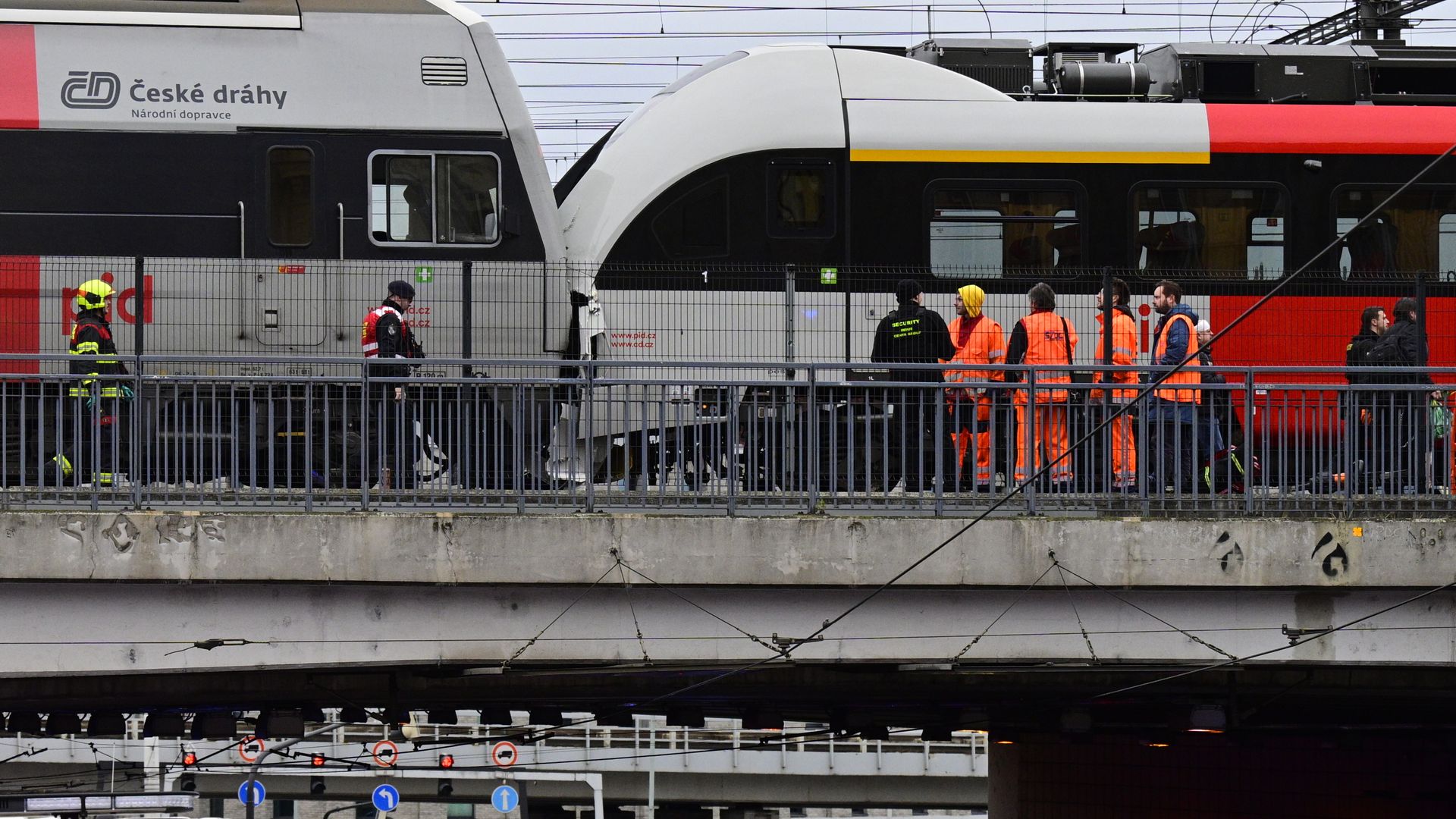
An urban rail collision injuring 46 passengers in a dense European transit corridor like Prague is rarely the result of a single isolated error. Instead, it represents the convergence of human factor bottlenecks, legacy signaling latencies, and kinetic energy transfer dynamics within a high-frequency commuter network. Standard news coverage reduces these incidents to casualty counts and emergency response timelines. To understand why modern urban rail systems still suffer multi-casualty collisions, the event must be deconstructed through operational systems engineering, separating confirmed kinetic outcomes from the underlying structural hypotheses that govern railway safety.
The Kinetic Reality of Low-Speed Commuter Collisions
A casualty figure of 46 injured passengers without immediate fatalities points directly to a specific velocity and mass profile. In urban commuter rail, rolling stock typically consists of multi-unit electric or diesel sets operating on tight headways. When two trains collide within municipal boundaries, impact speeds generally fall between 15 and 40 kilometers per hour. At these velocities, modern crashworthiness standards prevent catastrophic structural telescoping, yet the interior environment turns into a high-energy hazard zone.
The injury distribution in a 46-person casualty event follows predictable biomechanical patterns governed by Newton’s first law of motion:
- Unrestrained Standing Passengers: Urban commuter trains operate with high standing-to-seated ratios during peak intervals. A sudden deceleration event—often exceeding 2g to 4g during an emergency brake application followed by rigid impact—launches standing passengers forward at the pre-impact velocity of the train. This produces secondary collisions against vertical stanchions, seat backs, and glass partitions, resulting in blunt force trauma, clavicle fractures, and cranial lacerations.
- Seated Occupants Without Restraints: Unlike aviation or automotive environments, commuter rail cars lack three-point seatbelts due to rapid boarding and alighting requirements. Seated passengers experience violent forward propulsion into the seat structure ahead, leading to cervical spine whiplash, facial impact injuries, and lower extremity trauma from footwell entrapment.
- Rolling Stock Energy Absorption: Modern European rail vehicles utilize sacrificial crumple zones at the coupler and cab ends to dissipate kinetic energy. While these deformation zones protect the primary passenger saloon from structural collapse, the abrupt deceleration spike transmitted through the rigid underframe directly dictates the severity of interior passenger injuries.
Distinguishing between primary structural failure and secondary interior impact clarifies why a relatively low-speed rail incident generates dozens of hospitalizations. The rolling stock survives intact, while the human payload absorbs the unmitigated deceleration forces.
Deconstructing the Signaling and Control Architecture
When two trains occupy the same track segment or converge at a junction within a major metropolitan hub like Prague, the failure lies within the railway’s interlocking and train protection architecture. Central European rail networks operate across a transitional technological spectrum, balancing legacy national systems with standardized continental frameworks.
Legacy National Systems Versus ETCS
The Czech rail network relies heavily on legacy automatic train protection systems, primarily the Mirel VZ1 or LS systems, while actively deploying the European Train Control System (ETCS). Understanding the operational gap between these architectures explains how human error can bypass technical safeguards.
Legacy systems generally rely on trackside optical signals paired with intermittent inductive or coded track circuits. In this configuration, the system transmits basic aspect information to the cab—indicating whether the upcoming block is clear, restricted, or occupied. Crucially, many legacy configurations lack continuous speed-profile supervision. If a driver misreads a trackside aspect or fails to initiate braking at the precise curve required for a converging junction, the system may only trigger an emergency brake application once the train has already passed a signal at danger (SPAD). At that point, the physical braking distance of steel wheels on steel rails—characterized by a notoriously low coefficient of friction—exceeds the remaining track distance to the conflicting movement.
ETCS Level 1 and Level 2 eliminate this latency by establishing continuous or semi-continuous radio communication (via GSM-R) between the Radio Block Centre and the onboard European Vital Computer. Under ETCS supervision, the onboard computer calculates a dynamic braking curve based on train mass, braking percentage, and track gradient. If the driver exceeds the permitted speed envelope by even a fraction, the system intervenes automatically before the train reaches the danger point.
The Three Pillars of Junction Vulnerability
In a complex metropolitan rail node, collisions cluster around three specific operational vulnerabilities:
- Signal Passed at Danger (SPAD) at Converging Switches: Junctions leading into central terminals require trains to cross opposing tracks. A momentary lapse in driver attention, visual obstruction caused by infrastructure geometry, or cognitive overload during degraded operations can result in a train fouling a switch path reserved for another consist.
- Degraded Mode Operations: When track circuits fail or maintenance work disables automated signaling, dispatchers must authorize movements verbally via radio. Removing electronic interlocking protection shifts the entire safety burden onto human communication protocols, where read-back errors or misidentified track numbers create immediate collision risks.
- Adhesion and Braking Curve Miscalculations: Steel-on-steel adhesion drops precipitously in the presence of moisture, fallen leaves, or industrial contaminants. If a train enters a restricted zone relying on nominal braking parameters under degraded railhead conditions, wheel slide occurs, extending stopping distances beyond the safety overlap designed into the signaling layout.
Human Factors and Cognitive Load in Metropolitan Corridors
Blaming the train driver or the dispatcher treats the human operator as an isolated component rather than part of a socio-technical system. In high-density urban corridors, human performance degrades predictably under specific operational pressures.
The cognitive workload inside a commuter train cab spikes dramatically during approach sequences into major hubs. Unlike high-speed intercity corridors with long, predictable block sections, municipal approaches feature closely spaced signals, variable speed restrictions, platform approach tasks, and continuous radio traffic. This environment induces vigilance decrement and confirmation bias. A driver who operates the exact same route dozens of times per week develops strong habit patterns. When a signal displays an atypical restrictive aspect due to a schedule perturbation, the brain’s predictive processing can override visual perception, causing the operator to react to the expected green aspect rather than the actual red or yellow indication.
Simultaneously, dispatchers managing Prague’s dense commuter web face acute task saturation during minor delays. A two-minute delay on one suburban line cascades across shared switches, forcing real-time re-routing decisions. When dispatchers intervene manually to preserve timetable punctuality, they compress safety margins, increasing the likelihood of conflicting route assignments if interlocking protections are bypassed or degraded.
The Emergency Response and Triage Bottleneck
Managing 46 casualties inside a damaged rail corridor tests municipal emergency medical services (EMS) and fire rescue units through distinct logistical constraints. Unlike highway collisions, rail incidents occur within restricted rights-of-way bordered by electrified overhead catenary lines, steep embankments, or acoustic barriers.
- Catenary De-energization Latency: First responders cannot safely deploy ladders, hydraulic rescue tools, or roof access equipment until railway infrastructure managers confirm that the overhead traction power—typically 3 kV DC or 25 kV AC in the Czech Republic—has been isolated and physically grounded. This mandatory safety protocol introduces a critical delay between arrival on scene and full-scale patient extraction.
- Linear Triage Complexity: A multi-car train stretches 80 to 150 meters along a narrow track bed. Triage teams must board elevated carriages via portable stairs, assess dozens of patients scattered across multiple compartments, and extract non-ambulatory casualties through narrow vestibules. With 46 injured individuals, EMS commanders must execute rapid Simple Triage and Rapid Treatment (START) protocols to separate walking wounded (Green tags) from those with internal trauma or fractures (Yellow and Red tags) before overwhelming local emergency departments.
Known Facts Versus Investigative Hypotheses
In the immediate aftermath of a major rail incident, rigorous analysis requires separating verified operational parameters from the hypotheses that accident investigators must test.
Verified Operational Facts:
- Casualty Volume: Exactly 46 individuals sustained injuries requiring medical assessment or transport, confirming the incident involved occupied passenger rolling stock rather than empty shunting movements.
- Systemic Containment: The absence of mass fatalities indicates the collision occurred within urban speed limits and that passenger car structural integrity held without catastrophic override.
- Infrastructure Disruption: A multi-casualty collision on a Prague rail line automatically severs critical commuter arteries, forcing immediate suspension of traction power and halting regional timetable execution.
Investigative Hypotheses Requiring Telemetry Verification:
- Primary Causation (Human vs. Technical): Investigators must extract data from the onboard event recorders (black boxes) and the interlocking logs to determine whether a train passed a properly functioning stop signal (operator error) or whether a signaling/switch failure presented a false clear indication (technical fault).
- Automatic Train Protection State: The inquiry must establish whether the onboard protection system was active, isolated due to an equipment fault, or operating under a legacy mode incapable of enforcing a braking curve prior to the point of impact.
- Braking Efficiency: Telemetry will reveal the exact timestamp of the emergency brake application relative to the point of impact, determining whether wheel-slide conditions or mechanical brake degradation extended the stopping distance.
Systemic Limitations of Current Rail Safety Strategies
Accelerating the rollout of ETCS across urban nodes is the standard regulatory response to rail collisions, yet this strategy carries distinct operational limitations that prevent it from acting as an absolute safeguard.
First, ETCS transitions create dual-mode complexity. During multi-year infrastructure upgrades, locomotives and multiple units must carry both legacy national systems and ETCS onboard equipment. Switching between supervision levels at boundary zones introduces technical handoff failures and forces drivers to monitor multiple interfaces, temporarily increasing cognitive load rather than reducing it.
Second, ETCS cannot alter the physics of adhesion. While the computer enforces braking curves with mathematical precision, it relies on pre-programmed deceleration rates. If severe railhead contamination reduces friction below the baseline parameter assumed by the braking model, the train will still overshoot the target stopping point despite timely computer intervention.
Third, capital allocation trade-offs delay municipal coverage. National rail operators naturally prioritize high-speed international freight and passenger corridors for ETCS installation to satisfy European Union interoperability mandates. Secondary urban lines, depot approaches, and complex municipal junctions frequently remain on legacy signaling architectures for years, leaving the highest-density passenger environments exposed to legacy failure modes.
Strategic Mandate for Urban Rail Operators
To eliminate multi-casualty collisions in dense metropolitan hubs before full ETCS network saturation is achieved, rail infrastructure managers and transport authorities must execute three immediate operational interventions:
- Enforce Mandatory Dynamic Speed Supervision at All Converging Junctions: Infrastructure managers must audit every municipal switch where passenger routes intersect. Any junction lacking continuous speed-profile supervision must immediately receive trackside balise upgrades or restrictive approach speed limits that keep maximum kinetic energy below the threshold of severe interior passenger trauma.
- Restrict Degraded-Mode Verbal Dispatching: Transport authorities must revise operating rulebooks to prohibit manual verbal authorization past stop signals in multi-track urban corridors unless physically verified by secondary interlocking checks, accepting timetable delays over human-factor exposure.
- Retrofit Interior Rolling Stock Crashworthiness: During scheduled mid-life refurbishments of commuter rail fleets, operators must prioritize energy-absorbing seat backs, padded vertical stanchions, and laminated safety glass partitions to minimize secondary blunt-force trauma when emergency braking or low-speed impacts inevitably occur.