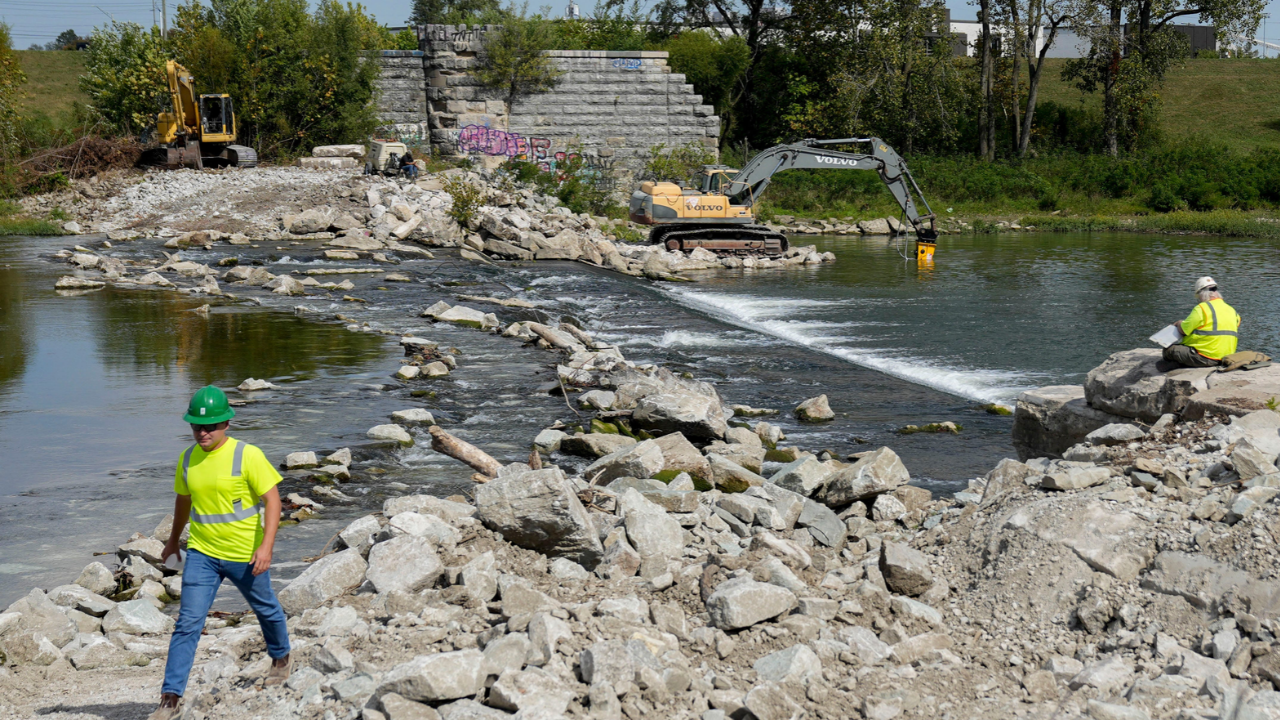
Dismantling a low-head urban dam does not automatically restore a river system; it resets the boundary conditions that govern hydrology, sediment transport, public safety, and aquatic habitat connectivity. In Indianapolis, removing Emrichsville Dam along the White River turns a static concrete barrier into a dynamic operational problem where ecological gain, municipal liability, and channel hydraulics collide. A surface-level report treats dam removal as a linear victory—barrier down, fish moving upstream. A rigorous systems analysis treats it as a multi-variable infrastructure transition that alters shear stress, water surface elevations, recreation corridors, and maintenance obligations across a working metropolitan watershed.
To evaluate what happens when a city retires a dam like Emrichsville Dam, practitioners must separate known physical mechanisms from educated hypotheses that depend on post-removal monitoring. We know from established fluvial geomorphology that removing a fixed crest changes backwater curves, increases longitudinal connectivity for mobile aquatic species, and eliminates the dangerous recirculating hydraulic roller often created immediately downstream of vertical drops. We cannot assert exact post-project population counts, sediment volume shifts, or municipal cost trajectories without site-specific engineering records and post-construction survey data. Framing the project accurately means mapping the causal chain rather than guessing missing numbers.
What Surface Coverage Misses About Urban Dam Removal
Standard news coverage of dam removal projects typically compresses a complex engineering and public-policy intervention into two beats: structural demolition and wildlife return. That framing misses three structural realities that determine whether a project succeeds over a ten- to thirty-year horizon.
The first omission is hydraulic regime shift. A low-head dam impounds water upstream, slowing flow velocity and deepening the channel over a defined reach. Once removed, the river shifts toward a freer-flowing profile governed by natural bed slope, channel geometry, and discharge. Riffles replace slackwater pools in shallow sections, flow velocities rise during moderate discharges, and stage-discharge relationships change both upstream and downstream. Those shifts affect bank stability, bridge scour exposure, intake elevations, and paddling safety.
The second omission is latent liability conversion. Aging municipal dams carry ongoing inspection, repair, and public safety liabilities. Removing the structure retires physical dam-safety exposure for that specific barrier, yet it introduces transition risks during construction and early post-removal adjustment—such as mobilized legacy sediment, exposed bank toe zones, and altered debris transport. Retiring one liability rarely eliminates governance responsibilities along an urban river corridor; it reallocates them across parks, public works, environmental regulators, and emergency managers.
The third omission is network connectivity versus local reach recovery. Restoring fish passage at a single dam reopens the mainstem or tributary segment immediately above the site until the next barrier. Ecological recovery depends not only on whether fish can physically swim past the former dam footprint, but also on water quality, dissolved oxygen, thermal regimes, instream cover, and spawning or nursery habitat quality along the newly connected reach. Removing a barrier unlocks access; it does not magically purify urban runoff or rebuild degraded riparian zones overnight.
Four Pillars of Evaluating an Urban Dam Removal
A disciplined assessment of a project like the Indianapolis dam removal rests on four analytical pillars: connectivity mechanics, sediment and bed dynamics, public safety and hydraulic risk, and lifecycle asset economics.
1. Connectivity and Habitat Mechanics
Aquatic organisms experience rivers as branched networks rather than isolated points. A low-head dam fragments longitudinal movement, blocking upstream migration for resident riverine fish and altering downstream drift and dispersal. Removing the obstruction restores continuous hydraulic pathways—provided the replacement channel or rock-ramp/naturalized grade does not create velocity barriers or shallow pinch points at low flow.
In a practical assessment, connectivity has two distinct dimensions:
- Passage continuity: Whether target species can move upstream and downstream across varying seasonal flow stages without excessive energy expenditure or stranding.
- Habitat functional suitability: Whether the newly accessible upstream reach offers depth diversity, substrate complexity, velocity refugia, and water quality sufficient to support feeding, growth, or reproduction.
- Cumulative network payoff: How much total linear stream miles and tributary habitat become accessible before encountering the next impassable structure.
If water quality or habitat complexity upstream is poor, opening passage expands range without guaranteeing population rebound. Conversely, if upstream habitat is intact or improving, removing a mainstem bottleneck can yield immediate dispersal benefits.
2. Sediment Mobilization and Channel Adjustment
Behind any dam, reduced flow velocity encourages deposition of fine silts, sands, and gravel, depending on inflowing sediment supply and reservoir geometry. When a dam is removed, the local base-level control drops, increasing energy slope over the former impoundment and triggering erosion or incision as the river seeks a new quasi-equilibrium profile.
In an urban watershed, sediment behavior is rarely uniform. Fine sediments can carry legacy nutrients or urban pollutants, while coarse sands and gravel reshape bars and riffles downstream. Engineers evaluate this through a sediment transport and grade-control lens:
- Erosion potential: Steepened local water surface slopes increase bed shear stress, mobilizing stored deposits headward through the former pool.
- Deposition zones: Mobilized material tends to settle where channel slope flattens, flow widens, or velocity drops—potentially affecting backwaters, side channels, or downstream structures.
- Infrastructure interaction: Shifting bars and scour pockets can alter local flow angles near bridge piers, outfalls, and utility crossings.
Without empirical core sampling, bathymetric surveys, and sediment transport modeling, claiming that sediment will move cleanly—or claiming it will cause severe downstream choking—is an educated hypothesis rather than a verified fact. Sound operational planning monitors bed elevation and turbidity across high-flow events rather than assuming static post-demolition conditions.
3. Hydraulic Safety and Corridor Risk
Low-head dams are notorious in river engineering for creating submerged hydraulic jumps—often called "drowning machines"—where circulating water pulls floating objects and swimmers back toward the face of the dam. Removing the vertical drop eliminates that specific recirculation hazard at the dam crest, which is a major safety upside for urban rivers used by anglers, paddlers, and trail visitors.
At the same time, removing a barrier changes how water behaves during floods and normal recreation flows. A deeper impoundment can sometimes mask submerged hazards or slow currents, whereas a restored free-flowing channel can introduce faster currents, boulder gardens, strainers from fallen wood, and sharper channel bends. Public safety management therefore shifts from point-hazard containment at a structure to corridor-wide hazard communication and channel management.
4. The Cost Function of Infrastructure Retirement
Municipal infrastructure decisions live or die by lifecycle economics. Keeping an aging low-head dam entails recurring inspection cycles, concrete or masonry repairs, debris clearing, safety signage/barriers, and potential reconstruction costs if structural condition deteriorates. Removing a dam requires upfront demolition, environmental compliance, dewatering or diversion, sediment and site stabilization, and post-project ecological or hydraulic monitoring.
The cost function of retiring a dam can be expressed conceptually as:
$$\text{Net Lifecycle Value} = (\text{Avoided CapEx} + \text{Avoided OpEx} + \text{Ecological & Safety Value}) - (\text{Decommissioning Cost} + \text{Transition & Monitoring Cost})$$
This equation highlights why municipalities pursue removal when a dam no longer serves a vital operational purpose such as active water supply storage or hydropower generation. When ongoing maintenance and rehabilitation costs outpace the functional utility of keeping the structure, removal becomes a rational capital allocation choice rather than an ideological gesture. Yet the equation also reminds decision-makers that decommissioning is not free, and budget overruns typically happen when hidden structural conditions, utility conflicts, or sediment handling requirements surface mid-project.
Cause-and-Effect Chains That Shape Outcomes
Understanding how variables interact over time prevents oversimplified conclusions. Consider four cause-and-effect chains central to the Emrichsville Dam removal and comparable urban river restorations:
- Barrier removal to trophic ripple effects: Removing the dam restores upstream and downstream fish movement $\rightarrow$ mobile predators and forage species redistribute across previously segmented reaches $\rightarrow$ local food-web dynamics and angler catch composition shift gradually over multiple breeding cycles, contingent on water quality.
- Base-level drop to channel reconfiguration: Lowering the hydraulic control at the dam site $\rightarrow$ local water surface slope increases upstream $\rightarrow$ flow velocity rises and bed shear stress increases $\rightarrow$ stored sediment erodes and redistributes downstream, reshaping riffles, bars, and bank toes until slope and sediment supply balance again.
- Impoundment loss to recreational profile change: Removing the slackwater pool $\rightarrow$ standing-water or slow-pool character gives way to flowing-water riffles and runs $\rightarrow$ user experience shifts from flatwater/impoundment conditions toward moving-water river dynamics, requiring clear public communication on currents and access points.
- Liability retirement to governance reallocation: Decommissioning the physical dam $\rightarrow$ long-term dam-structure liability drops $\rightarrow$ municipal stewardship focuses on riparian buffers, bank stabilization, invasive species control, and flood/water-quality coordination across the wider White River corridor.
Tactical Execution Blueprint for Urban Dam Removal Programs
For city leaders, watershed managers, and infrastructure analysts overseeing or evaluating a dam removal project, execution quality determines whether ecological and civic benefits materialize cleanly.
- Audit functional obsolescence before demolition scope is locked. Document every operational function the dam currently performs—water withdrawal, recreation, flood attenuation, utility support, or aesthetic water level—and verify whether alternatives exist or whether the function is already obsolete.
- Establish a pre-removal physical baseline. Collect pre-demolition channel profiles, sediment characteristics, water quality indicators, and aquatic community snapshots so post-removal changes are measured against empirical reality rather than memory.
- Sequence construction around hydrological and biological windows. Schedule heavy earthwork and structure removal during low-flow periods and outside sensitive spawning or high-risk flood windows whenever feasible, maintaining clear temporary flow-diversion and public-exclusion controls.
- Engineer grade transitions and bank interfaces deliberately. Ensure the tie-in between the former impoundment bed, adjacent banks, and downstream channel avoids abrupt knickpoints or unprotected erodible fills that could trigger rapid bank failure.
- Pair physical removal with corridor-scale water quality and access upgrades. Treat dam removal as one lever inside a broader river strategy that addresses urban stormwater, riparian vegetation, trail safety, and clear wayfinding for river users.
- Commit to multi-year post-removal monitoring. Track channel geometry, turbidity during storm events, aquatic species movement, and infrastructure conditions over several seasons so adaptive adjustments can be made early if unexpected erosion or access issues appear.
Limitations and Failure Modes to Watch
Dam removal is a powerful restoration tool, not a universal cure. Several real-world constraints can blunt or complicate results:
- Upstream degradation caps ecological upside. If urban runoff, combined sewer overflows, thermal pollution, or habitat simplification limit upstream reaches, restoring fish passage alone will not produce healthy populations.
- Legacy sediment and infrastructure surprises create cost friction. Unmapped utilities, buried debris, or contaminated fine sediments can slow work and raise disposal or stabilization expenses.
- Downstream bottlenecks limit network gains. If additional impassable dams or culverts remain close upstream or downstream, opening one site yields a smaller connectivity gain than opening a long, unimpeded corridor.
- Social and aesthetic trade-offs spark local pushback. Residents and visitors accustomed to a calm pool or familiar shoreline view may dislike exposed banks during transition or faster currents after removal, making transparent public communication essential.
Strategic Play
Treat every urban dam removal as a corridor-wide systems reset rather than a single-site demolition event: pair structural removal with a funded, multi-year baseline-and-post-removal monitoring protocol covering channel hydraulics, sediment movement, and aquatic connectivity, and tie the project directly to upstream water-quality and public-safety management so the newly connected river delivers durable ecological and civic value rather than shifting problems downstream.