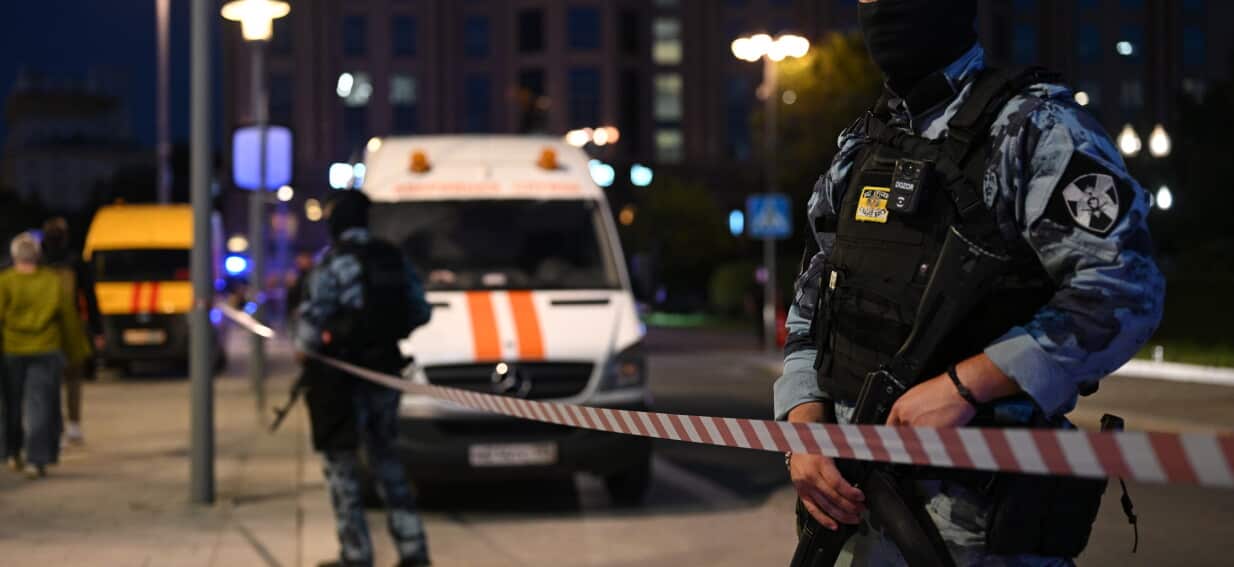
An improvised explosive device detonated outside the Balzi Rossi restaurant on Kudrinskaya Square in central Moscow, killing three individuals and injuring at least twenty-one others. State media reports and the National Anti-Terrorism Committee establish that an unidentified woman attempted to transport the explosive device into the venue but was intercepted by a security guard at the threshold. The resulting blast killed the carrier, the security guard, and a patron, while the venue itself—housed within one of Moscow's Stalin-era skyscrapers—was closed for a private function. Deconstructing this event requires moving past superficial casualty counts to examine the operational mechanics of urban target selection, the physical dynamics of threshold interdiction, and the strategic vectors governing modern asymmetric warfare within metropolitan capitals.
The Operational Mechanics of Target Selection
Urban asymmetric operations rely on precise optimization between target accessibility and symbolic or tactical yield. The selection of an upscale venue hosting a private gathering in a high-density municipal center highlights a deliberate choice to exploit predictable soft-target vulnerabilities.
- Spatial Constraints: High-density urban architecture creates confinement zones that amplify the physical radius of an explosive shockwave. Kudrinskaya Square, flanked by monumental Stalinist structures, creates acoustic and blast-pressure reverberation effects that increase structural damage and shrapnel dispersion.
- Access Control Friction Points: Venues hosting private events introduce rigid access vetting, turning entry thresholds into choke points. While these barriers are designed to exclude unauthorized personnel, they inadvertently compress threat vectors into localized geographic spots.
Reports from investigative media outlets indicating the device may have been triggered remotely while carried by an unwitting individual introduce an advanced dimension of operational proxy execution. In such operational designs, the human carrier functions as an autonomous transit mechanism, removing psychological reluctance or behavioral anomaly detection that might otherwise compromise an operative during stationary reconnaissance.
The Cost Function of Threshold Interdiction
The intervention of the security guard at the restaurant entrance fundamentally altered the physical damage distribution curve of the attack. Analyzing this intervention through a security efficacy framework reveals a distinct trade-off between interior asset protection and perimeter containment failure.
$$\text{Total Impact} = \text{Initial Payload Energy} \times (\text{Mitigation Factor} - \text{Proximity Coefficient})$$
When the carrier was denied interior access, the detonation occurred at the perimeter interface rather than deep within the enclosed dining room.
- Interior vs. Exterior Deflagration: Had the device penetrated the primary dining hall, structural confinement would have maximized internal thermal and pressure loading on occupants, likely driving the fatality rate significantly higher.
- The Proximity Paradox: Interdiction at the threshold successfully preserved the interior space but concentrated the blast energy immediately adjacent to the doorway and outdoor movement corridors, resulting in twenty-one collateral injuries among passersby and terrace-adjacent individuals.
The security guard's tactical intervention optimized for asset protection at the micro-level, converting a potential mass-casualty interior disaster into a localized perimeter incident, albeit at the direct cost of the interdictor's life.
Geopolitical Friction and Intelligence Vectoring
Operating more than four years into the active conflict with Ukraine, Moscow's domestic security apparatus faces a persistent threat landscape characterized by decentralized infiltration and clandestine sabotage cells. The Federal Security Service previously signaled heightened threat levels directed at high-profile military and political figures.
- Asymmetric Proxy Networks: The deployment of improvised explosive devices via unwitting couriers points to an evolving tradecraft designed to bypass electronic surveillance and behavioral profiling checkpoints.
- Attribution Delays: State investigative committees frequently experience latency between physical site processing and definitive institutional attribution. This friction stems from the necessity to decouple forensic ballistics from immediate political rhetoric, mapping electronic signatures, communications relays, and supply chains of chemical precursors used in the homemade explosive device.
The incident underscores the persistent vulnerability of metropolitan infrastructure to low-signature kinetic disruptions. Defensive posture adjustments in urban environments must account for proxy transport models where the delivery vector is structurally separated from the operational command node. Future countermeasures will likely mandate automated standoff detection layers well beyond the immediate structural threshold of high-value commercial venues.