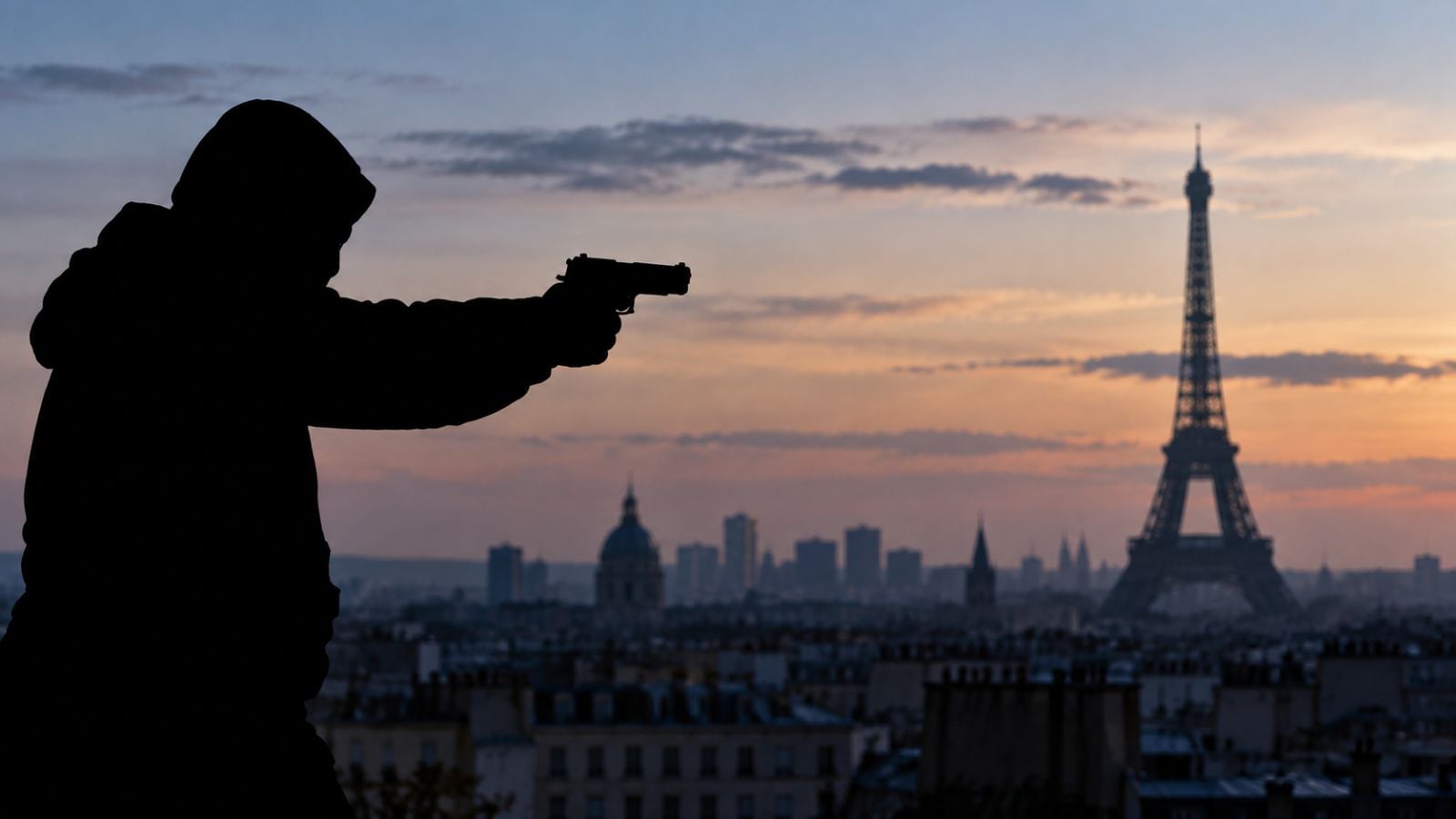
Acute violent incidents in suburban zones follow a predictable operational trajectory where initial criminal mechanics immediately collide with political framing, institutional verification bottlenecks, and community mobilization. Analyzing a suspected racist shooting in the Paris suburbs—resulting in one fatality and five injuries—requires separating verified ballistics and legal classifications from the socio-political friction that governs French peripheral urban centers. Standard news coverage reduces these events to isolated casualty counts and reactionary quotes, missing the structural variables that dictate how an interpersonal or targeted attack escalates into a national security event.
To evaluate the incident accurately, the analytical focus must move across four distinct phases: the tactical execution of the attack, the legal architecture of motive verification in France, the spatial dynamics of the banlieues, and the institutional protocols deployed to contain secondary civil unrest.
The Tactical Mechanics of Suburban Ballistic Incidents
When a shooting occurs in a high-density residential perimeter outside central Paris, the immediate physical variables dictate both the casualty ratio and the subsequent investigative path. A single shooter producing one fatality and five non-fatal wounds indicates specific operational parameters regarding weapon selection, target density, and engagement duration.
- Weaponry and Firepower Constraints: In France, strict firearm regulations under the Code de la sécurité intérieure restrict civilian access to handguns and semi-automatic rifles. When such weapons appear in suburban incidents, they typically originate from illicit trafficking networks supplying the peripheral underground economy, or they represent legacy hunting firearms (Category C) diverted from rural or regulated channels. The casualty profile—six total hits with a 16.7% lethality rate—aligns with either a low-caliber semi-automatic pistol discharged rapidly in a confined area or a shotgun fired at intermediate range where pellet dispersion increases injury count while reducing immediate lethality.
- Target Selection and Spatial Concentration: High casualty-to-incident ratios in suburban environments occur when the perpetrator targets static gathering points—such as local commercial storefronts, transit hubs, or community courtyards—rather than mobile individuals. The spatial design of post-war suburban housing estates (grands ensembles) often channels foot traffic through narrow architectural bottlenecks, maximizing exposure during a sudden ballistic event.
- Engagement Window and Extraction: Unlike prolonged barricade scenarios, rapid-casualty shootings in the Paris suburbs generally conclude within ninety seconds. The perpetrator relies on immediate vehicular extraction via the dense highway network surrounding the Petite Couronne (Hauts-de-Seine, Seine-Saint-Denis, Val-de-Marne) or the Grande Couronne, forcing law enforcement into a reactive containment posture rather than active intervention.
The Legal Architecture of Hate Crime Classification
Designating a shooting as a "suspected racist attack" triggers a specific set of judicial mechanisms within the French legal system that differ fundamentally from standard criminal homicide investigations. Under the French Penal Code, racism is not prosecuted as a standalone offense in the context of violent assault; rather, it operates as an aggravating circumstance (circonstance aggravante) attached to the primary charges of murder (meurtre) or attempted murder (tentative de meurtre).
[Primary Offense: Homicide / Attempted Homicide]
                     │
                     ▼
[Evidentiary Threshold: Article 132-76 of the Penal Code]
  ├── Pre-incident ideological markers (manifestos, digital footprint)
  ├── Real-time verbal declarations during execution
  └── Target selection patterns (institutional or demographic targeting)
                     │
                     ▼
[Judicial Reclassification]
  ├── Standard Criminal Court (Cour d'assises) -> Base Sentence
  └── Aggravated Hate Motive Confirmed -> Elevation to Life Imprisonment (Réclusion criminelle à perpétuité)
Proving this aggravating circumstance under Article 132-76 requires prosecutors to establish dol spécial—specific intent demonstrating that the act was committed because of the victims' actual or supposed membership in a specific ethnic, national, racial, or religious group.
This creates an immediate investigative friction. Public perception and community leaders often classify an attack as racist based on the demographic disparity between the perpetrator and the victims within hours of the shooting. The judicial apparatus, conversely, cannot formally apply the aggravating circumstance until digital forensics, witness statements, and ballistic trajectories rule out alternative operational motives. In the Paris suburbs, alternative hypotheses routinely include territorial disputes over narcotics distribution points, interpersonal retaliation, or indiscriminate violence driven by acute psychiatric instability.
Until the Procureur de la République (Public Prosecutor) formally retains the racist aggravating circumstance, the investigation remains split between two competing hypotheses: targeted ideological violence versus localized criminal or psychiatric pathology.
Spatial Sociology and the Banlieue Friction Index
The geography of the Paris suburbs amplifies the political resonance of any ethnically charged violent crime. Unlike Anglo-American urban models where wealth concentrates in outer suburbs, the Paris metropolitan area exhibits an inverse socioeconomic gradient. The historic core (Paris intra-muros) retains concentrated capital and institutional power, while the peripheral departments house a disproportionate share of working-class populations, immigrant communities, and public housing infrastructure (Habitation à Loyer Modéré or HLM).
This spatial segregation produces three structural vulnerabilities when a suspected racist attack occurs:
- Asymmetric Trust in State Institutions: Residents in peripheral departments frequently experience the state primarily through coercive mechanisms—specifically, specialized police units such as the Brigade Anti-Criminalité (BAC)—rather than administrative or social services. When an external or ideologically motivated attack targets local residents, community skepticism regarding the state's willingness to prosecute hate crimes aggressively creates an immediate legitimacy deficit.
- The Echo Chamber of Historical Precedent: Every suspected racist shooting in France is processed through the collective memory of previous watershed incidents, such as the December 2022 shooting at a Kurdish cultural center in Paris's 10th arrondissement. In that instance, the initial hesitation by authorities to label the act terrorism—despite the perpetrator's explicitly stated hatred of foreigners—sparked severe clashes between demonstrators and police. Subsequent incidents inherit this baseline tension, compressing the window authorities have to establish narrative control.
- Media Amplification and Semantic Drift: Early reporting relies heavily on fragmented police sources and bystander accounts. When headlines anchor on "suspected racist attack" prior to judicial confirmation, the framing locks in public expectations. If the judicial investigation later uncovers mixed motives—such as a perpetrator exhibiting severe mental illness alongside xenophobic rhetoric—the nuance is frequently rejected by the public as an institutional cover-up designed to downplay systemic racism.
Institutional Containment and Security Protocols
Following a mass-casualty shooting with suspected ideological motives, the French Ministry of the Interior activates a dual-track operational response: forensic resolution and public order maintenance (maintien de l'ordre).
The forensic track falls to the Police Judiciaire (PJ) or, if the ideological dimension approaches organized extremism, the Direction Générale de la Sécurité Intérieure (DGSI). Investigators immediately execute a digital and physical sweep of the suspect's background to determine whether the shooter operated as an isolated actor (loup solitaire) or within an accelerated extremist network. French intelligence services have increasingly documented the rise of "ultra-right" (ultradroite) micro-groups operating on encrypted platforms, shifting counter-terrorism resource allocation that was previously focused almost exclusively on radicalized networks.
Simultaneously, the Préfecture de Police deploys mobile security forces—specifically the Compagnies Républicaines de Sécurité (CRS) or Gendarmes Mobiles—to perimeter zones around the crime scene, local hospitals treating the five wounded victims, and municipal buildings. This deployment manages two distinct risks:
- Retaliatory Mobilization: Preventing spontaneous, localized unrest driven by anger over the attack or perceived police slowness.
- Copycat or Counter-Protest Escalation: Securing vulnerable community institutions (places of worship, cultural associations) against secondary attacks while blocking far-right or far-left agitators from converging on the neighborhood to exploit the crisis.
Limitations of Current Analytical and Security Frameworks
Evaluating this event through security and legal frameworks reveals systemic blind spots that prevent state institutions from effectively deterring or managing suburban hate violence.
First, the binary classification of motive fails to capture hybrid radicalization. French legal statutes force prosecutors to categorize violence cleanly as ideological terrorism, aggravated hate crime, or non-ideological criminal/psychiatric acts. Modern radicalization rarely adheres to these neat boundaries. Individuals frequently exhibit severe cognitive instability combined with fragmented ideological grievances absorbed online. Forcing these cases into rigid legal boxes delays public communication and erodes institutional credibility.
Second, predictive policing models in the Paris suburbs remain structurally misaligned with ideologically motivated threats. Surveillance and intelligence assets in the banlieues are heavily optimized to track organized crime, drug trafficking networks, and specific religious extremism. Consequently, an outside actor or a non-networked local resident radicalized by xenophobic narratives can acquire a firearm and execute a targeted attack without triggering the standard behavioral tripwires monitored by local intelligence units (Renseignement Territorial).
Third, rapid-response crisis communication cannot outpace decentralized social media narratives. By the time the Public Prosecutor holds a press conference to clarify the legal status of the investigation, unverified video footage, misattributed motives, and partisan commentary have already saturated local networks. Official statements emphasizing procedural caution appear evasive against the certainty of viral rumor.
Strategic Imperatives for Crisis Management and Prevention
To mitigate the destabilizing impact of suburban hate violence and close the operational gaps exposed by a multi-casualty shooting, municipal authorities, judicial bodies, and security planners must execute three targeted adjustments:
- Decouple Preliminary Protective Deployment from Judicial Motive Confirmation: Security planners must treat any multi-victim shooting targeting a specific demographic or community space as an ideological attack for the first 72 hours regarding asset allocation. Deploying protective details to affiliated community centers immediately—without waiting for the Public Prosecutor to confirm Article 132-76 aggravating circumstances—signals state commitment to victim protection and reduces the incentive for community self-defense mobilization.
- Establish Standardized Transparency Protocols for Forensic Milestones: The Public Prosecutor's office should replace ad-hoc press briefings with a scheduled, transparent reporting cadence during the first week of a high-tension investigation. Explicitly detailing the exact forensic steps required to legally prove racist intent—such as digital device extraction timelines and psychiatric evaluation protocols—educates the public on procedural mechanics and counters narratives of institutional neglect.
- Integrate Cross-Ideological Threat Monitoring into Suburban Intelligence Units: Local intelligence desks in the Petite and Grande Couronne must recalibrate their monitoring parameters to track the intersection of illicit firearms circulation and online xenophobic accelerationism. Bridging the intelligence gap between traditional organized crime units and domestic extremism desks is essential to intercepting non-traditional shooters before they reach high-density suburban targets.