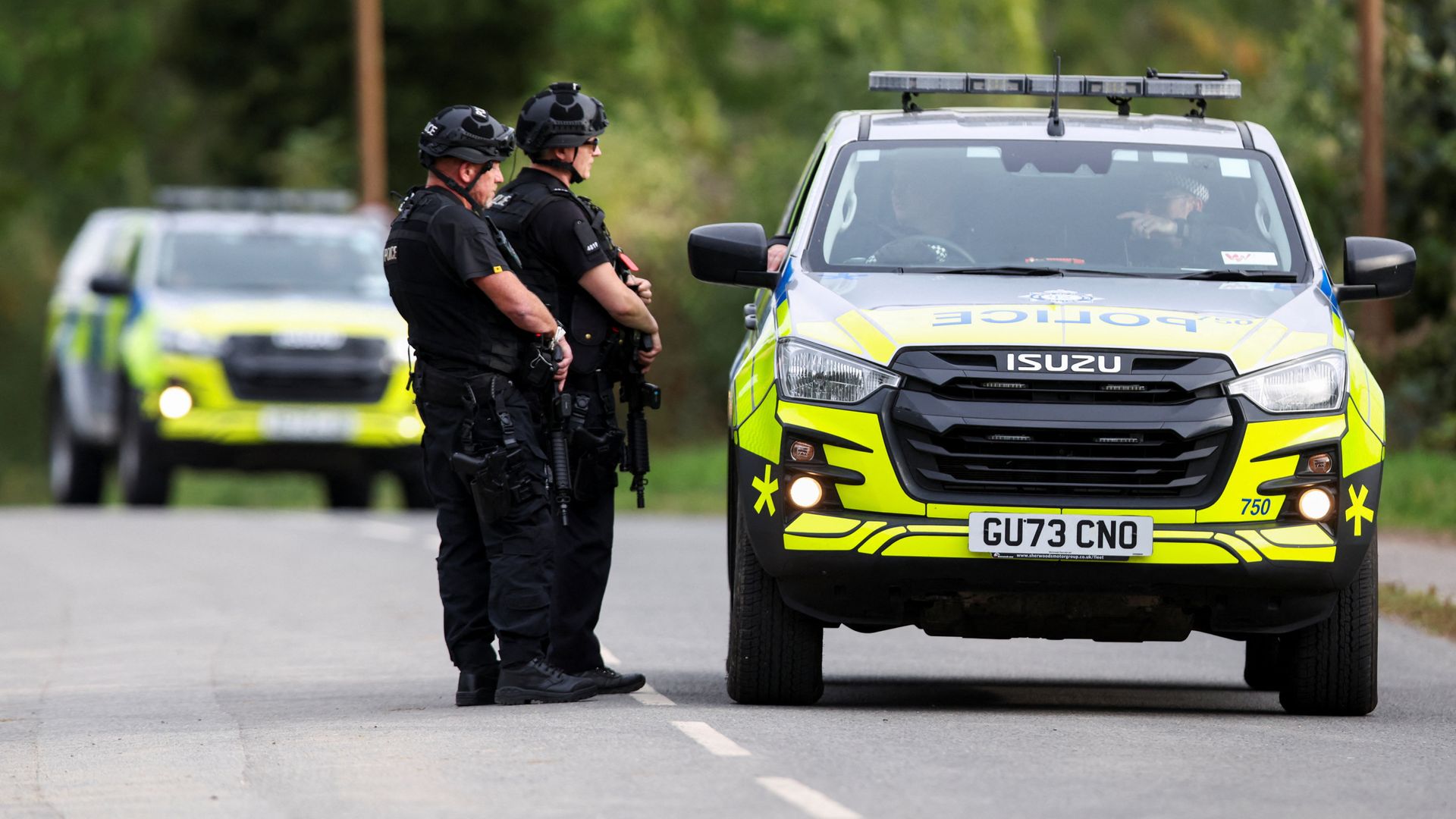
The formal charging of two individuals by United Kingdom authorities in connection with an alleged plot to attack Royal Air Force (RAF) Fairford represents far more than an isolated criminal indictment. It exposes the structural mechanics of modern asymmetric warfare, the friction points of domestic intelligence interdiction, and the strategic vulnerability of high-value forward operating bases. Most public reporting reduces such events to surface-level crime blotters, focusing on court dates and basic biographical details while ignoring the operational architecture that makes a facility like Fairford a primary target—and how state security apparatus executes pre-emptive disruption.
To understand the significance of this prosecution, analysts must separate the tactical arrest from the strategic context. RAF Fairford is not a standard domestic airfield; it is a specialized forward operating location for United States Air Force (USAF) strategic bombers, including the B-52H Stratofortress, B-1B Lancer, and B-2 Spirit. Any credible threat against this installation crosses the threshold from local criminality into an attack on transatlantic strategic deterrence. Analyzing this case requires deconstructing the target's operational profile, the legal architecture of UK counterterrorism statutes, and the economic and security trade-offs inherent in defending sprawling military infrastructure.
The Strategic Value of RAF Fairford
A target's attractiveness in asymmetric conflict is governed by a simple calculus: the ratio of symbolic and operational disruption achieved relative to the resources expended by the attacker. RAF Fairford sits at the apex of this equation for hostile actors operating within Western Europe.
Located in Gloucestershire, England, Fairford serves as the USAF's only European airfield capable of supporting heavy bomber operations on a sustained basis. Its 10,000-foot runway is specifically engineered to handle the extreme takeoff weights of fully loaded strategic aircraft. Beyond physical concrete, the base houses specialized munitions storage, hardened communications infrastructure, and logistical pipelines designed for rapid force projection across Europe, the Middle East, and North Africa.
From a threat-modeling perspective, Fairford presents three distinct vulnerabilities that elevate its risk profile:
- Predictable Operational Cycles: Strategic bomber task force deployments to Fairford are frequently publicized or easily observed via open-source intelligence (OSINT), including flight-tracking transponders and local aviation photography networks. This transparency allows hostile actors to map peak vulnerability windows without needing insider access.
- Geographic Perimeter Complexity: Unlike urban diplomatic compounds enclosed by reinforced concrete blast walls, rural airfields span thousands of acres. Securing a perimeter of this scale against reconnaissance, unmanned aerial systems (UAS), or standoff weaponry requires immense manpower and sensor density.
- Alliance Signaling: An attack on a joint US-UK facility—even an unsuccessful one that forces a temporary operational pause—generates immediate geopolitical friction. It tests the host nation's ability to guarantee the security of allied strategic assets, creating diplomatic leverage for state sponsors or ideological networks.
Standard reporting treats the location as mere geographic background. In reality, the physical and geopolitical specifications of Fairford dictate the entire intelligence response. Threat actors targeting this facility are rarely motivated by localized grievances; they are aiming at a node in global power projection.
Mechanics of the UK Counterterrorism Charging Threshold
When UK authorities—typically Counter Terrorism Policing South East (CTPSE) working alongside MI5—transition from covert surveillance to formal charges via the Crown Prosecution Service (CPS), they operate under a strict legal and operational framework. Understanding the charges requires examining the statutory architecture of the UK Terrorism Act 2000 and the Terrorism Act 2006.
Unlike conventional criminal law, which generally requires an actus reus (guilty act) closely tied to the completion of a crime, UK counterterrorism legislation is explicitly designed for pre-emptive interdiction. The state does not wait for an attacker to breach a perimeter fence. Instead, prosecutors rely heavily on Section 5 of the Terrorism Act 2006: Preparation of terrorist acts.
Under Section 5, the prosecution must establish two core elements:
- Intent: The individual intended to commit an act of terrorism or assist another to commit such an act.
- Conduct: The individual engaged in any conduct in preparation for giving effect to that intention.
This statutory design lowers the physical threshold for arrest while raising the evidentiary burden regarding psychological intent. Buying dual-use materials, conducting hostile reconnaissance of a base perimeter, or acquiring encrypted communications tools are legally benign actions in isolation. They only become prosecutable crimes when intelligence agencies link them to an ideological or operational blueprint.
The Intelligence-to-Evidence Bottleneck
The transition from intelligence gathering to criminal charging represents the most fragile phase of any counterterrorism operation. Intelligence agencies collect information to understand networks and prevent attacks; law enforcement collects evidence to prove guilt beyond a reasonable doubt in an open court.
When authorities charge suspects in connection with a plot against a military installation, it indicates that investigators have successfully navigated three operational constraints:
- Source Protection: Intelligence derived from human sources (HUMINT) or sensitive signals interception (SIGINT) often cannot be disclosed in court without compromising ongoing operations or allied capabilities. Prosecutors must construct a parallel evidentiary chain using admissible material—such as physical surveillance logs, financial records, seized digital devices, and forensic traces—that mirrors what the intelligence already revealed.
- The Intervention Timing Dilemma: Arresting suspects too early risks a collapsed trial due to insufficient evidence of concrete preparation. Waiting too long risks operational failure, where suspects acquire functional weapons or execute an attack before tactical teams can intervene. The decision to charge confirms that the threat had matured past theoretical chatter into observable preparatory steps, triggering mandatory disruption.
- Jurisdictional Coordination: Because RAF Fairford hosts US forces under the NATO Status of Forces Agreement (SOFA), any domestic plot involving the base necessitates immediate deconfliction between British domestic security (MI5/CPS) and US military counterintelligence (such as the Air Force Office of Special Investigations, or OSI). While UK civilian courts retain primary jurisdiction over offenses committed on British soil by non-military personnel, the evidentiary standards must satisfy the security concerns of both nations.
Deconstructing the Threat Vector Hypothesis
While specific operational details remain restricted under sub judice rules ahead of trial, established counterterrorism doctrine allows us to categorize the plausible threat vectors against a facility like Fairford. Distinguishing between known facts and analytical hypotheses is essential here. The known facts are confined to the public confirmation of the arrests, the formal charges brought by the CPS, and the identification of the target facility. The exact methodology remains a matter of prosecution disclosure.
However, attacks against hardened military airfields historically cluster into four distinct operational models:
- Perimeter Infiltration and Sabotage: Small teams attempting to breach outer fencing to destroy high-value aircraft on the tarmac using incendiary devices or explosives. This method relies on stealth and exploits the vast perimeter-to-guard ratio of rural airfields.
- Standoff Indirect Fire or UAS Attack: Launching improvised rockets, mortars, or commercial-off-the-shelf (C-O-T-S) drones modified to carry explosive payloads from outside the base perimeter. This bypasses traditional ground security checkpoints entirely, shifting the defensive burden to airspace monitoring and counter-UAS electronic warfare systems.
- Insider Threat Facilitation: Radicalizing or coercing base contractors, logistics personnel, or local service providers to smuggle contraband inside the secure zone or provide detailed maps of internal patrol schedules.
- External Gate Assault: Targeting the transitional chokepoints where military personnel and civilian contractors enter and exit the installation. Vehicle-borne improvised explosive devices (VBIEDs) or edged-weapon attacks at access control points require minimal technical sophistication while guaranteeing high visibility.
Each of these models leaves a distinct preparatory footprint. Perimeter infiltration requires physical reconnaissance, breaching tools, and night-vision or thermal evasion planning. Standoff drone attacks require procurement of airframes, flight controllers, and energetic materials, alongside digital testing. Insider plots leave financial or communications anomalies. The fact that UK authorities secured sufficient evidence to levy formal charges demonstrates that the suspects generated observable signatures within one or more of these preparatory phases.
The Economics of Asymmetric Base Defense
The RAF Fairford case highlights a fundamental asymmetry in national security economics: the cost disparity between offense and defense.
A covert cell can plan, reconnoiter, and equip a rudimentary attack against an airbase for a few thousand pounds. Commercial drones, basic chemical precursors, or conventional vehicles require minimal capital. Conversely, defending a strategic bomber base against these low-cost vectors demands continuous, capital-intensive expenditure.
Consider the structural costs imposed on the host nation and allied forces when a credible plot is uncovered:
- Sensor Saturation: Securing a rural airfield against small-signature threats requires deploying multi-layered radar systems, electro-optical/infrared (EO/IR) cameras, acoustic sensors, and radio-frequency (RF) detectors along miles of perimeter.
- Manpower Allocation: High-alert postures require increasing armed patrol frequencies by Ministry of Defence Police (MDP) and USAF Security Forces. Sustained heightened readiness induces personnel fatigue and degrades training cycles for other missions.
- Operational Friction: Every security enhancement slows down logistics. Deepening vehicle inspections at entry gates creates traffic bottlenecks, delays maintenance crews, and extends the turnaround time for aircraft sorties. In a crisis scenario where rapid bomber deployment is required, security friction directly degrades military readiness.
Hostile actors do not always need to detonate a device to achieve a partial strategic effect. Simply forcing security services to divert intelligence resources, harden perimeters, and alter deployment patterns imposes an ongoing tax on Western defense budgets.
Limitations of Pre-Emptive Interdiction
While the disruption and charging of suspects in the RAF Fairford case demonstrates the effectiveness of British intelligence integration, relying on pre-emptive law enforcement carries inherent structural limitations.
First, intelligence bandwidth is finite. Monitoring potential threat actors requires massive human and technical allocation. A single active surveillance target can consume dozens of trained officers per shift across physical surveillance teams, digital forensics, and legal oversight. As the volume of low-sophistication threats increases, intelligence agencies face constant triage decisions, creating the risk that a quiet, disciplined cell slips below the monitoring threshold.
Second, the democratization of dual-use technology compresses the warning window. In previous decades, acquiring the capability to threaten a military aircraft required state backing or access to black-market military ordnance. Today, commercial drones, encrypted messaging applications, and open-source satellite imagery provide off-the-shelf reconnaissance and delivery capabilities. When the time between ideation and execution shrinks from months to days, intelligence services have far less margin for error before they must execute arrests.
Third, public prosecution creates a counter-intelligence trade-off. Bringing suspects to trial validates the rule of law and deters future plotters, yet the discovery process inevitably reveals the methods, timelines, and thresholds used by security services to detect the plot. Hostile actors study court transcripts to refine their operational security (OPSEC), learning precisely which digital behaviors or procurement patterns triggered state intervention.
Strategic Imperatives for Force Protection
The charging of suspects in the RAF Fairford plot should serve as a catalyst for structural adjustments in how allied militaries manage domestic forward operating bases. Relying solely on national intelligence agencies to catch plots upstream is an incomplete strategy; physical and operational base defenses must evolve to neutralize the threats that bypass early detection.
Defense planners and base commanders must execute three immediate shifts:
- Transition from Perimeter Defense to Domain Awareness: Traditional fencing and gate guards are obsolete against standoff drone threats and open-source intelligence gathering. Bases like Fairford require persistent, automated counter-UAS detection and kinetic/non-kinetic defeat systems integrated directly into local airspace management, operating continuously rather than only during active bomber deployments.
- Enforce Operational Opacity During Deployments: The strategic signaling value of announcing bomber task force arrivals must be weighed against the tactical vulnerability it creates. Military public affairs and aviation authorities should implement stricter protocols regarding transponder usage and advance deployment notifications to degrade the open-source targeting cycle used by hostile reconnaissance.
- Integrate Local Intelligence Buffers: Rural bases cannot be defended purely from inside the wire. Establishing formalized, continuous intelligence-sharing frameworks between base security forces, local constabularies, and regional counterterrorism units ensures that anomalous behavior in surrounding communities—such as unusual drone flights, suspicious property rentals, or unauthorized photography—is flagged and correlated before it matures into an operational threat.
The legal proceedings ahead will determine the individual culpability of the charged men, but the strategic lesson is already clear: high-value military infrastructure in domestic territory is permanently on the front line of asymmetric conflict.