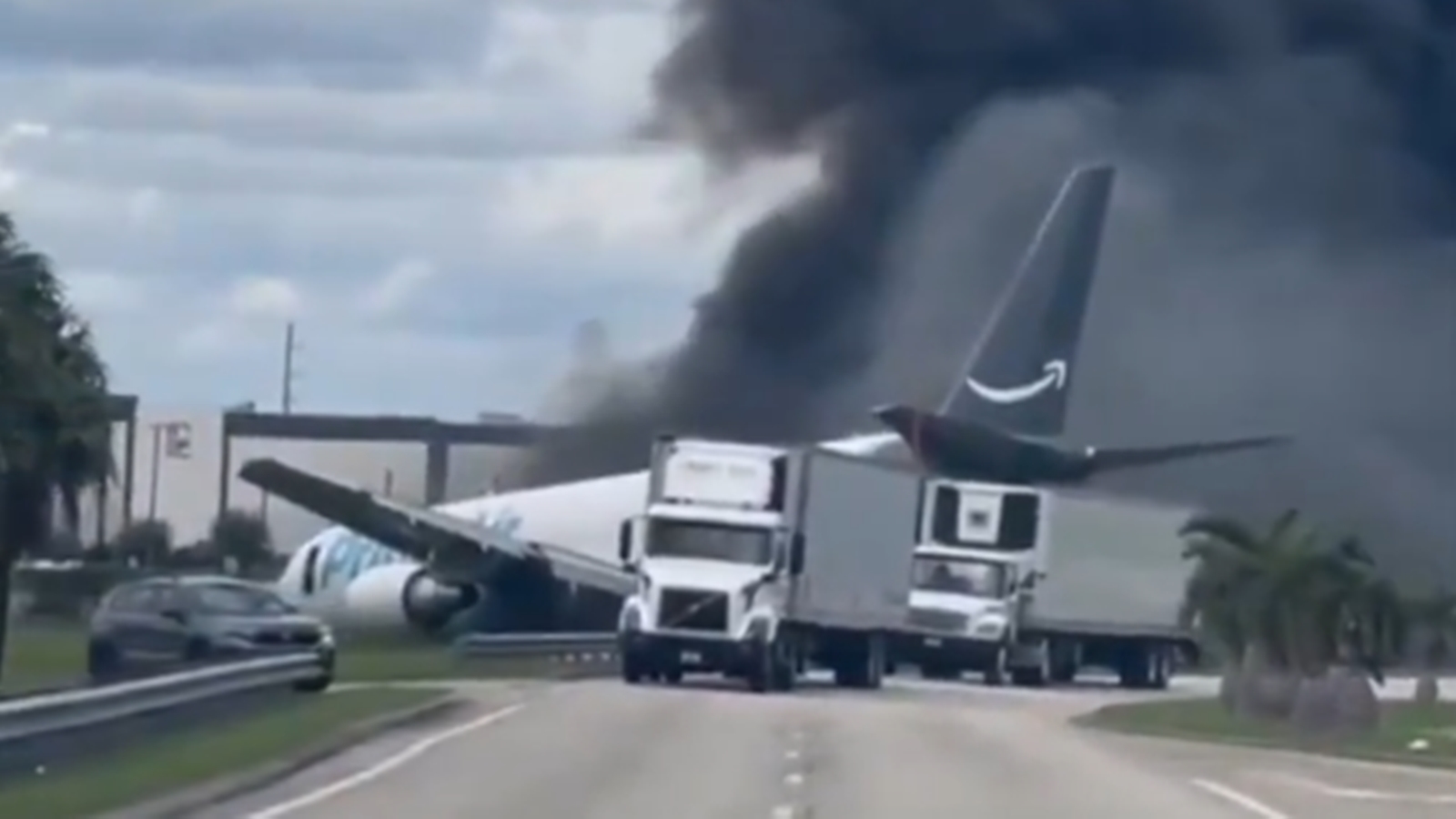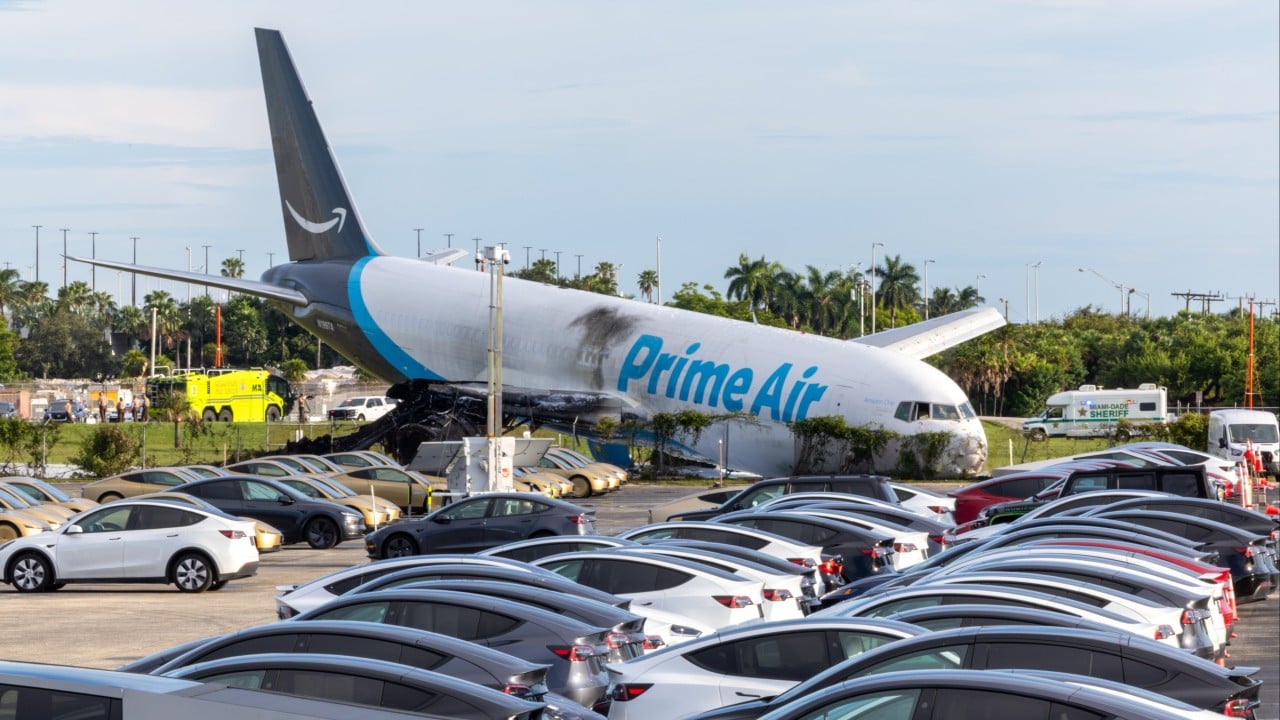
When a three-decade-old Boeing 767 freighter operated by 21 Air on behalf of Amazon Prime Air breached the perimeter of Miami International Airport, the resulting catastrophe killed five people and triggered a systemic gridlock across regional airspace. Standard media coverage defaulted to surface-level descriptions of smoke, flames, and operational disruption. Deconstructing the event requires shifting from descriptive journalism to an operational failure analysis. Evaluating commercial aviation incidents demands an examination of kinetic energy management, runway safety area compliance, and third-party wet-lease risk diffusion.
The mechanism of a runway overrun is governed by a strict equation of stopping force versus remaining landing distance. Flight 7598 arrived from San Juan, Puerto Rico, touching down on a diagonal runway before failing to decelerate within the designated pavement boundaries. A landing aircraft possesses momentum defined by its landing weight and touchdown velocity. Dissipating this kinetic energy relies on three primary variables: aerodynamic drag through spoilers and reverse thrusters, wheel braking friction, and the physical margin provided by the Runway Safety Area. When touchdown occurs late down the runway, or when contaminated pavement reduces braking friction coefficients, the available stopping distance shrinks below the required braking distance. This creates a critical kinetic deficit. Discover more on a connected issue: this related article.
The physical geography of urban airports exacerbates this deficit. Unlike isolated rural fields with miles of clear zones, metropolitan hubs like Miami position active roadways and dense vehicular traffic directly adjacent to runway thresholds. When the Boeing 767 breached the airport boundary and crossed a local thoroughfare, it struck multiple motor vehicles. The severity of the outcome was a direct function of urban density meeting unmitigated aircraft momentum. Kinetic energy does not halt instantly upon pavement exhaustion; it transfers entirely to whatever structural obstacles lie in the deceleration path.
Outsourcing logistics models introduces a distinct layer of organizational complexity that traditional safety metrics often obscure. Amazon Prime Air does not operate its entire fleet directly; instead, it utilizes a network of third-party air carriers, such as 21 Air, under contractual wet-lease or charter frameworks. This structure fragments operational oversight. While the Federal Aviation Administration maintains regulatory authority over the certificate holder, the contractor operates within a distinct corporate ecosystem governed by separate internal safety cultures, maintenance scheduling pressures, and crew training budgets. More analysis by NPR explores comparable views on this issue.
Risk diffusion models in corporate supply chains dictate that when a platform owner scales via third-party operators, the operational variance increases. A major e-commerce enterprise optimizing for velocity places intense temporal demands on transport networks. The friction between delivery speed mandates and rigorous risk mitigation creates structural vulnerabilities. While investigations by the National Transportation Safety Board will focus heavily on mechanical factors like braking systems, reverse thruster deployment, and meteorological variables, the structural vector involves how operational cadence influences decision-making on the flight deck.
Examining the airframe itself reveals additional parameters of lifecycle risk. The involved aircraft was approximately thirty-two years old, having spent the majority of its operational life configured for passenger transport before undergoing freighter conversion. Cargo conversions involve cutting large main-deck cargo doors, reinforcing floor structures, and altering weight distributions. While older airframes remain entirely airworthy under strict maintenance directives, their lifecycle cost functions change exponentially. Aging hydraulic actuators, secondary flight control systems, and anti-skid braking components require heightened maintenance scrutiny to perform identically to newer digital-fly-by-wire equivalents.
The immediate aftermath exposed vulnerabilities in metropolitan infrastructure resilience. A ground stop issued by federal regulators paralyzed hundreds of flights across the eastern United States, rippling through hub-and-spoke scheduling matrices. Modern aviation networks operate on tight turn-around efficiencies where a localized blockage at a primary gateway cascades into systemic delays. Emergency response operations involving dozens of municipal units highlight the dual burden placed on local first responders when an aviation incident transitions seamlessly into a multi-vehicle highway mass-casualty event.
Mitigating future catastrophic excursions requires recalibrating how airports evaluate Runway Safety Areas and arresting systems. Engineering Material Arresting Systems use crushable concrete beds designed to deform under an aircraft's weight, safely absorbing kinetic energy without requiring physical open space. Airports operating constrained urban runways face high structural costs to retrofit these systems, yet incidents demonstrate that relying purely on perimeter fencing and open roadways as a buffer is functionally obsolete.
Transport authorities and logistics operators must fundamentally restructure accountability frameworks. The convergence of aging conversion airframes, third-party operational delegation, and high-density urban airport perimeters establishes a high-consequence risk matrix. Future safety optimization demands binding operational integration between e-commerce platform owners and their contracted air carriers, eliminating any ambiguity in safety reporting, maintenance verification, and weather-minimum compliance.