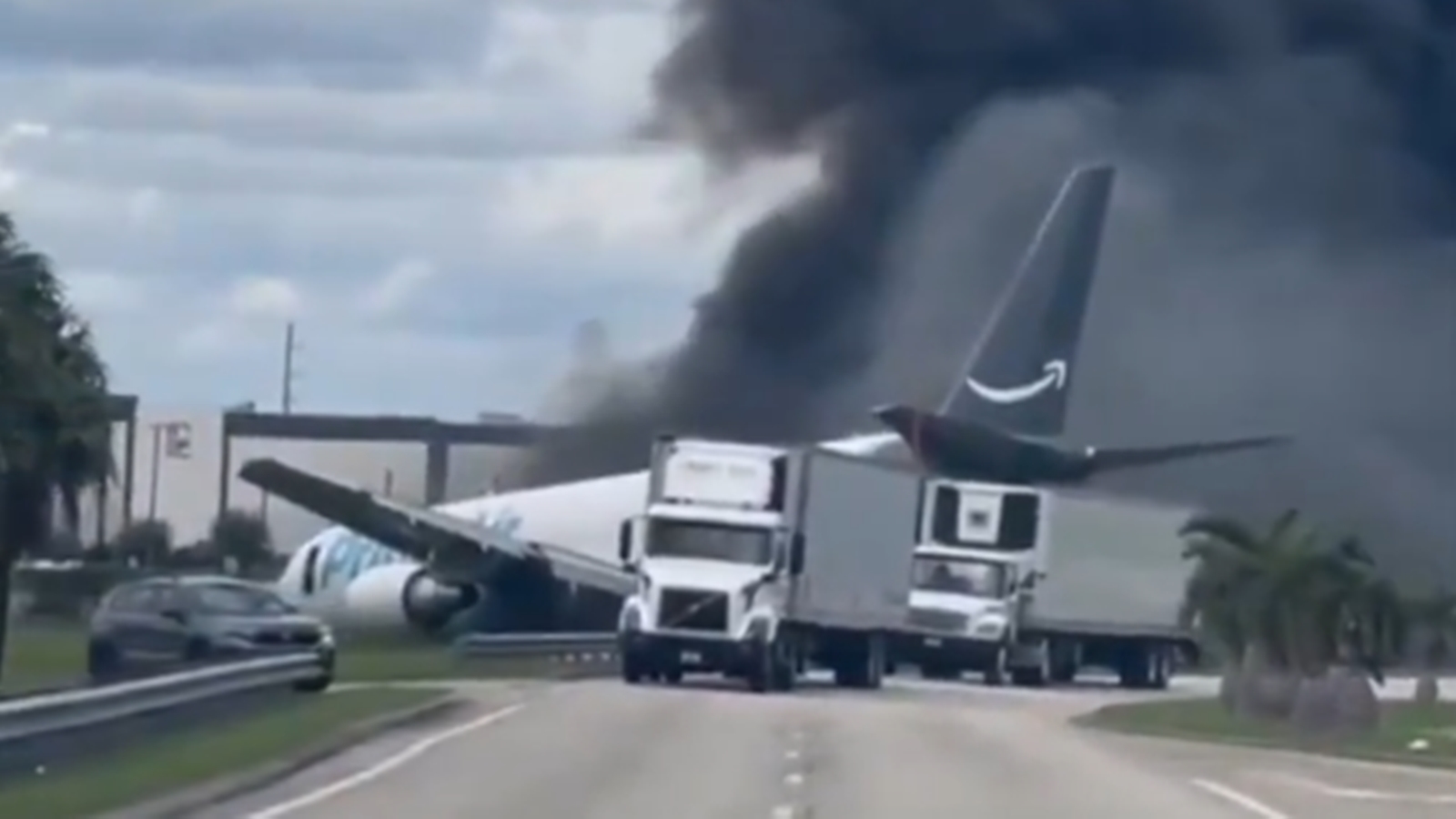
When a Boeing 767-300 freighter operated for Amazon Air overran Runway 30 at Miami International Airport, the immediate operational reality was captured not by automated sensors, but by a concise nine-word radio transmission from a ground vehicle to the control tower: "Looks like we have an aircraft overran the runway." This sparse syntax marks the exact boundary where normal aviation cadence collapses into emergency protocol. Deconstructing this event requires moving past sensationalist framing to examine the kinetic thresholds, spatial economics, and communication feedback loops that govern modern airfield safety.
The Kinetics of Energy Management
An aircraft landing is fundamentally an exercise in energy dissipation. A widebody freighter touching down at high velocity possesses massive kinetic energy that must be scrubbed through aerodynamic drag, mechanical braking, and thrust reversal within a strictly finite spatial envelope. When an aircraft fails to arrest its forward momentum before the pavement ends, the system has experienced a catastrophic failure in energy budgeting.
Runway safety areas and engineered materials arresting systems are designed to absorb overrun energy under standardized assumptions regarding aircraft weight, touchdown point, and surface friction. If a heavy transport category aircraft crosses the airport perimeter road and strikes vehicular traffic, the structural margins of the airfield interface have been entirely exhausted. The physical distance between the runway threshold and the airport boundary fence dictates the time window available for a decelerating airframe to shed its remaining velocity vector.
The Information Bottleneck in Crisis Communication
Air traffic control environments rely on hyper-compressed, unambiguous phraseology to maintain situational awareness. The initial nine-word observation highlights the inherent latency of human-in-the-loop reporting during runway excursions. Primary radar and surface movement optimization systems often register position, but the qualitative confirmation of an overrun frequently depends on visual spotters or ground personnel relaying observations to local controllers.
This communication friction introduces a distinct operational hazard tree.
- Phase one involves the physical departure from the paved surface, where flight deck crew workload spikes as they transition from landing configuration to emergency shutdown procedures.
- Phase two requires ground control and local control loops to recognize the anomaly, suspend active arrivals and departures, and institute immediate ground stops.
- Phase three triggers external coordination with municipal rescue units, shifting the communication network from internal aviation frequencies to multi-agency disaster response channels.
Systemic Vulnerabilities at High-Density Cargo Hubs
Miami International Airport functions as a critical multi-modal nexus connecting North America with Latin America and the Caribbean. High-density mixing of heavy widebody cargo operations with complex perimeter road networks creates inherent spatial friction. Unlike isolated rural airstrips, urban-adjacent airfields maintain tight geographical boundaries where local thoroughfares run parallel to airport perimeters.
When an aircraft breaches this perimeter, the incident ceases to be a purely aviation-internal event and scales immediately into a municipal infrastructure crisis. The implementation of an airport-wide ground stop ripples through national air traffic management networks, demonstrating how localized kinetic failures induce systemic scheduling decay across connecting hubs.
To mitigate the recurrence of similar overrun events, operators and airport authorities must re-evaluate landing distance assessment matrices under degraded braking conditions and variable runway surface friction reports. Operational protocols should mandate stricter safety margins for heavy cargo configurations operating on diagonal or constrained runways during high-humidity or precipitation events, ensuring that structural deceleration capacity matches real-world environmental variables.