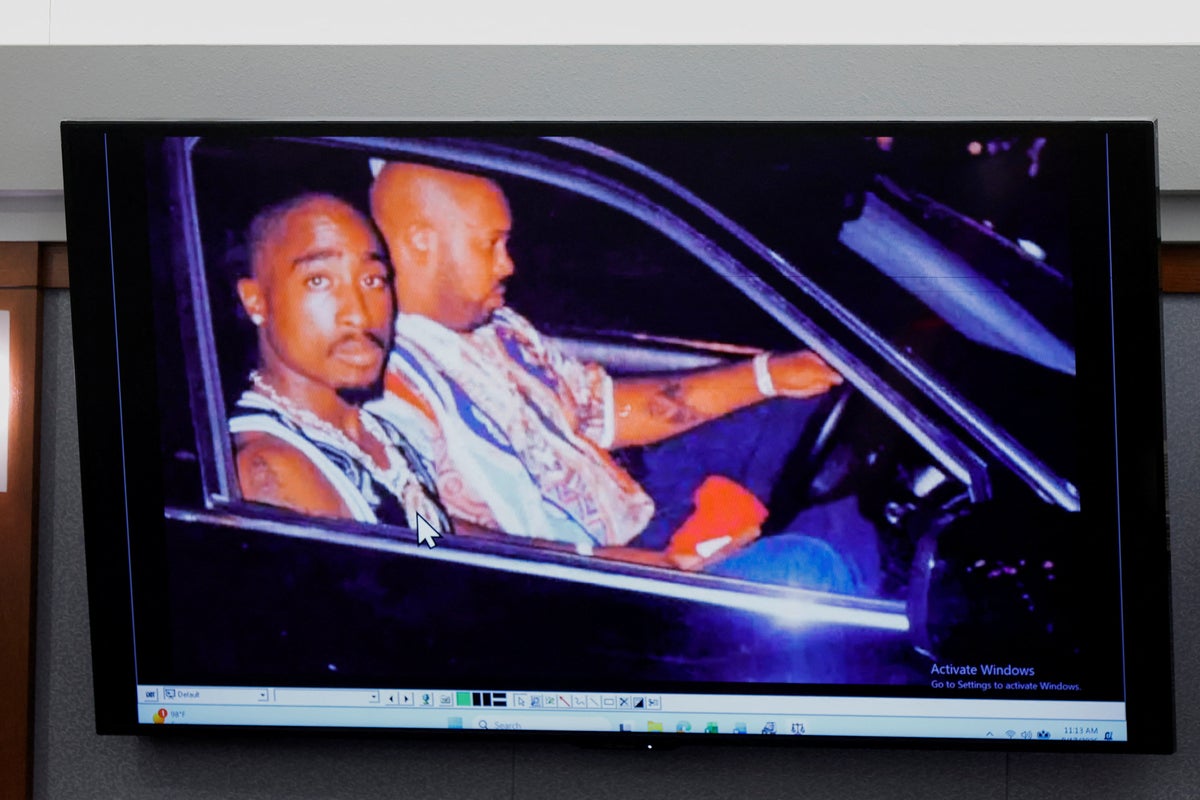
The prosecution of Duane Davis in 2026 for the 1996 killing of Tupac Shakur represents a rare intersection of criminal law and archival storytelling. By utilizing the defendant’s own admissions as the primary evidence against him, the state has shifted the burden from traditional forensic reconstruction to behavioral analysis. This case serves as a model for understanding how long-dormant criminal investigations are reactivated through the "narrative trap"—the tendency for defendants to monetize their crimes in the public domain, thereby creating a paper trail that legal systems can later exploit.
The Dynamics of Escalation
The incident on September 7, 1996, serves as a textbook example of reactive violence within a decentralized power structure. The sequence of events provides a clear input-output model: For another look, consider: this related article.
- The Catalyst: An physical altercation at the MGM Grand involving Shakur’s entourage and Orlando Anderson.
- The Response Loop: A brief period of two to three hours during which the victim-turned-aggressor, Duane Davis, coordinates a retaliatory strike.
- The Execution: A mobile hit-and-run operation intended to resolve an perceived imbalance of power.
This was not a long-term strategic play; it was a high-velocity reaction to a perceived loss of status. In gang dynamics, the refusal to retaliate following a public humiliation is functionally equivalent to surrendering territorial authority. Davis’s alleged motivation—retaliation for the beating of his nephew—highlights the core driver: the preservation of street capital.
The Evidentiary Transformation
The legal challenge in this trial rests on the bridge between past silence and present disclosure. For decades, the case remained cold because the primary variable was "omertà"—the survival-driven silence of potential witnesses. The prosecution’s pivot involves two primary assets: Similar analysis on this trend has been provided by NPR.
- The Admission Archive: Davis’s 2008 and 2009 interviews with law enforcement, coupled with his 2019 memoir, constitute the foundation of the state's case. Legally, the defense faces a containment problem: they must discredit a source (the defendant himself) that has spent over a decade documenting his own participation.
- Contextual Corroboration: The state is not relying solely on the confession; it is utilizing video surveillance of the initial fight to provide a motive framework for the subsequent violence. This anchors the narrative in objective, observable reality, making the subjective "fiction" argument harder for the defense to sustain.
The Limits of Retrospective Prosecution
The defense strategy relies on the "void of evidence" argument. By highlighting the lack of physical forensic data from the 1996 scene and the historical distrust between law enforcement agencies, they are attempting to reframe the confession as a performative, sensationalized narrative rather than a factual account. This reveals a critical limitation in cold case prosecution: as time passes, the "chain of custody" for information degrades. Witnesses pass away, memories distort, and the institutional memory of the involved police departments shifts.
The prosecution is essentially attempting to override this decay by substituting physical evidence with testimonial evidence. If they succeed, it establishes a precedent where a defendant’s own public posturing functions as a self-convicting mechanism.
Strategic Forecast
The outcome of this trial will not be determined by the revelation of new evidence, but by the jury’s interpretation of the defendant’s motive and intent. The state’s strategy is designed to minimize the complexity of the investigation by reducing the scope to a simple "Cause and Effect" loop: humiliation leads to retaliation.
The defense, conversely, must exploit the gaps in the timeline to create reasonable doubt, focusing on the lack of reliable corroboration for the specific logistical details provided by Davis in his book. The primary strategic risk for the prosecution is the possibility that the jury views the confession as a commodity—a story manufactured for profit rather than a true account of historical fact.
To secure a conviction, the state must prove that the defendant’s actions were not merely talk, but an act of "on-the-ground, on-site" command. The trial will ultimately hinge on the weight assigned to the memoir—specifically, whether the jury accepts it as a truthful record or dismisses it as a commercialized fabrication. If the state succeeds, it confirms a new reality: the permanent digital and written record is the most dangerous adversary for those involved in historical criminal activity.


