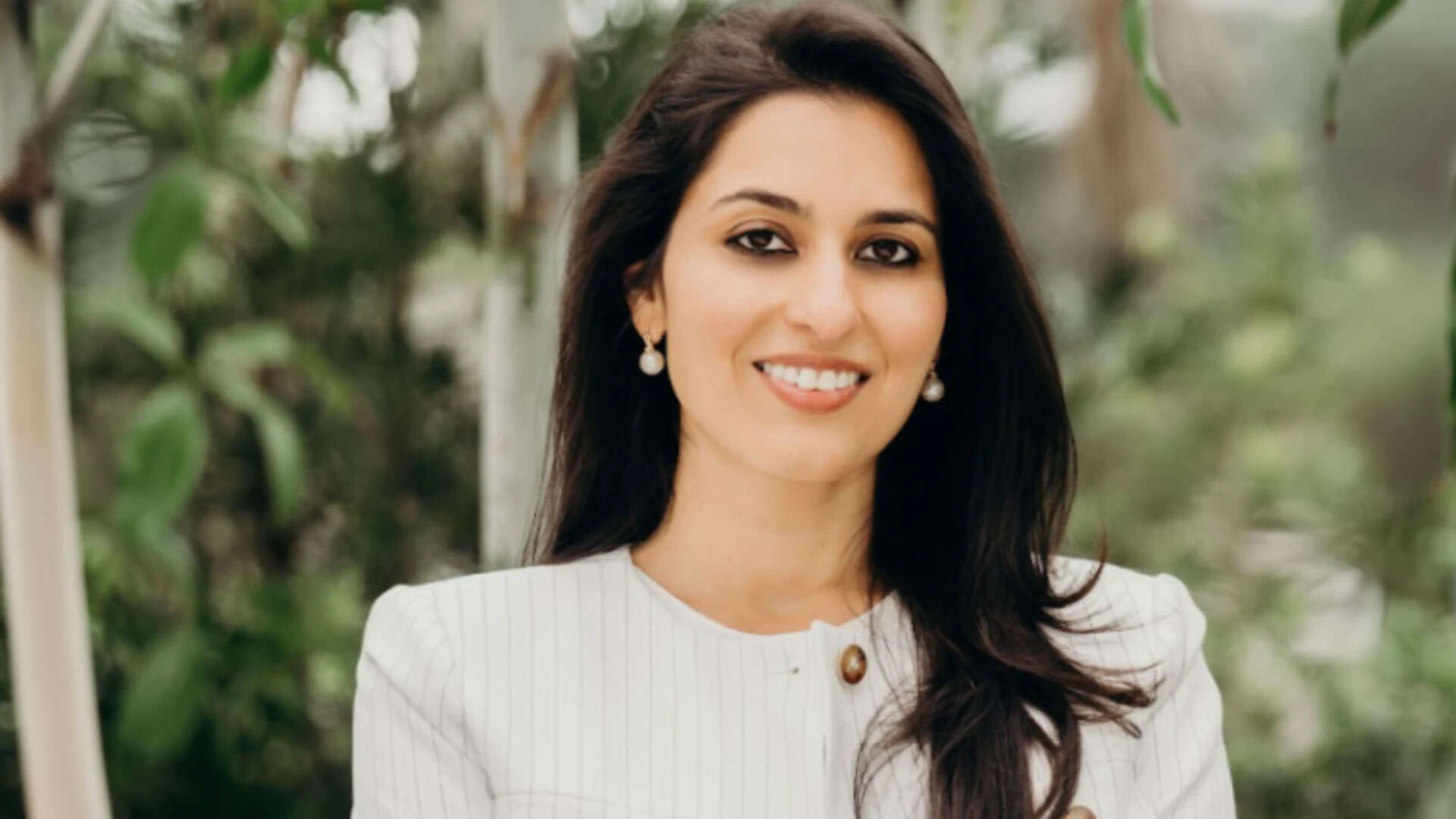
Political campaigns frequently rely on biographical narrative to bridge the gap between a candidate's past and their future policy platform. In the race for Florida's newly realigned 22nd Congressional District, the candidacy of Democrat Pia Dandiya represents a calculated study in the translation of non-traditional professional capital into electoral viability. Popular media narratives framing her trajectory as a sentimental journey "from teaching in Delhi slums to contesting elections in Florida" obscure the underlying structural mechanism. The reality is not a series of disconnected, feel-good milestones, but an optimized sequence of institutional leverage points.
To evaluate her competitive positioning in a highly volatile swing district, we must deconstruct her career through a strict operational framework. Her path relies on a three-stage compounding asset acquisition strategy: the foundational social validation phase, the institutional hyper-scaling phase, and the current political arbitrage phase. Understanding this mechanism explains how a first-generation Indian-American educator managed to compile a $1.17 million primary campaign war chest and secure top-tier party alignment before the voting booths even open.
The Three Pillars of Narrative Credibility
The biographical arc presented by the Dandiya campaign is engineered to resolve a specific structural challenge in American politics: establishing local authenticity while simultaneously projecting elite technocratic competence. This is achieved by anchoring her profile in three distinct operational environments.
+------------------------------------------+
|  1. Foundational Social Validation       |
|  (Undergrad Volunteering, Delhi Slums)   |
+---------------------+--------------------+
                      |
                      v
+------------------------------------------+
|  2. Institutional Hyper-Scaling          |
|  (Harlem Charter Founder, White House)   |
+---------------------+--------------------+
                      |
                      v
+------------------------------------------+
|  3. Political Arbitrage Phase            |
|  (Apple Public Sector, FL-22 Campaign)   |
+------------------------------------------+
1. The Low-Resource Baseline
The early phase of Dandiya's profile relies on a high-empathy, zero-capital testing ground. Volunteering to teach English in New Delhi slums during her undergraduate years at Harvard University serves a dual diagnostic purpose. First, it establishes an early, uncompensated commitment to educational equity, insulating her from accusations of pure careerist opportunism. Second, it provides a stark baseline against which her subsequent administrative efficiency can be measured. The primary logic missing from standard profiles is that this phase was not a detour; it was the acquisition of an experiential proof point necessary to access domestic educational management pipelines, specifically Teach For America and her subsequent Master’s program at Boston University.
2. Institutional Proof of Execution
The transition from direct instruction to systemic administration occurred when Dandiya founded a charter high school in Harlem, New York, at age 28. The operational metrics from this tenure form the quantitative core of her campaign’s policy authority:
- Demographic Constraints: An environment where 86% of the student body lived below the federal poverty line.
- Performance Metrics: Achieving a reported 100% college admission rate among graduates and driving over 90% of students to state proficiency levels.
In the lexicon of public policy, this converts a qualitative desire for "better schools" into a verified capability to manage complex public-private educational systems under severe resource constraints. This execution metric acted as the direct catalyst for her selection as a White House Fellow, placing her within the Domestic Policy Council and the Department of Education. This step effectively shifted her operational scale from municipal management to federal policy design.
3. Corporate and Technical Modernization
The final pillar before entering electoral politics was her tenure leading public sector initiatives at Apple. In this role, she negotiated and managed infrastructure modernization projects intersecting education, healthcare, and state government systems. This corporate phase completes the candidate matrix. By combining grassroots empathy, federal policy credentials, and big-tech operational experience, the campaign constructs an idealized technocratic profile designed to appeal across traditional factional divides.
The Strategic Realignment of Florida’s 22nd District
The analytical value of the Dandiya campaign is not found merely in her resume, but in how this specific asset mix intersects with sudden structural changes in Florida's political geography. A mid-decade redistricting plan approved by Governor Ron DeSantis fundamentally realigned South Florida’s congressional boundaries, transforming the 22nd District into a highly competitive swing seat that stretches from Marco Island to Wellington.
The Calculus of the District Shift
Dandiya was originally positioned to challenge Republican incumbent Brian Mast in the 21st District—a high-friction, low-yield race against an entrenched incumbent. The redistricting map created an open seat in the 22nd District after Democratic Representative Debbie Wasserman Schultz opted to run in the 20th District. Dandiya’s immediate pivot to the open 22nd District demonstrates a pragmatic optimization of campaign resources.
The electoral math of the newly configured FL-22 reveals a razor-thin partisan equilibrium. In the 2020 presidential election, Joe Biden carried the territory with just over 51% of the vote. By 2024, the district shifted, with 54.6% of voters backing Donald Trump. This 5.6-point swing highlights a highly fluid electorate. To win a district with these specific dynamics, a candidate cannot rely on ideological purity. They require a platform that addresses the economic anxieties of the center-right while maintaining the base mobilization infrastructure of the left.
The Cash-on-Hand Bottleneck
Entering an open swing district requires immediate financial liquidity to build name recognition across divergent media markets. Dandiya’s position as the top fundraiser from her previous CD-21 challenge allowed her to transfer $1.17 million in cash on hand directly into the CD-22 race. This capitalization gives her a decisive structural advantage over primary rivals like James Martin.
By commanding a seven-figure war chest and securing the immediate endorsement of Florida Democratic Party Chair Nikki Fried, Dandiya effectively raised the barrier to entry for other potential primary challengers, positioning herself as the presumptive nominee through financial foreclosure.
Policy Architecture and the Affordability Crisis
The campaign’s policy framework directly reflects an attempt to convert technocratic expertise into populist economic solutions. In a district split by the premium costs of coastal South Florida living, the platform focuses heavily on the mechanics of middle-class cost containment.
       [Macroeconomic Inflationary Pressures]
                         |
                         v
     +---------------------------------------+
     |   Dandiya's Cost Containment Matrix   |
     +-------------------+-------------------+
                         |
        +----------------+----------------+
        |                                 |
        v                                 v
[Microeconomic Caps]             [Human Capital Supply]
 - Prescription Drug Costs        - Universal Pre-K
 - Fuel & Grocery Relief          - Vocational Pipelines
The Cost Function of Everyday Commodities
Rather than running on abstract social platforms, Dandiya’s core economic messaging targets the immediate cost functions of working families: gas, groceries, and healthcare. The campaign’s tactical focus centers on:
- Monopsony Power in Healthcare: Advocating for the direct negotiation of prescription drug prices to artificially lower consumer price ceilings.
- Defensive Entitlement Protection: Standard defense of Social Security, Medicare, and Medicaid to preserve the financial safety net of the district’s substantial retiree demographic.
The Long-Term Human Capital Pipeline
Reflecting her background as a school principal and an Apple public sector strategist, her educational policies are framed not as social spending, but as long-term macroeconomic investments. The framework links universal pre-kindergarten and increased public school funding directly to future workforce readiness. Furthermore, the explicit emphasis on expanding vocational and job training programs serves to bridge the gap with non-college-educated voters who have increasingly abandoned the Democratic column in recent Florida election cycles.
Structural Limitations and Electoral Risks
No political strategy is without critical vulnerabilities. The primary risk factor for the Dandiya campaign lies in the tension between her elite institutional pedigree and the populist demands of a swing district.
The Outsider vs. Elite Paradox
While a Harvard degree, a White House Fellowship, and a corporate tenure at Apple signal peak professional competence, they simultaneously expose the candidate to a potent counter-narrative. In a district that voted 54.6% for Donald Trump in 2024, opponents can easily weaponize these exact credentials to paint Dandiya as an out-of-touch product of coastal, elite institutions. Her past work in New York and Washington, D.C., can be framed as a carpetbagging liability rather than an asset, despite her roots as a lifelong resident born and raised in Palm Beach County.
The Execution Gap in Public-Private Models
Charter school networks and corporate public-sector initiatives rely heavily on selective resource allocation and top-down management structures. Translating these successes into the highly bureaucratized, horizontally distributed system of public education and federal legislation presents an execution bottleneck. Critics can argue that managing a specialized charter high school in Harlem with a highly motivated staff does not automatically scale to solving systemic infrastructure shortfalls or inflation in South Florida.
Strategic Recommendation for Campaign Execution
To secure the 22nd Congressional District, the campaign must shift away from standard biographical storytelling and focus on a hyper-localized economic model.
First, the campaign must aggressively deploy its $1.17 million capital advantage to define Dandiya's narrative before the opposition can frame her institutional pedigree as an elitist liability. This means running targeted media campaigns in the interior, less affluent parts of the district, focusing purely on her operational execution metrics—specifically her history of driving lower-income students toward economic freedom.
Second, the campaign must treat the 5.6-point rightward shift from 2020 to 2024 as an inflation-driven phenomenon rather than an ideological realignment. Messaging must remain strictly focused on the microeconomic pressures of middle-class families. By framing issues like universal pre-K as an immediate cost-relief measure for working parents rather than a government expansion, the campaign can build a coalition capable of winning back the moderate swing voters required to flip the seat.


