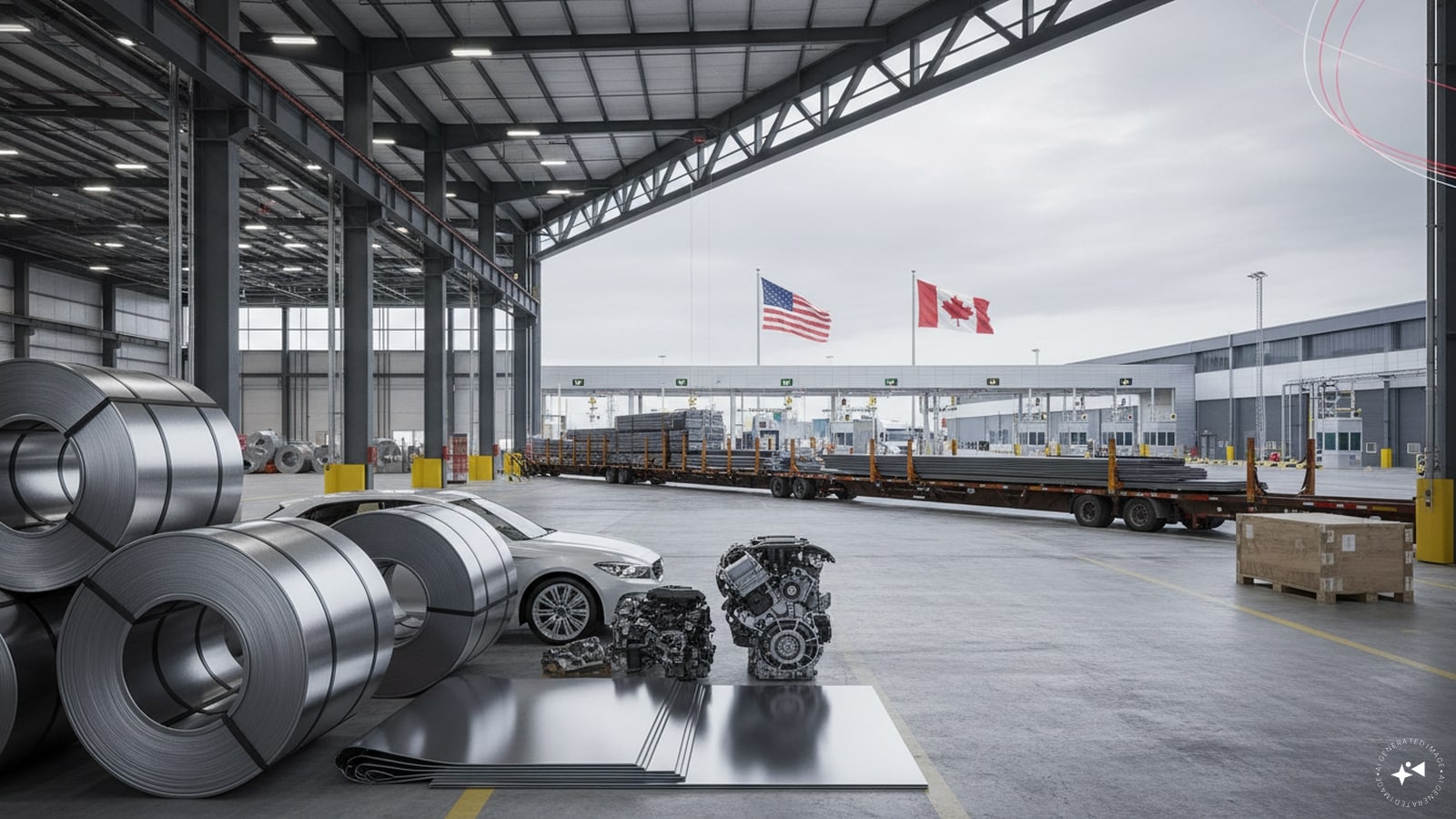
Bilateral trade negotiations between Washington and Ottawa to ease steel and automotive tariffs are not a routine diplomatic adjustment; they represent an emergency pressure-release valve for an integrated industrial base approaching structural failure. When two economies share an assembly line that crosses a border up to eight times before a final vehicle rolls off the lot, import duties function less like a protective wall and more like a compounding tax on domestic manufacturing. Understanding the mechanics of these negotiations requires stripping away political rhetoric and examining the underlying supply chain architecture, statutory trade mechanisms, and margin compression driving both governments back to the bargaining table.
The Structural Friction of Integrated Supply Chains
Modern North American manufacturing operates as a single, continuous production floor divided by a political boundary. Unlike transoceanic trade—where a finished good is produced in one jurisdiction and exported to another—the North American automotive and metals sectors rely on sequential value-addition. Raw iron ore or recycled scrap is melted in one country, rolled into specialized flat-rolled steel in another, stamped into body panels across the border, and finally mated to a chassis in a fourth location.
Under this architecture, tariffs violate the fundamental economic principle of comparative advantage and introduce severe deadweight loss. When the United States imposes Section 232 national security tariffs on Canadian steel, or threatens broad-based duties on Canadian-assembled vehicles, the financial penalty does not fall exclusively on foreign producers. Instead, it triggers a cascading cost-inflation event across the entire continental value chain.
Consider the mechanics of an automotive tier-one supplier. Operating on thin gross margins—typically between 6% and 10%—these firms cannot absorb a 10% to 25% tariff shock. They are forced to pass the cost downstream to Original Equipment Manufacturers (OEMs) through contractual price-adjustment clauses or force majeure declarations. OEMs, facing price-elastic consumers and elevated interest rates, cannot pass the full cost onto the retail buyer without destroying unit volume. The result is immediate capital expenditure freezes, delayed retooling for next-generation drivetrains, and production line stoppages.
Negotiations to ease these tariffs are driven by the mathematical reality that sustained trade friction between the United States and Canada degrades the global competitiveness of North American-built vehicles relative to Asian and European imports.
The Three Pillars of Bilateral Tariff Negotiations
To understand how Washington and Ottawa structure a tariff-easing agreement, one must analyze the three distinct operational mechanisms typically deployed in North American trade diplomacy. Any durable settlement relies on balancing domestic political constraints against industrial survival.
1. Tariff-Rate Quotas and Historical Baselines
A complete, unconditional elimination of tariffs is politically hazardous for an administration seeking to project industrial protectionism. The standard operational compromise is the Tariff-Rate Quota (TRQ). Under a TRQ framework, a predetermined volume of Canadian steel or automobiles enters the United States duty-free, while imports exceeding that ceiling face the full statutory tariff rate.
The critical variable in any TRQ negotiation is the baseline period used to calculate the duty-free volume.
- Pre-tariff historical averages favor the exporting nation, allowing normal commercial flows to resume without penalty.
- Post-tariff depressed volumes favor the importing nation, locking in a permanently reduced market share for the exporter.
- Market-share indexing ties the quota dynamically to total domestic consumption, ensuring that if US demand expands, Canadian producers can scale output proportionally without triggering punitive duties.
2. Rules of Origin and Melted-and-Poured Standards
The primary stated rationale for US tariffs on Canadian metals is not Canadian overcapacity, but transshipment—the fear that non-market economies, specifically China, will route subsidized steel through Canadian ports or perform minimal finishing work in Ontario to claim North American origin.
To resolve this, negotiators tighten the Rules of Origin (ROO) beyond the baseline requirements of the United States-Mexico-Canada Agreement (USMCA). In the steel sector, this takes the form of a strict melted-and-poured standard. For a steel product to qualify for tariff exemption, the raw steel must be initially produced in a blast furnace or electric arc furnace within North America. Downstream processing, such as cold-rolling or galvanizing in Canada, is insufficient if the substrate slab originated outside the bloc.
In the automotive sector, tariff relief is increasingly tethered to Regional Value Content (RVC) thresholds and specific component tracing. Negotiators demand verifiable digital supply chain audits proving that high-value subcomponents—such as battery cells, electric motors, and advanced semiconductors—meet strict North American sourcing mandates before granting duty-free transit.
3. Coordinated External Trade Defense
A bilateral deal to lower internal friction requires a unified external perimeter. Washington frequently conditions tariff relief for Ottawa on Canadian alignment with US trade enforcement against third-party nations. If the United States maintains a 25% tariff on foreign steel or a 100% tariff on foreign electric vehicles, Canada must mirror those external barriers to prevent trade diversion. Without synchronized external tariffs, foreign producers will flood the Canadian market, displacing Canadian domestic production and forcing Canadian mills to push their displaced volume south into the United States.
The Cost Function of Automotive and Steel Friction
The urgency behind these talks is best understood through the unit economics of vehicle manufacturing. Steel accounts for roughly 50% to 60% of the curb weight of an average internal combustion vehicle, and remains the primary structural material for electric vehicle enclosures and chassis components.
When tariffs distort steel pricing, two distinct economic effects occur simultaneously:
- Direct Input Inflation: Domestic US steel producers, insulated from Canadian competition by tariffs, raise their spot prices to sit just beneath the tariff-inclusive price of imported steel. This is classic economic rent-seeking. Consequently, US automakers pay inflated prices even when sourcing 100% domestic steel.
- Working Capital Trap: Tariffs must be paid at the port of entry upon customs clearance. For cross-border automotive suppliers shipping parts daily on a Just-In-Time (JIT) basis, tariffs tie up massive amounts of liquid working capital in customs bonds and duty payments, months before the finished vehicle is sold to a dealership.
The second limitation of prolonged tariff regimes is the disruption of long-term tooling investments. Automotive stamping dies and specialized aluminum-steel hybrid welding lines require capital commitments made three to five years ahead of a vehicle's model-year launch. Regulatory uncertainty surrounding cross-border tariffs forces capital allocation committees to pause North American plant expansions, shifting future model allocations to jurisdictions with predictable trade regimes.
Statutory Leverage and Executive Authority
Why do these negotiations occur through executive-level diplomacy rather than formal legislative channels? The answer lies in the statutory architecture of US trade law, which delegates sweeping, unilateral tariff authority to the executive branch.
- Section 232 of the Trade Expansion Act of 1962: Allows the President to impose tariffs or quotas on imports deemed to threaten national security. Because "national security" is broadly defined to include the economic health of domestic industries vital to defense, the executive branch can impose or lift steel tariffs overnight via presidential proclamation without Congressional approval.
- International Emergency Economic Powers Act (IEEPA): Grants the executive branch authority to regulate international commerce following a declaration of a national emergency, providing a rapid mechanism for broad-based tariff threats.
- USMCA Dispute Settlement Mechanisms: While the USMCA provides formal arbitral panels to adjudicate illegal tariffs, the litigation timeline spans 18 to 36 months. Industrial supply chains cannot survive three years of 25% margin compression while waiting for a legal ruling.
This statutory reality creates a profound asymmetry. The executive branch holds immediate, unilateral leverage to disrupt trade, forcing trading partners like Canada to negotiate concessions outside the formal dispute resolution framework of the USMCA. Ottawa's primary counter-leverage is targeted retaliatory tariffs—historically calibrated to hit politically sensitive US agricultural and manufacturing exports—combined with the systemic reality that US industrial output relies directly on Canadian raw materials, including primary aluminum, critical minerals, and specialized steel grades that US mills do not produce in sufficient volume.
Operational Limitations of Bilateral Tariff Deals
Even when Washington and Ottawa reach an agreement to ease steel and automotive tariffs, corporate supply chain leaders must recognize the inherent structural weaknesses of executive-brokered trade deals. Relying on these agreements as permanent fixtures introduces severe operational risk.
First, executive proclamations lack statutory permanence. A Tariff-Rate Quota or exemption framework established via executive action can be revoked, modified, or subjected to new "snap-back" provisions with minimal notice if political priorities shift or if import volumes breach arbitrary thresholds.
Second, compliance costs remain permanently elevated. To prove eligibility for tariff exemptions under tightened Rules of Origin, manufacturers must maintain granular, batch-level metallurgical certificates and customs documentation for every cross-border shipment. For a mid-sized automotive stamping plant executing hundreds of cross-border truckloads per week, the administrative overhead of customs compliance acts as a permanent non-tariff barrier, eroding the financial gains of the duty exemption itself.
Third, bilateral deals do not resolve underlying structural imbalances in global manufacturing. Easing friction between the US and Canada stabilizes the North American perimeter, but it does not automatically lower North American production costs to parity with state-subsidized Asian competitors. It merely removes a self-inflicted tax penalty, returning the industry to its baseline competitive challenges of high labor costs, energy transition expenses, and legacy pension obligations.
Tactical Positioning for Industrial Operators
Supply chain executives, procurement officers, and capital allocators operating within the North American industrial corridor cannot afford to treat bilateral tariff negotiations as a passive spectator sport. Waiting for final diplomatic communiqués leaves balance sheets exposed to sudden margin erosion.
Procurement teams must immediately audit all cross-border Bill of Materials (BOM) to identify every component subject to potential snap-back tariffs, mapping the exact country of melt-and-pour for all metallic inputs. Commercial contracts with upstream suppliers and downstream OEMs must be renegotiated to replace vague "force majeure" language with explicit, automated tariff pass-through clauses indexed to customs entry dates. Finally, capital allocation strategies should prioritize dual-sourcing architectures—establishing parallel tooling capabilities on both sides of the border—so production volumes can be dynamically shifted in response to regulatory volatility rather than remaining hostage to customs policy.