When a wildfire persists for thirty consecutive days, attaining a spatial footprint comparable to a populated municipality, the crisis shifts from an acute containment event to an entrenched systemic failure. Standard incident command protocols are designed for rapid operational closure. They rely on predictable fuel loads, standard weather windows, and immediate resource saturation.
A month-long combustion cycle breaks these assumptions. It exposes the structural friction between short-term tactical response models and multi-week operational attrition.
Analyzing an extended-duration wildfire requires discarding colloquial descriptions such as small-town sizing metrics. Those comparisons obscure the operational reality. Instead, analysts must examine three core vectors: the thermodynamics of persistent fuel consumption, the supply-chain degradation of suppression assets, and the economic friction of prolonged deployment.
Understanding why a fire sustains itself for a calendar month demands a breakdown of the variables governing thermal propagation over extended temporal scales.
The Thermodynamic Persistence Model
A fire that burns for thirty days does not represent a single continuous event. It functions as a dynamic, self-propagating system composed of shifting micro-climates, localized pyrolytic feedback loops, and varying fuel topographies.
In the initial phase of a wildfire, the spread rate is dictated by wind velocity, relative humidity, and immediate surface fuel moisture. When a fire crosses the thirty-day threshold, these primary meteorological drivers are frequently subordinated by deep-seated thermal inertia.
Subsurface Fuel Loading and Pyrolysis
The primary driver of multi-week persistence is the transition from surface combustion to subterranean and heavy-fuel consumption.
- Duff and Organic Soil Layers: Accumulated organic matter beneath the canopy holds moisture differently than surface litter. Over weeks of drought, this layer dries completely, creating a continuous bed for smoldering combustion.
- Large-Diameter Downed Wood: Logs exceeding twelve inches in diameter require prolonged heat exposure to drive off internal moisture before ignition. Once ignited, they act as thermal batteries. They radiate heat long after ambient temperatures drop and surface flames recede.
- Root Systems: Subsurface root networks provide continuous pathways for fire to travel undetected beneath containment lines, breaching defensive perimeters without surface manifestation.
These factors create an asynchronous burn rate. While tactical teams measure containment along the perimeter, the interior of the fire zone maintains thousands of localized ignition points. Each point acts as an independent heat source capable of reigniting surface fuels when atmospheric conditions shift.
Atmospheric Feedback Loops
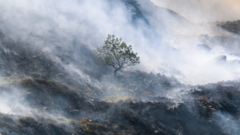
Prolonged combustion generates localized weather patterns that actively resist suppression efforts. Intense thermal columns create their own pyrocumulus clouds, which can collapse and generate erratic microbursts of wind.
These winds scatter embers across established containment lines, initiating spot fires up to a mile away from the primary front.
Furthermore, persistent smoke plumes reduce ambient solar radiation over the fire zone. While cooler surface temperatures theoretically assist suppression, the reduced visibility grounds aerial reconnaissance and retardant-dropping aircraft. This creates a critical operational blind spot precisely when tactical agility is most required.
The Operational Decay Function
The efficiency of emergency response organizations decays exponentially over time. This decline is not a failure of personnel discipline, but a structural inevitability driven by human physiology, equipment depreciation, and logistical strain.
Personnel Fatigue and Decision Fatigue
Firefighting is an intensely demanding physical endeavor executed under conditions of extreme cognitive load. Standard operational rotations—typically fourteen to twenty-one days—are pushed to their limits during extended campaigns.
As fatigue accumulates, cognitive bandwidth narrows. Personnel experience measurable declines in risk assessment accuracy and situational awareness.
- Tactical Myopia: Fatigued crews focus heavily on immediate local threats, losing sight of broader strategic shifts in the fire's behavior.
- Communication Breakdown: Information transfer between incoming relief shifts and exhausted outgoing leadership often suffers from compressed briefing windows.
- Injury Rates: The incidence of musculoskeletal injuries and heat-related illnesses increases non-linearly after the second week of continuous deployment.
Asset Attrition and Supply Chain Bottlenecks
Heavy machinery, specialized water tenders, and rotary-wing aircraft require rigorous, scheduled maintenance. In a thirty-day deployment, these assets operate far beyond their standard duty cycles without access to depot-level repair facilities.
Maintenance windows shrink, leading to higher rates of mechanical failure in the field. Simultaneously, consumable supplies—ranging from Class A foam and retardant slurry to basic hydration and caloric provisions for personnel—strain regional distribution networks.
When a crisis extends beyond standard planning horizons, supply chains shift from proactive provisioning to reactive triage. Critical components must be sourced from distant jurisdictions, introducing multi-day delays that jeopardize frontline tactical operations.
The Economic and Strategic Friction of Extended Deployment
The financial architecture of wildfire suppression is front-loaded. Budgets assume high-intensity, short-duration interventions. When a fire enters its fourth week, the cost function shifts from capital-efficient suppression to a linear accumulation of endurance expenses.
Marginal Return on Investment in Suppression
In the first week of a wildfire, every dollar spent on containment yields a high return in avoided property loss and environmental degradation. By week four, the marginal return on investment plummets.
The remaining uncontained perimeter typically occupies inaccessible terrain—steep canyons, heavy blowdown areas, or dense wilderness—where direct attack is impossible.
Resources are diverted to indirect containment strategies, such as backburning and bulldozer line construction, which require massive resource allocations for modest territorial gains.
The cost per acre of containment rises exponentially as the easiest perimeters are secured first, leaving the most complex logistical challenges for the end of the campaign.
Opportunity Cost across Regional Jurisdictions
Extended deployments create severe regional vulnerabilities. When elite interagency hotshot crews and specialized aviation assets are tied down for a month on a single incident, surrounding jurisdictions are stripped of their initial-attack capabilities.
A secondary ignition elsewhere in the region, which would normally be suppressed within hours, can expand unchecked because the primary response capacity is locked in a prolonged stalemate.
This creates a systemic cascade effect. The optimization of resources for one prolonged event increases the systemic risk of catastrophic failures across the broader geographical theater.
Strategic Realignment for Long-Duration Events
Addressing fires that persist for months requires a fundamental shift in institutional design. Emergency management agencies must transition from an episodic response model to a continuous campaign framework.
First, tactical rotation models must be decoupled from the duration of the fire. Automated, mandatory force rotations must be enforced regardless of perimeter status to prevent the cognitive and physiological decay of leadership elements.
Second, logistical infrastructure must be modularized. Rather than relying on fragile, ad-hoc supply chains, extended deployments require pre-positioned logistical hubs equipped with mobile maintenance and heavy-repair capabilities capable of servicing equipment directly in the field.
Finally, risk communication and strategic objective setting must evolve. When a fire reaches a thirty-day duration, traditional metrics like containment percentages lose their analytical utility.
Decision-makers must replace these metrics with volumetric thermal output tracking, assessing success not by the presence of a scraped dirt line, but by the systematic reduction of interior heat capacity and fuel load exhaustion.
The transition from emergency response to sustained operational management is the defining challenge of modern crisis logistics. Until institutional frameworks reflect this reality, extended wildfires will continue to outpace the structures designed to stop them.