Urban surface transit networks operate under strict spatial optimization principles. When a 15-tonne double-decker bus interacts with a 200-kilogram motorcycle, the structural outcome is dictated entirely by kinetic energy transfer differentials and spatial layout design.
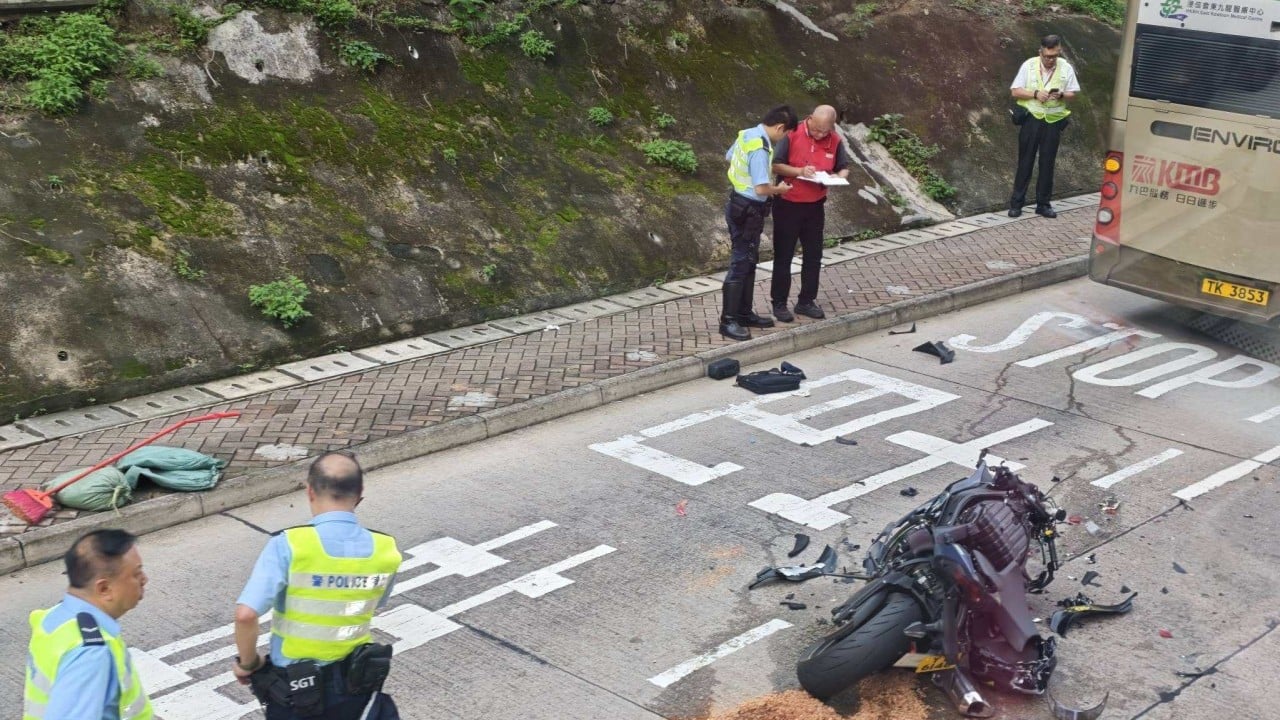
A stark baseline reality illustrates this friction: on June 20, 2026, a fatal rear-end collision occurred on New Clear Water Bay Road in Sau Mau Ping, Hong Kong, involving a Kowloon Motor Bus (KMB) double-decker vehicle operating on route 290A and an approaching motorcycle. The operational mechanics of this incident expose a severe failure rate at the intersection of heavy mass transit stopping profiles and high-velocity two-wheeler pathing.
Understanding this dynamic requires breaking down the transit environment into engineering variables rather than treating collisions as isolated pieces of misfortune.
The Kinematics of Asymmetrical Mass Interaction
The physics governing a collision between a mass transit vehicle and a light vehicle can be modeled through momentum conservation and kinetic energy dissipation.
A standard double-decker bus, fully loaded with passengers, possesses a gross vehicle weight ranking (GVWR) of approximately 15,000 to 18,000 kilograms. A standard commuter motorcycle, including rider mass, averages roughly 250 kilograms. This represents a mass asymmetry ratio of up to 72:1.
When the KMB bus decelerated and occupied a stationary position at the designated bus stop outside the Shun Lee Disciplined Services Quarters near the Church of Christ in China Kei Shun Special School, its kinetic energy dropped to zero. The trailing motorcycle, reported to be traveling at high velocity, carried kinetic energy calculated by the standard formula:
$$E_k = \frac{1}{2}mv^2$$
Where $m$ is the mass of the motorcycle and rider, and $v$ is the velocity vector. Because velocity is squared, an increase in speed exponentially raises the impact energy. Upon striking the right rear quadrant of the stationary double-decker bus, the deceleration window for the motorcycle was near-instantaneous.
The structural rigidity of a double-decker bus chassis is designed to withstand severe impacts to protect the high-occupancy passenger cabin. This design leaves the rear steel framework completely unyielding to ultra-low-mass vehicles.
Because the bus did not deform significantly, the entirety of the kinetic energy transferred directly back into the crumple zones of the motorcycle and, consequently, the body of the rider. This deceleration force triggered an immediate vector change, throwing the rider clear of the vehicle and causing multiple internal and deceleration injuries upon pavement impact.
The Three Pillars of Transit Stop Vulnerability
To systematically analyze why this specific zone on New Clear Water Bay Road became a point of systemic failure, the situation must be dissected into three distinct operational variables.
1. Spatial Obstruction and Lane Geometry
Bus stops on arterial roads like New Clear Water Bay Road create temporary localized bottlenecks. When a double-decker bus stops to exchange passengers, it changes the active road geometry. If the bus bay lacks sufficient depth to fully isolate the vehicle from the main transit lane, the right rear corner of the bus hangs into the active flow of traffic. This creates a critical infrastructure blind spot where trailing motorists must rapidly execute lateral lane changes.
2. Sightline Topology and Perception Drift
Human processing speeds scale poorly against compounding velocity. At a high speed, the available time window to differentiate between a moving bus and a stationary bus drops significantly. This perceptual lag is called "closure rate misjudgment." Trailing drivers assume ahead-vehicles are maintaining cruising speeds until the distance drops below a threshold where braking distance exceeds the actual clearance space.
3. Energy Capture Disparity
The structural design profiles of both vehicles are fundamentally mismatched.
- Bus Engineering Priorities: Structural integrity focuses on rollover protection, side-impact reinforcing bars, and heavy lower-chassis beams to shield up to 130 passengers.
- Motorcycle Engineering Priorities: Weight reduction for fuel efficiency and maneuverability, relying entirely on secondary rider gear (helmets, padded armor) to absorb impact forces.
The secondary impact—the rider hitting the asphalt after being thrown—often introduces equal or greater deceleration trauma than the primary impact with the vehicle frame.
Operational Bottlenecks in Crash Survival Rates
The sequence following the crash highlights a critical timing constraint in urban trauma response systems. Emergency reports were triggered at approximately 4:00 PM. Paramedics stabilized the unconscious victim and initiated transport to United Christian Hospital in Kwun Tong.
In clinical trauma medicine, this timeline is governed by the "Golden Hour" principle, which dictates that definitive surgical intervention must occur within 60 minutes of severe deceleration trauma to prevent systemic shock and internal exsanguination.
The operational bottleneck here is not merely traffic density delaying the ambulance, but the biological threshold of rapid deceleration injuries. When a human body transitions from high velocity to a dead stop against a rigid object, internal organs continue moving forward within the thoracic and cranial cavities. This causes severe vascular shearing and traumatic brain injuries that often prove fatal before surgical triage can begin, regardless of transit response efficiency.
Infrastructure Engineering Realities
A standard policy response to such incidents often leans on introducing driver warnings or reducing speed limits. However, these solutions fail to fix the core structural design vulnerabilities of mixed-use transit corridors.
The primary limitation of existing urban arterial designs is the reliance on shared-lane configurations where heavy passenger vehicles and high-velocity light vehicles occupy identical spatial paths. To eliminate this systemic risk, urban planners face a hard choice between major capital expenditure and structural throughput efficiency.
The most effective physical mitigation strategy is the construction of fully recessed, grade-separated bus bays that remove decelerating mass transit units completely out of the lateral path of traveling traffic. The secondary strategy requires implementing active, automated infrastructure-to-vehicle (I2V) radar systems at high-speed bus stops. These systems broadcast real-time stop-state metrics to incoming digital dashboards on trailing vehicles, shifting the burden of hazard detection from human sightlines to automated sensors.
Without these structural interventions, the physical realities of mass asymmetry and kinetic energy distribution will continue to produce fatal outcomes whenever these two vehicle profiles occupy the same space.