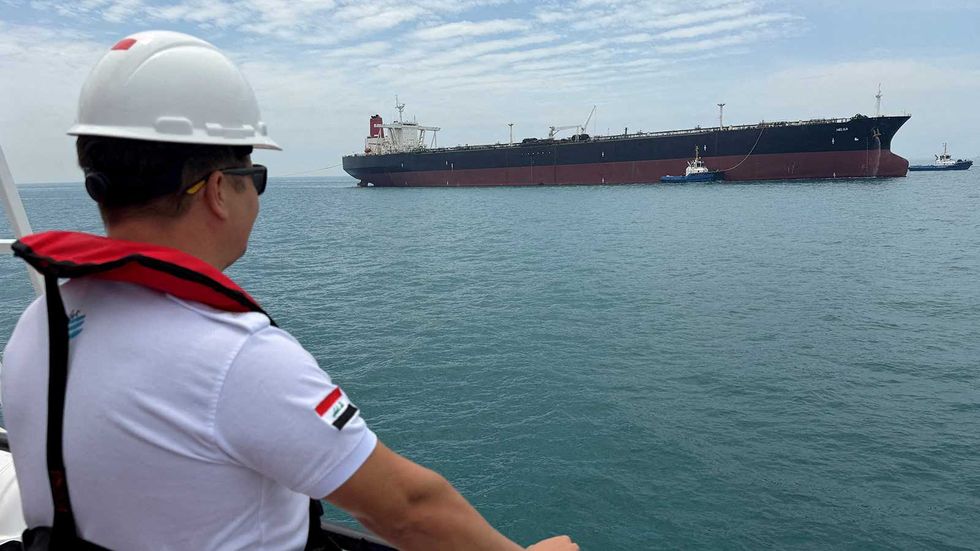
The transformation of international maritime safety frequencies into theaters of profane, unmoderated psychological warfare reveals a structural breakdown in global trade governance. In July 2026, the public VHF radio waves of the Strait of Hormuz became the primary medium for a high-stakes geopolitical stand-off. When United States military transmitters broadcasted declarations that the shipping lane remained open, they were met with immediate, crude mockery from Iranian Islamic Revolutionary Guard Corps (IRGC) naval operators. Far from minor diplomatic friction, this radio warfare is a calculated tactical mechanism designed to manipulate the financial and physical realities of international shipping.
When states resort to open-frequency shouting matches, they are targeting the invisible infrastructure of global commerce: the risk calculators, maritime insurance underwriters, and merchant ship masters who must decide whether to transit a chokepoint that handles approximately 20 percent of the world’s petroleum liquids.
The Geography of Risk and the Dual Route Conflict
To understand why a radio transmission can halt a supertanker, one must map the exact physical and legal constraints of the Strait of Hormuz. The passage is not a wide-open sea; it is a highly restricted, 21-mile-wide choke point divided into incoming and outgoing shipping lanes, each only two miles wide, separated by a two-mile buffer zone.
[Persian Gulf] <---> [Northern Route (Iranian Waters)] <---> [Gulf of Oman]
             <---> [Southern Route (Omani Waters)]   <--->
Under the United Nations Convention on the Law of the Sea (UNCLOS), foreign vessels enjoy the right of "transit passage" through such straits solely for continuous and expeditious transit. However, the physical shipping lanes are split into two distinct operational vectors:
- The Northern Route: Transiting directly through Iranian territorial waters. This route is highly vulnerable to physical interdiction, boarding, and sea-mine placement by the IRGC.
- The Southern Route: Running closer to Omani territorial waters. This is the corridor where the U.S. military provides active naval escort and navigation assistance.
Following a series of projectile attacks on neutral tankers, including the targeting of United Arab Emirates vessels in the southern corridor, the U.S. Central Command initiated a naval blockade of Iranian ports while simultaneously broadcasting that the "southern route remains open."
The Iranian response—broadcasting warnings that the entire Strait is closed and that any unauthorized transit will result in destruction—creates a state of absolute legal and physical ambiguity. By asserting that the southern route is a fiction, Iranian operators force commercial ship captains to make a binary, high-risk choice under conditions of degraded GPS reliability and active electronic jamming.
The Insurance Cost Function of Public Rhetoric
Commercial shipping does not operate on military bravado; it operates on capital efficiency. The ultimate target of both American declarations of "openness" and Iranian threats of "destruction" is the London insurance market, specifically the Lloyd’s Joint War Committee (JWC).
War risk premiums are calculated dynamically based on perceived threat levels. Under normal operating conditions, these premiums are a negligible fraction of transit costs. During active hostilities, they can rise to over 1% of the total hull value per transit. For a modern Very Large Crude Carrier (VLCC) valued at $120 million carrying $100 million of crude oil, a single transiting war risk premium can exceed $2 million.
We can model the financial decision-making process of a vessel owner using a basic cost function:
$$C_{transit} = C_{base} + [P(attack) \times L_{total}] + P(seizure) \times C_{detention}$$
Where:
- $C_{transit}$ is the total cost of executing the voyage.
- $C_{base}$ is the standard operational cost (fuel, crew, standard insurance).
- $P(attack)$ is the subjective probability of a kinetic attack, heavily influenced by active warnings on maritime radio.
- $L_{total}$ is the total financial loss of hull, cargo, and crew liabilities.
- $P(seizure)$ is the probability of a vessel being boarded and detained in an Iranian port.
- $C_{detention}$ represents the daily compounding cost of a stranded vessel, crew, and delayed cargo.
When the U.S. military broadcasts that the southern route is open, it attempts to drive $P(attack)$ and $P(seizure)$ down in the minds of underwriters, preserving the viability of the shipping lane. Conversely, when the IRGC fills the airwaves with profanity, threats, and claims that the "key is lost" to the Strait, they are intentionally spiking the subjective variables in the cost equation.
If the cost of transit exceeds the marginal profit of the cargo, shipping companies will choose to anchor their fleets in the Indian Ocean or the Gulf of Oman rather than risk entering the Persian Gulf. The physical blockade is thus achieved virtually, without the IRGC having to fire a single anti-ship missile.
The Breakdown of VHF Channel 16 as an Operational Vulnerability
International maritime safety relies on VHF Channel 16 (156.8 MHz), the designated international calling and distress frequency. Every ship at sea is legally mandated to maintain a continuous watch on Channel 16 to receive distress alerts, collision warnings, and vital navigational safety information.
The weaponization of this frequency by military actors represents an unprecedented degradation of maritime safety protocols. In typical operations, VHF communication is highly structured, brief, and professional, using standard marine communication phrases to overcome language barriers.
The escalation to highly politicized, profane verbal skirmishes over this channel introduces three operational vulnerabilities for civilian mariners:
1. Signal Masking and Emergency Blocking
VHF line-of-sight communication operates on a "capture effect" where the strongest signal dominates, or multiple signals of similar strength block each other entirely, creating an unmodulated squeal. When state actors use high-powered naval transmitters to exchange insults or broadcast competing political proclamations, they physically block actual Mayday distress calls from civilian vessels in active danger.
2. Navigational Spoofing and Misdirection
The broadcasting of conflicting coordinates and legal threats makes it impossible for shipmasters to verify legitimate navigational warnings. When an IRGC station broadcasts that a specific sector is mined, while a U.S. destroyer simultaneously broadcasts that the sector is clear, the civilian crew has no empirical method to verify the physical safety of their route.
3. Spoofed Identity and Electronic Deception
Because VHF radio lacks cryptographic authentication, any station can transmit under any callsign. This allows bad actors to impersonate naval commands, issuing false orders to redirect commercial vessels into hostile territorial waters where they can be seized under the guise of maritime law violations.
Strategic Playbook for Shipping Consortia and Naval Commands
The current crisis requires a transition away from reactive, verbal posturing toward structured, resilient protocols that remove human emotion and subjective risk from the equation.
Implementation of Cryptographic Maritime Identity (CMI)
The international community must rapidly deploy authenticated digital voice and data channels for maritime safety. Relying on unencrypted, open-analog VHF for high-stakes security declarations is an obsolete practice. Navigational warnings must be transmitted via authenticated satellite networks (such as Inmarsat or Iridium) using public-key cryptography to prevent spoofing and radio-frequency hijacking.
The Decoupling of Security and Commercial Tolls
Proposals to charge a 20% security toll on transiting cargo to fund naval protection operations present a dangerous precedent. Such measures legally muddy the waters, transforming a state-led freedom of navigation operation into a commercial escort service. This fuels the adversarial narrative that the Strait is a rent-extraction zone rather than an international waterway, further driving up insurance premiums.
Fleet Dispersion and Redirection Mechanics
Shipping companies must establish clear financial trigger points for route redirection. Rather than waiting for a physical closure, fleets must utilize automated risk-indexing software. If the subjective war risk premium ($P(attack) \times L_{total}$) exceeds the cost of a 10-day detour around the Cape of Good Hope, vessels should automatically be rerouted at the port of origin, neutralizing the economic leverage of localized chokepoint intimidation.