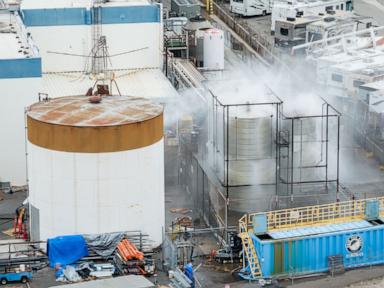
When an industrial chemical threat triggers a mandatory evacuation, the official declaration that an area is safe for re-entry rarely aligns with the psychological and economic stabilization of the affected community. The gap between technical containment and community repatriation is governed by measurable vectors of risk perception, economic friction, and systemic communication failures. Media narratives frequently reduce these events to a simple binary of danger and safety. A rigorous operational analysis reveals that a chemical tank crisis operates as a multi-tiered system where physics, engineering, and human behavior intersect.
Evaluating the lifecycle of a chemical containment threat requires breaking down the event into three distinct phases: the structural destabilization of the asset, the execution of the exclusion zone, and the tail-risk of community repatriation.
The Mechanics of Chemical Tank Destabilization
Industrial chemical storage tanks compromise through specific thermodynamic or structural pathways. To understand the threat that forces an evacuation, one must isolate the variables controlling the containment vessel's integrity.
Thermal Runaway and Pressure Dynamics
When a chemical storage vessel undergoes an unexpected chemical reaction, polymerisation, or external heating, the internal pressure climbs exponentially. The critical vulnerability lies in the relationship between the maximum allowable working pressure (MAWP) of the tank and the rate of pressure generation.
- Vapor Generation: As temperature increases, the liquid phase transitions to gas, increasing volume within a fixed space.
- Venting Capacity: If the volumetric flow rate of the generation exceeds the discharge capacity of the pressure relief valves (PRVs), structural failure becomes inevitable.
- BLEVE (Boiling Liquid Expanding Vapor Explosion): If the tank contains a pressurized liquid above its boiling point and the shell breaches, the sudden drop in pressure causes instantaneous flashing of the liquid into vapor, resulting in a catastrophic blast wave and potential fireball.
Structural Integrity and Chemical Degradation
Apart from thermodynamic events, containment failure can stem from chronic asset degradation that reaches a tipping point. This includes localized corrosion, stress corrosion cracking, or mechanical fatigue from cyclic loading. When stress concentration factors exceed the yield strength of the tank material, catastrophic unzipping occurs, releasing the entire inventory into secondary containment or beyond.
The Calculus of Exclusion Zones
Civil authorities and incident command structures establish evacuation boundaries using quantitative plume modeling and blast radius calculations, rather than arbitrary geographic markers.
Toxic Plume Modeling
The deployment of tools like the Computer-Aided Management of Emergency Operations (CAMEO) suite and ALOHA (Areal Locations of Hazardous Atmospheres) dictates the initial footprint of an evacuation. The model ingests specific parameters:
- Source Strength: The mass release rate of the chemical over time.
- Aqueous Chemistry: The volatility, molecular weight, and vapor pressure of the compound.
- Meteorological Conditions: Wind speed, atmospheric stability class (Pasquill-Gifford parameters), ambient temperature, and relative humidity.
The exclusion boundary is drawn where the predicted outdoor concentration falls below specific threshold values, such as Acute Exposure Guideline Levels (AEGLs) or Emergency Response Planning Guidelines (ERPGs). Specifically, AEGL-2 defines the airborne concentration of a substance above which it is predicted that the general population could experience irreversible or other serious, long-lasting adverse health effects or an impaired ability to escape.
Blast and Fragmentation Radii
In scenarios involving explosive risks, the exclusion zone accounts for overpressure waves. A peak overpressure of 1.0 psi will shatter standard windows and cause minor injuries, while 5.0 psi causes structural collapse of residential buildings. Incident commanders set evacuation perimeters at the distance where the predicted overpressure drops below 0.5 to 1.0 psi, integrating a safety factor to protect civilian life from flying debris and structural failure.
The Friction of Community Repatriation
The lifting of an evacuation order signals that the immediate physical threat has been mitigated—the tank is cooled, stabilized, or emptied. However, the operational process of returning residents to their homes exposes a secondary layer of systemic challenges.
The Asymmetry of Risk Assurance
A core friction point during repatriation is the informational asymmetry between incident command metrics and public perception. While engineers verify stability through thermal imaging, pressure transducers, and zero-ambient VOC (Volatile Organic Compound) readings, residents evaluate safety through sensory inputs (smell, visible smoke) and institutional trust.
This divergence creates a measurable lag in community stabilization. If a facility has a history of compliance infractions or poor communication, the public views the declaration of safety with skepticism. The psychological footprint of the event outlasts the physical hazard because risk perception is inversely proportional to the perceived control over the risk source.
Residual Environmental Contamination
Even when a tank is secured, the surrounding environment may retain trace contaminants that present long-term exposure pathways.
- Soil Vapor Intrusion: Volatile chemicals spilled during a containment crisis can migrate through the soil matrix and penetrate residential basements or crawl spaces, elevating indoor air pollution levels long after the outdoor air clears.
- Surface Adsorption: Porous building materials, vegetation, and soil can adsorb chemical vapors during the peak of the release and slowly desorb them over days or weeks, creating localized pockets of low-level exposure.
- Deposition on Agriculture: For rural or semi-rural areas, the settling of chemical particulates or aerosols onto crops and soil introduces risks to the local food supply chain, necessitating agricultural testing before economic activity can resume.
Infrastructure and Economic Strain of Displacement
Evacuations incur compounding costs that degrade the economic resilience of both households and local governments. Industrial operators face acute liability, but the immediate financial friction is distributed across the community.
Municipal Resource Depletion
The operational cost of maintaining an exclusion zone drains municipal budgets through several vectors. Emergency services must sustain continuous shifts for police, fire, and medical personnel to secure the perimeter and prevent looting. Public transit systems are disrupted, and emergency shelters require staffing, catering, and medical support. These unbudgeted expenditures distort municipal fiscal planning, often requiring emergency declarations to access state or federal contingency funds.
Household Economic Disruption
For displaced residents, the financial impact of an evacuation behaves as a regressive tax, disproportionately penalizing hourly wage earners and low-income families.
| Cost Category | Operational Impact | Economic Consequence |
|---|---|---|
| Direct Out-of-Pocket | Lodging, fuel, food, emergency childcare | Immediate depletion of liquid savings |
| Income Disruption | Inability to access workplaces within or near the exclusion zone | Lost wages for non-salaried employees |
| Business Interruption | Forced closure of small businesses within the zone | Supply chain breaks, lost revenue, inventory spoilage |
De-risking Future Containment Incidents
Mitigating the systemic shock of chemical containment threats requires industrial operators and municipal planners to shift from reactive crisis management to predictive asset optimization and structured community integration.
Implementation of Fixed Continuous Monitoring Networks
Relying solely on mobile monitoring units during a crisis introduces data collection delays. Industrial facilities handling hazardous materials must deploy permanent, fence-line monitoring arrays equipped with photoionization detectors (PIDs), open-path Fourier-transform infrared (FTIR) spectroscopy, and electrochemical sensors. This hardware must feed real-time data directly to a publicly accessible dashboard, stripping away the information lag that fuels community anxiety during an incident.
Upgrading Asset Lifecycle Management
Storage infrastructure must incorporate redundant, passive safety systems that operate independently of human intervention or external power supplies.
- Runaway Reaction Inhibition: Automated injection systems that introduce chemical inhibitors or catalysts termination agents when internal temperatures cross a critical threshold.
- High-Capacity Emergency Dump Tanks: Gravity-fed, sub-grade containment vessels capable of rapidly receiving the entire liquid volume of a compromised tank, isolating the material from atmospheric exposure or thermal stress.
- Advanced Metallurgy and Cathodic Protection: Continuous acoustic emission testing to detect micro-fractures before they propagate into structural failure, paired with upgraded cathodic protection systems to eliminate localized corrosion hot spots.
Formalization of Tri-Party Communication Frameworks
The breakdown in community trust during repatriation stems from fragmented messaging. Municipalities must establish a formalized tri-party communication protocol linking the industrial operator, local emergency management agencies, and independent third-party environmental auditors.
When a repatriation order is issued, it must be accompanied by a unified data packet containing the precise engineering metrics that justify the decision, the independent verification of air and soil safety, and a clear, step-by-step remediation guide for residents addressing potential residual issues like soil vapor or surface deposition. This replaces vague institutional assurances with verifiable, structured evidence.