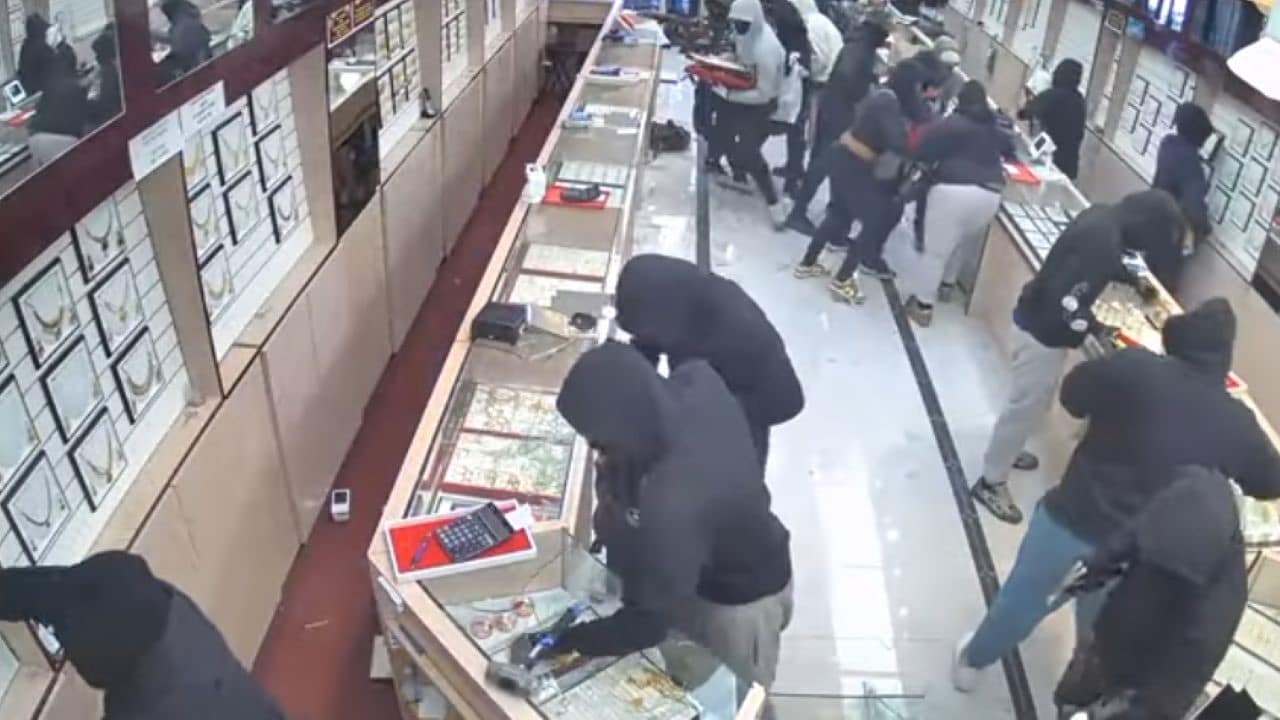
The execution of a ₹16 crore jewellery theft in a 70-second window is not a feat of luck; it is a clinical exploitation of the "Response Gap." This gap represents the temporal deficit between the initiation of a security breach and the arrival of a deterrent force. When the duration of a crime is shorter than the minimum possible response time of law enforcement or private security, the physical security of the assets relies entirely on on-site denial systems. In this instance, the failure was not a lack of surveillance, but a lack of active mitigation.
The Calculus of the 70-Second Breach
To understand how ₹16 crore (approximately $1.9 million USD) in inventory can be liquidated from a physical storefront in just over a minute, we must examine the heist through the lens of operational efficiency. The perpetrators treated the retail floor as a high-density extraction zone, utilizing a three-stage workflow:
- Entry and Dominance (T+0 to T+15): The immediate suppression of store staff and any existing security personnel. By using masks and brandishing weapons, the attackers achieve psychological "total-lockdown," preventing the activation of silent alarms or the deployment of manual deterrents during the most critical seconds.
- Systemic Extraction (T+15 to T+60): The physical clearing of display cases. This stage relies on the vulnerability of standard tempered glass. Without ballistic or high-impact resistant glazing (laminated polycarbonate layers), glass remains a negligible barrier.
- Egress and Dissipation (T+60 to T+70): The transition from the high-risk hot zone to a pre-arranged mobile perimeter.
The success of this timeline suggests a pre-calculated "Smash and Grab" coefficient, where the value of the goods per second of exposure justifies the risk of daylight operation.
The Failure of Passive Surveillance
Most high-value retail environments over-invest in passive surveillance (CCTV) while under-investing in active denial systems. CCTV serves two functions: post-incident forensic analysis and psychological deterrence. In the case of masked professional units, the deterrence value drops to zero.
The forensic value is also limited if the egress route utilizes "cold" vehicles—stolen or untraceable transport—and the perimeter is breached before a digital dragnet can be established. The core structural flaw here is the Observation-to-Action Lag. If a camera records a crime in high definition but does not trigger an immediate, automated physical barrier, it is merely documenting a loss rather than preventing one.
The Missing Layers of the Defense-in-Depth Model
A robust security architecture for high-density wealth environments requires a "Defense-in-Depth" strategy. This model assumes the perimeter will be breached and focuses on delaying the intruder at every subsequent layer to extend the heist duration beyond the Response Gap.
- Layer 1: Structural Resistance. Most jewellery stores prioritize aesthetics, using thin-frame glass. High-velocity heists are neutralized by UL 752 Level 1-3 bullet-resisting glazing or specialized security laminates that require repeated, sustained force to penetrate, effectively breaking the 70-second extraction timeline.
- Layer 2: Obscuration Systems. The deployment of thermally activated security fog (smoke screens). Within 5 to 10 seconds of a sensor trip or panic button activation, these systems reduce visibility to less than 30 cm. If an attacker cannot see the product, they cannot extract it.
- Layer 3: Modular Asset Protection. High-value items should be housed in cases equipped with "drop-safe" mechanisms—internal trays that retract into a reinforced floor vault upon alarm activation.
Economic Incentives and Black Market Fluidity
The speed of this theft indicates a sophisticated understanding of the "liquidity of stolen assets." Jewellery, unlike electronics or serialized luxury watches, can be rapidly dismantled.
The primary value drivers in a ₹16 crore haul are the raw materials: gold and loose stones.
- Gold Smelting: Gold can be melted down within hours, erasing all hallmarks and origins. This transforms a traceable asset into a fungible commodity that can be re-integrated into the legal market with near-zero friction.
- Diamond Decoupling: Large stones are easily removed from their settings. While GIA-certified diamonds have laser inscriptions, these can be polished off at a negligible loss of carat weight, or the stones can be moved to international markets with lower regulatory oversight.
This rapid "wash cycle" means that the window for recovery is even narrower than the window for apprehension. Once the physical form of the jewellery is altered, the evidentiary chain is broken.
The Fragility of Modern Retail Floor Plans
Architectural trends in luxury retail favor open-plan layouts with minimal physical obstructions. This design philosophy maximizes customer flow and product visibility but creates a "low-friction" environment for criminals.
The lack of Mantrap Portals—interlocking doors that require the first to close before the second opens—is a significant vulnerability. While mantraps can impede the customer experience, they are the only reliable method for controlling the rate of egress. In high-stakes environments, the trade-off between "hospitality" and "security" has tilted too far toward the former, leaving stores structurally incapable of mounting a defense against high-velocity incursions.
Quantifying Risk via the Probability of Interdiction
For a retailer, the risk is a function of:
$$Risk = (Asset Value \times Vulnerability) - (Countermeasure Effectiveness)$$
In the ₹16 crore heist, the vulnerability was maximized by the 70-second execution time. If the local police response time is 5 minutes (300 seconds), the probability of interdiction is effectively 0% unless the store can artificially extend the "crime duration" by at least 230 seconds through physical delays.
The current industry standard of relying on a single armed or unarmed guard at the entrance is a "single point of failure." If that guard is neutralized in the first 5 seconds, the entire security budget spent on that guard is invalidated for the remainder of the event.
Strategic Hardening of High-Value Assets
To prevent the recurrence of 70-second extractions, the retail strategy must shift from "Detection and Reporting" to "Delay and Denial."
- Time-Lock Display Cases: Implementing hardware that prevents cases from being opened, even with a key, during certain hours or during an alarm state.
- IoT-Linked Asset Tracking: Micro-GPS or RFID tags embedded in high-value pieces. While these can be shielded by "Faraday bags" used by sophisticated thieves, they provide a secondary layer of tracking if the thieves are forced to move quickly and sloppily.
- Biometric Triggering: Panic alarms should not be limited to hidden buttons under a desk. Wearable triggers or AI-driven "anomaly detection" software—which identifies aggressive movements or the drawing of a weapon via the CCTV feed—can shave 10 to 15 seconds off the alarm notification time.
The 70-second heist is a signal that the traditional "guarded box" model of retail security is obsolete. The evolution of criminal tactics toward hyper-efficiency requires a corresponding shift toward automated, physical denial-of-service. Retailers must treat their floor space not just as a showroom, but as a hardened logistical node. Failure to integrate active delay mechanisms ensures that the Response Gap will continue to be exploited by any unit capable of basic temporal coordination.
Direct investment should be diverted from high-resolution recording toward impact-resistant glass and rapid-deployment obscuration systems. This creates a physical bottleneck that forces the attacker to choose between a failed extraction or a prolonged engagement—the latter of which significantly increases their risk of capture.