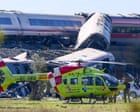
High-speed rail systems operate on razor-thin margins of error where kinetic energy scales with the square of velocity, turning minor signaling anomalies or human oversights into catastrophic structural failures. When a collision occurs on a high-speed corridor in Spain, the resulting casualty figures—such as 68 fatalities and dozens of severe injuries—are rarely the product of a single broken part. Instead, they represent the simultaneous alignment of latent organizational weaknesses, signaling transition gaps, and kinetic physics. Standard live-blog coverage of rail disasters captures the immediate human toll and emergency response timelines, yet it routinely obscures the systemic engineering and operational mechanics that allow two multi-ton railsets to occupy the same block of track. Understanding how modern European rail infrastructure fails requires stripping away sensationalist reporting and examining the precise failure modes of train protection systems, track geometry, and emergency triage protocols.
The Physics of Kinetic Energy and Structural Survivability
To understand why high-speed rail collisions produce sudden, massive fatality spikes, one must first examine the governing physics of rail transport. Kinetic energy ($E_k$) is defined by the equation $E_k = \frac{1}{2}mv^2$, where $m$ is mass and $v$ is velocity. A standard high-speed trainset weighs roughly 400 to 500 metric tons. Doubling the operating speed from 100 km/h to 200 km/h does not double the destructive energy released during an impact; it quadruples it. At 250 km/h or higher, the energy dissipation required during a sudden deceleration exceeds the structural yield limits of conventional rolling stock.
Modern railcar design relies on Crash Energy Management (CEM) principles. Rather than building rigid, indestructible boxes—which would transmit fatal deceleration forces directly to passengers—engineers design sacrificial crumple zones at the ends of each carriage. These zones are engineered to deform predictably, absorbing kinetic energy and preventing telescoping, the phenomenon where one railcar overrides the chassis of another and slices through the passenger compartment.
However, CEM systems have strict operational ceilings. They are typically rated to protect passenger survival spaces in head-on collisions up to closing speeds of roughly 36 to 50 km/h, or rear-end collisions at similar speed differentials. When a signaling failure or braking omission results in a high-speed impact, the closing velocity overwhelms the sacrificial deformation zones within milliseconds. Once the crumple zones bottom out, the remaining kinetic energy transfers directly into the passenger survival cells, causing structural buckling, lateral derailment, and secondary impacts against trackside infrastructure. The ratio of fatalities to injuries in any rail disaster is largely determined in the first 200 milliseconds by whether the closing speed remained within the CEM envelope.
Signaling Architectures and the Transition Vulnerability
Spain operates one of the most extensive high-speed rail networks in the world, managed primarily by the state infrastructure administrator, Adif. To prevent collisions, modern networks rely on Automatic Train Protection (ATP) systems designed to override human error. In Spain, two primary systems govern high-speed and transitional corridors:
- ERTMS (European Rail Traffic Management System): Specifically ETCS Level 1 and Level 2, which provide continuous or semi-continuous speed supervision, calculating braking curves in real time and automatically applying emergency brakes if a train exceeds the permitted speed profile or approaches an occupied block.
- ASFA (Anuncio de Señales y Frenado Automático): A legacy national system that relies on trackside beacons (balises) to transmit signal aspects to the cab. While effective at enforcing speed limits at specific points, traditional ASFA does not provide continuous speed-curve monitoring between beacons.
A critical vulnerability in rail operations occurs at signaling transition zones—sections of track where a train moves from a high-speed corridor equipped with continuous ETCS supervision onto a conventional or mixed-use line governed by legacy systems like ASFA, or where track maintenance requires temporary speed restrictions and manual block authorization.
The Three Pillars of Signaling Failure
When a collision occurs despite multiple layers of automated protection, root-cause investigations typically trace the failure to one of three systemic breakdowns:
- Supervision Mode Downgrades: If an onboard ETCS computer experiences a fault, or if trackside infrastructure is undergoing maintenance, operational rules often permit the train to downgrade to a lower supervision mode (such as Staff Responsible mode or legacy ASFA). In these degraded modes, the system shifts the primary burden of collision avoidance from automated software back to the human driver's visual adherence to lineside signals.
- Block Occupancy Detection Errors: Track circuits and axle counters are used to detect whether a section of track (a block) is occupied. Contamination on the railhead (such as rust, leaves, or grease), electrical interference, or improper reset procedures following maintenance can cause a "false clear" indication, tricking the interlocking logic into routing a second train into an occupied block.
- Braking Curve Miscalculations: High-speed trains require immense distances to come to a complete stop—often exceeding 3 to 4 kilometers depending on gradient and rail adhesion. If a speed restriction or stop aspect is communicated too late, or if wet/contaminated rails reduce the coefficient of friction between steel wheels and steel rails, the train's actual stopping distance will exceed the system's calculated braking curve.
Deconstructing the Human-Machine Interface
Live news updates during a rail crisis frequently focus on immediate questions of driver error. From a systems-engineering perspective, attributing a high-speed collision solely to driver error is an analytical dead end. Human operators do not operate in a vacuum; they interact with a complex Human-Machine Interface (HMI) inside the cab.
In high-speed operations, visual observation of trackside signals becomes physically unreliable above 160 km/h due to optical blur, weather conditions, and cognitive reaction times. Consequently, cab signaling displays the permitted speed and target distance directly to the driver. However, cognitive overload occurs when multiple alarms, radio communications, and speed-transition warnings trigger simultaneously.
This creates a dangerous operational trap known as automation complacency punctuated by sudden mode confusion. During routine operations under ETCS, the driver monitors an automated system that handles speed supervision seamlessly. If an unexpected transition forces an abrupt handoff to manual control—for instance, navigating a complex junction or temporary single-line working—the driver must instantly rebuild situational awareness while managing a vehicle traveling at dozens of meters per second. If the HMI fails to present the mode change with unmistakable visual and auditory salience, the operator may continue operating under the mental model of the previous supervision state until the braking window has already closed.
The Cost Function of Emergency Response and Triage
Once a collision occurs, the focus shifts from accident prevention to casualty mitigation. Live reporting tracks the rising death toll chronologically—moving from initial estimates to confirmed figures like 68 dead and dozens injured—but misses the underlying cost function of emergency response, where every minute of delay in extrication compounds mortality rates.
High-speed rail derailments present unique logistical nightmares for first responders compared to aviation or highway accidents:
- Access Constraints: High-speed lines are heavily fenced, grade-separated, and frequently routed through tunnels, viaducts, or remote rural terrain. Heavy crane equipment and ambulance convoys cannot easily reach the wreckage without specialized rail-road access points.
- Electrical Hazards: High-speed corridors are electrified via overhead catenary wires carrying 25,000 volts AC. Before rescue teams can deploy hydraulic cutting tools to extract trapped passengers from deformed steel and aluminum carriages, power must be isolated, grounded, and verified dead across the affected sector.
- Structural Entrapment: When carriages jackknife or roll onto their sides, interior fixtures—seats, luggage racks, and paneling—detach and become secondary projectiles or entrapment hazards. Extricating survivors requires methodical stabilization of unstable wreckage, slowing down the "golden hour" trauma window.
In the immediate aftermath, triage teams must categorize victims into expectant, immediate, delayed, and minor classifications. The death toll rises in waves not because rescue workers are failing, but because initial counts reflect only fatalities visible in accessible carriages. As heavy cutting gear breaches crushed vestibules and overturned coaches, previously uncounted fatalities are discovered, and critically injured patients with crush syndrome or internal hemorrhaging succumb to trauma during transport to regional hospitals.
Operational Limitations and Systemic Trade-Offs
Eliminating rail collisions entirely is constrained by fundamental operational trade-offs between network capacity, capital expenditure, and safety margins.
The primary limitation is the legacy infrastructure bottleneck. Upgrading an entire national rail network—including every secondary line, station approach, and freight spur—to full ETCS Level 2 supervision requires billions of euros and years of service disruptions. Because high-speed trains must frequently enter urban centers using legacy track infrastructure to reach central terminals, the interface between ultra-modern high-speed lines and older commuter networks remains a permanent point of friction.
A second limitation involves rolling stock retrofitting. Installing uniform, interoperable onboard signaling computers across diverse fleets operated by competing rail operators (a byproduct of European rail liberalization) introduces software versioning conflicts. When infrastructure managers update trackside protocols, older trainsets may experience communication dropouts, forcing reliance on fallback systems.
Finally, there is an inherent tension between headway compression and safety buffers. To maximize return on infrastructure investment and meet passenger demand, operators push to run trains closer together—reducing the time interval (headway) between consecutive services. Tighter headways require more precise real-time positioning (moving-block signaling) and leave zero margin for delays. If a single train experiences a minor mechanical slowdown, the ripple effect forces following trains into unscheduled braking zones, increasing the frequency of degraded-mode operations across the corridor.
Strategic Imperatives for Infrastructure Resilience
Preventing catastrophic collisions on high-speed and transitional rail corridors requires moving beyond reactive post-accident blame and enforcing strict engineering and operational controls:
- Eliminate Unsupervised Transition Zones: Infrastructure managers must mandate continuous automated speed supervision across all station approaches and legacy connectors used by high-speed rolling stock. Where full ETCS Level 2 deployment is cost-prohibitive, overlay systems must enforce automated braking curves rather than relying on point-based beacon checks.
- Automate Degraded-Mode Speed Caps: Whenever a train downgrades from continuous supervision to a fallback mode, the onboard computer must automatically enforce a hard velocity ceiling—such as 80 to 100 km/h—that keeps potential impact energies strictly within the Crash Energy Management limits of the rolling stock.
- Standardize Cab HMI Alert Hierarchies: Regulators must audit cab interfaces to eliminate alarm flooding. Mode transitions and braking-curve interventions require distinct, non-dismissible tactile and auditory alerts that force active driver acknowledgment well ahead of the physical braking point.
- Pre-Position Emergency Access Infrastructure: High-speed corridors require mapped, heavy-duty emergency access gates every two kilometers, paired with automated sectional catenary grounding switches controlled remotely from the central traffic control center to cut power isolation times from thirty minutes to under ninety seconds.