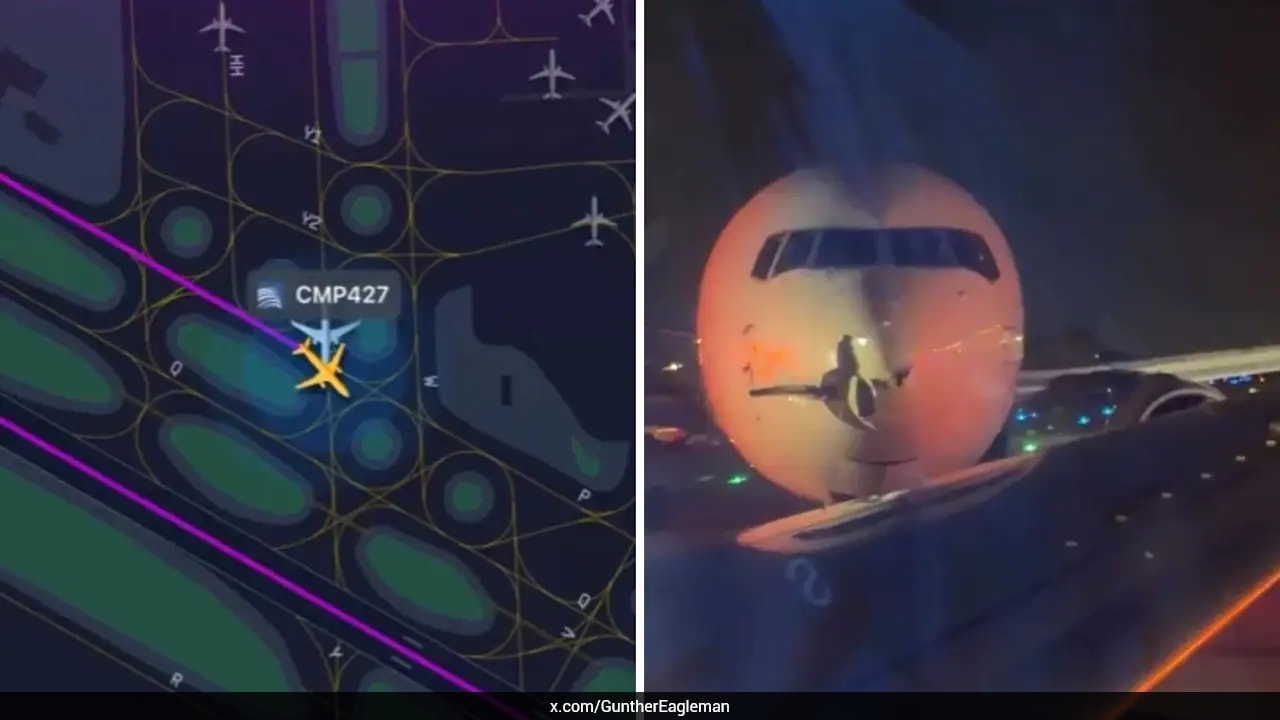
Ground collisions at major commercial hubs are rarely the product of a single catastrophic failure. When a flight crew transmits an immediate, reactive statement such as "Somebody hit us" over an active ground control frequency at Miami International Airport (MIA), that transmission marks the terminal node of a complex chain of spatial, procedural, and environmental breakdowns. Standard aviation reporting treats these incidents as isolated human errors or dramatic audio clips. An operational analysis reveals a different reality: taxiway and ramp collisions are systemic failures resulting from the friction between escalating traffic density, legacy airport geometry, and the cognitive limits of visual separation in complex surface environments.
To understand why two multi-million-dollar aircraft make physical contact at walking speed on a controlled airfield, one must deconstruct the ground movement ecosystem into its primary structural components: kinetic constraints, blind-spot geometry, communication latency, and organizational pressure.
The Structural Taxonomy of Surface Incursions and Collisions
Commercial aviation safety is overwhelmingly engineered around the airborne phase of flight, where radar, Traffic Collision Avoidance Systems (TCAS), and vast three-dimensional buffers prevent proximity events. Once an aircraft touches down and exits the high-speed turnoff, those automated safety nets vanish. The aircraft transitions into a two-dimensional, high-density environment governed primarily by visual scanning, painted asphalt lines, and voice-based air traffic control (ATC).
Surface collisions generally fall into three distinct operational categories:
- Active Taxiway Wingtip Strikes: Occur when moving aircraft pass each other on parallel taxiways with insufficient wingtip clearance, or when a stationary aircraft fails to hold short of an intersecting taxiway line, leaving its empennage or wingtip protruding into an active movement area.
- Ramp and Apron Congestions: Happen in non-movement areas—typically controlled by airline ramp towers rather than FAA air traffic controllers—where pushback tugs, service vehicles, and taxiing aircraft operate within tight, dynamic tolerances.
- Runway Incursions: The highest-risk category, involving the unauthorized presence of an aircraft, vehicle, or person on the protected surface of a designated landing and takeoff area.
At a high-capacity international gateway like Miami International Airport, the physical layout compounds these risks. MIA operates a complex network of intersecting runways and tightly spaced parallel taxiways constrained by urban boundaries. As fleet mixes have shifted toward larger widebody aircraft with extended wingspans—such as the Boeing 777, Boeing 787, and Airbus A350—the physical margins for error on older taxiway infrastructure have narrowed considerably. A taxiway designed for narrowbody operations in the late twentieth century leaves minimal buffer when two modern widebodies execute simultaneous opposite-direction taxi operations.
The Geometry of Visual Blind Spots
The immediate surprise captured in a pilot's cockpit voice transmission following a ground strike—"Somebody hit us"—reflects a fundamental physical limitation of commercial transport aircraft: the flight crew cannot see their own wingtips or tail section.
From the flight deck of a modern airliner, the forward field of view is optimized for approach and landing angles, not lateral surface clearance. The swept-wing geometry of commercial jets places the wingtips dozens of feet behind and well outside the peripheral vision of both the Captain and the First Officer. In a Boeing 737 or Airbus A320, the wingtip extends roughly 55 to 60 feet from the fuselage centerline. In widebody aircraft, that distance exceeds 100 feet.
This creates a severe spatial perception gap. Pilots rely on nose-wheel tracking along the yellow taxiway centerline, trusting that the airport's painted geometry guarantees object-free zones (OFZs) for their specific aircraft Design Group. However, this reliance fails under three specific conditions:
- Centerline Deviation: A minor steering error of three to five feet off the yellow centerline during a turn swings the outer wingtip or horizontal stabilizer across a much wider arc due to wheelbase geometry (the distance between the nose gear and main landing gear).
- Unverified Hold-Short Positioning: If a preceding aircraft stops short of a clearance limit based on cockpit sightlines rather than main-gear position, its tail cone can remain fouled inside the adjacent taxiway safety area without the crew realizing they are exposed.
- Pushback Vector Errors: During pushback from a gate, the flight crew is largely passive, relying entirely on the tug driver and wing-walkers. If a tug operator over-rotates the aircraft or pushes past the designated tail-clearance line onto an active alley, the flight crew has neither the visual angle nor the physical control to prevent an impact with a taxiing aircraft.
When impact occurs under these conditions, the flight crew experiences an abrupt, uncommanded yaw or shudder without visual warning. The resulting radio call is not an admission of fault, nor is it an accusation; it is an immediate operational alert to Ground Control to freeze surface traffic and initiate emergency protocols.
Cognitive Load and Frequency Congestion
The human factors governing ground operations are fundamentally different from those at cruise altitude. During taxi-out and taxi-in, cockpit workload spikes simultaneously across multiple domains.
The crew is executing checklists, configuring flight controls, calculating takeoff performance data, monitoring engine parameters, and navigating a labyrinth of taxiway intersections. This high-task-density environment is known in aviation human factors as the "sterile cockpit" phase, yet it is routinely interrupted by complex, multi-step taxi clearances delivered over congested VHF radio frequencies.
At major hubs during peak arrival and departure banks, a single Ground Controller may manage dozens of moving aircraft simultaneously. Transmissions are rapid, clipped, and packed with conditional clearances (e.g., "Follow the company 737 from the left, hold short of Bravo, monitor Tower on 118.3").
This creates three distinct failure mechanisms:
- Expectation Bias: Pilots familiar with a hub's standard taxi routes anticipate instructions before they are issued. When ATC alters the sequence due to gate holds or weather reroutes, expectation bias can cause a crew to execute a habitual turn rather than the cleared turn.
- Readback/Hearback Errors: Under high frequency saturation, a pilot may mishear a hold-short instruction and read back the incorrect clearance. If the controller is simultaneously coordinating with another sector or scanning radar, the erroneous readback can go unchallenged—a breakdown known as a hearback error.
- Divided Attention: While the Captain steers the aircraft via the nose-wheel tiller, the First Officer is typically heads-down verifying flight management computer (FMC) entries or communicating with dispatch. This temporarily reduces external visual scanning by 50 percent during critical taxiway transitions.
The Economic and Operational Cost Function
A low-speed ground collision rarely results in fatalities, yet its financial and operational ripple effects across an airline network are disproportionate to the kinetic energy of the impact. When two aircraft make contact on a taxiway, the immediate consequence is the instant removal of two revenue-generating assets from the schedule, accompanied by a cascading disruption across the entire hub.
The cost function of a ground strike comprises four distinct tiers:
1. Direct Structural Repair and Inspection
Modern composite and aluminum aircraft structures are engineered to withstand immense aerodynamic loads, not localized lateral impacts. Even a minor wingtip rub requires non-destructive testing (NDT), ultrasonic scanning for delamination in carbon-fiber components, and structural alignment checks of the wing spar and control surface actuators. A damaged winglet, static discharger, or navigation light assembly is not a simple bolt-on replacement; if structural rib damage is detected, the aircraft can be grounded for weeks.
2. Fleet Cascade and Network Disruption
Commercial airlines operate on tightly coupled hub-and-spoke schedules with minimal spare aircraft buffers. Losing two airframes simultaneously at a major hub like Miami forces immediate flight cancellations or multi-hour delays. Crews time out under Federal Aviation Administration (FAA) Part 117 duty-time regulations, requiring reserve pilots to be deadheaded in from other bases. Connecting passengers miss international departures, triggering hotel voucher obligations, rebooking costs, and statutory compensation liabilities under regimes like EU261 if transatlantic legs are affected.
3. Airfield Throughput Degradation
When a collision occurs on an active taxiway, the impacted surface becomes a crime scene and an investigation zone. Aircraft cannot be moved until FAA inspectors and airport operations personnel document the exact resting positions, tire marks, and debris fields. Closing a primary parallel taxiway at a capacity-constrained airport forces ATC to route traffic onto single-lane arteries, artificially throttling the airport's arrival and departure rates. A 30-minute taxiway closure during a peak afternoon bank can generate systemic airspace delays across the Eastern Seaboard.
4. Regulatory and Insurance Liabilities
Every ground collision triggers mandatory reporting to the FAA and the National Transportation Safety Board (NTSB). Flight Data Recorders (FDR) and Cockpit Voice Recorders (CVR) must be pulled and preserved, requiring immediate replacement units before the aircraft can return to service. Subsequent liability determinations between competing carriers, ground handling contractors, and airport authorities involve protracted forensic reconstruction and increased hull insurance premiums.
Technological Asymmetry: Airborne vs. Surface Systems
The persistence of ground collisions highlights a glaring technological asymmetry in commercial aviation. While airborne collision avoidance has reached near-zero failure rates through automated, predictive systems, surface movement remains overwhelmingly reliant on twentieth-century visual and verbal protocols.
Current surface safety technologies exist, yet their deployment and capabilities remain fragmented:
- ASDE-X (Airport Surface Detection Equipment, Model X): Deployed at major US hubs including Miami, ASDE-X fuses surface movement radar, multilateration sensors, and ADS-B data to display aircraft and vehicle positions on a controller's screen. While effective at alerting controllers to potential runway incursions via automated predictive algorithms, ASDE-X is primarily tuned for runway protection rather than low-speed wingtip clearance on congested taxiways or non-movement ramp areas.
- Electronic Flight Bag (EFB) Moving Maps: Modern flight decks utilize tablet-based airport diagrams with own-ship GPS positioning. These tools significantly reduce navigation errors and missed turns. However, standard EFB moving maps do not display the real-time GPS positions of surrounding ground traffic, nor do they calculate dynamic wingtip clearance against adjacent aircraft.
- The Absence of Proximity Sensors: Unlike consumer automobiles equipped with ultrasonic parking sensors, LiDAR, and 360-degree cameras, multi-hundred-million-dollar commercial airliners lack external proximity warning systems on their wingtips and empennage. The operational environment—extreme temperature swings, ice accretion, high-speed aerodynamic drag, and lightning strike certification requirements—makes mounting fragile sensors on wingtips a complex engineering and certification challenge.
Limitations of Current Mitigation Frameworks
Industry responses to ground collisions typically center on procedural reinforcement: issuing safety bulletins, emphasizing sterile cockpit discipline, and painting higher-visibility markings on the asphalt. While necessary, these administrative controls hit a hard ceiling of effectiveness because they rely on human vigilance to compensate for geometric and systemic constraints.
Human visual scanning cannot reliably judge lateral distances of 100 feet at oblique angles, particularly at night, during heavy tropical rainstorms common in South Florida, or against the visual clutter of high-intensity apron floodlighting. Telling pilots to "maintain vigilance" does not alter the turning radius of a swept-wing jet or reduce the radio congestion on a busy ground frequency.
Similarly, expanding physical taxiway separations at landlocked urban airports is economically and geographically unviable. Moving a parallel taxiway centerline by 50 feet requires relocating storm drainage infrastructure, underground fuel hydrant systems, lighting conduits, and potentially demolishing terminal concourses.
Strategic Imperatives for Surface Risk Reduction
Eliminating ground collisions requires shifting the safety architecture from passive human vigilance to active, automated spatial awareness. Airlines, airport operators, and aviation regulators must execute three specific technological and operational shifts:
- Cockpit Display of Traffic Information (CDTI) for Surface Operations: Regulators and avionics manufacturers must accelerate the integration of ADS-B In data directly onto cockpit moving maps. Displaying the real-time position, heading, and wingspan footprint of all surrounding aircraft and ground vehicles on the flight deck's primary navigation display eliminates the blind-spot problem during taxi and pushback.
- Automated Wingtip Proximity Systems: Airlines should prioritize the adoption of wingtip-mounted optical or millimeter-wave radar sensors designed specifically for low-speed ground operations. Activated automatically via weight-on-wheels switches below 30 knots, these systems can provide direct aural and visual alerts to the flight crew when an object breaches a defined lateral buffer, functioning independently of ATC oversight.
- Digital Taxi Clearances via Data Link (CPDLC): Transitioning routine taxi instructions from congested VHF voice channels to Controller-Pilot Data Link Communications eliminates hearback/readback errors and expectation bias. Written, unambiguous taxi routes uploaded directly into the aircraft's flight management system allow crews to verify hold-short limits visually on their cockpit displays before releasing the parking brake.
Until surface movement receives the same automated, predictive collision-avoidance engineering that governs en-route airspace, busy hubs will remain vulnerable to the friction of tight geometry and human limits—ensuring that sudden, startled transmissions over ground frequencies remain an inevitable feature of commercial operations.