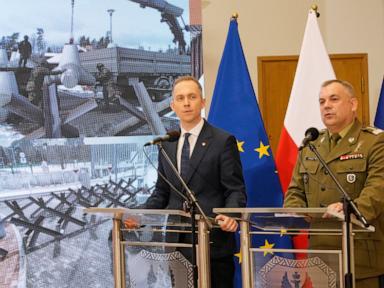
The strategic discourse surrounding the establishment of a permanent United States military installation in Poland consistently suffers from a fundamental analytical flaw: the conflation of symbolic political alignment with operational military utility. Public declarations by Polish officials highlighting Washington’s "interest" in a permanent base frame the issue as a binary milestone of diplomatic success. In reality, the transition from a rotational force architecture to a permanent garrison represents a complex, multi-variable equation governed by logistical friction, fiscal allocation models, and the cold logic of conventional deterrence.
To evaluate the strategic reality behind the rhetoric, the problem must be decoupled from political posturing and analyzed through its core structural components: infrastructure cost functions, the operational mechanics of deterrence, and the friction of force projection. If you liked this article, you might want to check out: this related article.
The Cost Function of Permanent vs. Rotational Basing
The primary structural bottleneck in shifting from a rotational presence to a permanent garrison is the fundamental transformation of the underlying cost function. Under the current Enhanced Defense Cooperation Agreement (EDCA) framework, the United States relies primarily on a rotational deployment model, supported by persistent elements such as the U.S. Army V Corps Forward Headquarters in Poznań (Kochis, 2024).
The operational cost of a rotational deployment is highly variable and tied directly to active transport, personnel movement, and temporary readiness cycles. Conversely, a permanent installation introduces massive, fixed capital expenditure requirements. The financial architecture of a permanent base involves three distinct cost tiers: For another perspective on this development, check out the latest update from Al Jazeera.
- Hard Infrastructure (Tier 1): The construction of hardened command posts, ammunition storage facilities, motor pools, and maintenance bays designed to sustain heavy mechanized units, such as an Armored Brigade Combat Team (ABCT).
- Soft Infrastructure (Tier 2): The establishment of non-combat support networks required for accompanied tours, including family housing, schools, medical facilities, and administrative complexes.
- Host-Nation Support Subsidies (Tier 3): The direct financial offsets provided by the host country to mitigate the capital expenditure burden on the deploying superpower.
While Warsaw has historically signaled a willingness to subsidize these costs substantially, a host-nation contribution does not eliminate the long-term operational and maintenance (O&M) liabilities for the U.S. defense budget. Permanent bases create path dependency; they lock a military service into specific geographic allocations, draining resources from global flexibility to maintain localized fixed assets.
The Mechanics of Deterrence: Tripwires vs. Lethality
The debate over a permanent base exposes a deep divergence in how Warsaw and Washington define the mechanics of conventional deterrence. This divergence can be modeled through two competing strategic frameworks:
[Tripwire Framework]
Small Persistent Force -> Immediate Superpower Involvement -> Escalation Dominance

[Lethality Framework]
Mechanized Combat Power + Organic Logistics -> High Attrition Capacity -> Denial of Objectives
Poland’s strategic calculus leans heavily toward the Tripwire Framework (Jureńczyk, 2022). Within this model, the absolute combat capability of the stationed force is secondary to its nationality. The presence of permanent U.S. service members and their dependents functions as an explicit geopolitical insurance policy. Any localized aggression by a revisionist power automatically inflicts U.S. casualties, ensuring immediate, non-discretionary American involvement and leveraging the full weight of the U.S. strategic arsenal.
Washington, conversely, views forward posture through the lens of the Lethality Framework. In an era characterized by standard active-duty army end-strengths facing severe recruiting and structural constraints (Hooker, 2026), the Pentagon cannot afford to deploy forces purely for symbolic value.
From an operational standpoint, a permanent base on NATO’s eastern flank is only justifiable if it enhances deterrence by denial—the ability to physically thwart an invasion at the line of contact. A light, unmechanized tripwire force fails to provide this capability, while a fully capable mechanized footprint requires deep, resilient logistical pipelines that are highly vulnerable to modern long-range precision strike assets.
Logistical Friction and the Tyranny of the Suwałki Gap
The structural vulnerability of a permanent base in Poland is dictated by geography. The primary operational theater along NATO's eastern flank is bounded by the Suwałki Gap—the narrow land corridor separating the Russian exclave of Kaliningrad from Belarus.
A permanent base situated east of the Vistula River places high-value U.S. assets within the immediate engagement envelope of Russian integrated air defense systems (IADS) and long-range artillery based in Kaliningrad. This geographic reality creates a severe operational paradox:
- The Vulnerability Paradox: To effectively deter a rapid fait accompli action, heavy armor must be stationed forward. However, stationing heavy units forward makes them highly vulnerable to pre-emptive interdiction and encirclement, effectively transforming a strategic asset into an operational liability.
- The Reinforcement Bottleneck: Western Europe’s rail and road networks feature distinct infrastructure variances, including differing rail gauges and bridge weight limits that restrict the rapid transit of heavy equipment like the M1A2 Abrams tank. A permanent base requires constant, high-volume logistical throughput that must pass through these predictable transit choke points.
Rather than committing to a single fixed target, the U.S. military has structurally preferred a hybrid model: pre-positioning massive equipment sets (Army Prepositioned Stocks, or APS) in hardened facilities like Powidz, while rotating the actual personnel required to operate them. This decouples the heavy hardware from the political vulnerabilities of a permanent garrison, providing operational flexibility without the static signature of a permanent base.
Strategic Playbook
The ongoing bilateral discussions between Washington and Warsaw will not culminate in a massive, legacy-style Cold War garrison. The structural constraints of the modern operational environment dictate a more calibrated outcome.
Poland will continue to increase its domestic defense expenditure, which has already established it as an alliance leader in terms of Gross Domestic Product allocation (Slakaityte, 2024). This capital injection will focus on building out host-nation infrastructure designed to receive, fuel, and sustain rapid allied reinforcements.
The United States will likely expand its "persistent" rather than "permanent" footprint. This means an increase in the complexity and duration of rotational combat teams, the expansion of forward command nodes, and the deepening of pre-positioned logistics infrastructure. This hybrid approach satisfies Poland's requirement for a visible, continuous American commitment while preserving the Pentagon’s global force maneuverability and mitigating the fixed cost liabilities of a permanent base.
References
Hooker Jr, R. D. (2026). The state of the US Army. Parameters, 56(1), 12–25. https://press.armywarcollege.edu/parameters/vol56/iss1/3
Jureńczyk, Ł. (2022). Polish-American alliance during the presidency of Donald Trump in the perspective of offensive bandwagoning. Torun International Studies, 1(15), 45–58. https://doi.org/10.12775/tis.2022.004
Cited by: 5
Kochis, D. (2024). Reducing the US force presence in Europe would weaken American interests (Research Report No. 4021). Hudson Institute. https://www.hudson.org/research/reducing-us-force-presence-europe
Cited by: 2
Slakaityte, V. (2024). North-eastern flank: Militarisation of the Baltic frontier. EconStor Research Report, 12(2), 112–130. https://www.econstor.eu/handle/10419/322177
Cited by: 4