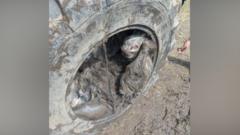
The intersection of equine behavioral biology and heavy industrial debris frequently generates low-probability, high-consequence operational crises. When a juvenile equine becomes physically trapped within the rigid interior geometry of a heavy machinery component—specifically a large tractor tire—standard reactive measures fail. The situation demands an immediate transition from emergency panic to a structured, physics-based extraction protocol. Surviving these incidents depends entirely on understanding three variables: structural elasticity, physiological stress thresholds, and mechanical leverage.
Standard local news coverage treats these events as isolated, heartwarming anomalies. This misinterprets the structural reality. Equine entrapment within industrial components is a predictable consequence of specific environmental hazards combined with the instinctual curiosity and spatial unawareness of young prey animals. To successfully resolve such an extraction without catastrophic injury to the animal or the rescue team, operators must deploy a systematic framework that balances mechanical force against biological tolerance.
The Tri-Factor Matrix of Equine Entrapment
Resolving an industrial-equine entrapment requires analyzing the three competing forces at play. Failure to account for any single factor invariably leads to structural failure of the rescue apparatus or lethal trauma to the animal.
1. The Rigid Boundary Condition (The Tire)
Heavy agricultural tires are not mere rubber rings; they are highly engineered composite structures. They feature a complex architecture of vulcanized rubber, woven textile plies, and high-tensile steel bead bundles.
[Cross-section of heavy agricultural tire construction showing steel beads and plies]
The steel bead is virtually inextensible, designed to seat against a metal rim under immense pressure. When an animal penetrates the central void of the tire, the interior geometry acts as a one-way mechanical valve. The tapered shape allows entry under momentum but resists exit as the animal’s anatomy shifts and expands due to gravity, position, and panic.
2. The Dynamic Biological Variable (The Pony)
Equine physiology is poorly optimized for prolonged entrapment. As a prey species, a horse or pony subjected to physical restraint experiences an immediate, massive surge of adrenaline. This triggers a cascade of systemic failures:
- Hyperthermia: Muscular exertion against an immovable object generates extreme metabolic heat, which is trapped by the insulating properties of the surrounding rubber.
- Capture Myopathy: Prolonged muscle ischemia and metabolic acidosis lead to muscle necrosis. This releases myoglobin into the bloodstream, frequently causing acute renal failure.
- Positional Asphyxia: If the animal’s thorax is compressed within the central void, the mechanical ability to expand the lungs diminishes, leading to rapid hypercapnia and hypoxia.
3. The Environmental Constraints
The physical location of the entrapment dictates the available mechanical advantage. Soft terrain limits the efficacy of heavy lifting equipment, while confined spaces prevent the deployment of optimal leverage angles. Rescue teams must quickly map the terrain rigidity to establish stable anchor points for extraction tools.
The Extraction Protocol: A Phased Technical Breakdown
Defeating the mechanical lock of a tractor tire requires a disciplined, sequential execution of phases. Haphazardly pulling the animal or cut-and-mistake operations will escalate the trauma.
[Flowchart of large animal rescue phases: Stabilization, Friction Reduction, Structural Modification, Extraction]
Phase I: Physiological and Spatial Stabilization
Before any mechanical force is applied to the entrapment mechanism, the biological variable must be controlled. Attempting extraction on a conscious, thrashing equine introduces chaotic kinetic energy into the system, endangering both the animal and the technicians.
Veterinary intervention must be established immediately to administer a precise protocol of chemical restraint. A combination of alpha-2 agonists (such as detomidine or xylazine) and opioid analgesics (such as butorphanol) is typically deployed. This sedation achieves two critical operational goals: it lowers the animal’s metabolic heat production and induces profound muscle relaxation, effectively reducing the physical circumference of the trapped anatomy.
Simultaneously, the tire must be stabilized using heavy wood cribbing or step-chocks. If the tire shifts during the rescue, it can crush the animal’s limbs or pin a rescue technician.
Phase II: Friction Reduction and Spatial Optimization
The boundary layer between the equine coat and the vulcanized rubber possesses a high coefficient of friction. As the animal struggles, this friction generates heat and skin abrasions, which increases swelling and further locks the animal in place.
Technicians must introduce a high-slip lubricant into the interface zone. Water-soluble obstetrical lubricants are preferred over petroleum-based alternatives; they preserve the integrity of the rescue team’s protective gear and do not degrade the animal's skin. The lubricant should be pumped or poured deep into the constriction point using flexible catheters to coat the entire contact perimeter.
Phase III: Structural Modification vs. Mechanical Leverage
The core tactical decision centers on whether to alter the containment structure or use mechanical leverage to slide the animal free.
When dealing with a heavy agricultural tire, cutting the structure is exceptionally difficult and dangerous. Cutting the steel bead wire requires specialized tools like reciprocating saws or hydraulic cutters. The friction of cutting vulcanized rubber generates toxic smoke and intense heat, which can burn the animal. Furthermore, steel cords under tension can snap violently when severed.
If structural modification is deemed too high-risk, technicians must use a mechanical advantage system. This involves:
- Passing high-strength, wide-webbing animal rescue slings beneath the pelvic or thoracic girdles of the animal. Narrow ropes or chains must never be used, as they concentrate force and cause deep tissue damage.
- Anchoring a multi-purchase pulley system (e.g., a 3:1 or 5:1 block and tackle) or a heavy-duty winching unit to a verified structural anchor point.
- Applying steady, controlled, incremental tension along the natural anatomical axis of the entrapment. Jerking or sudden pulling forces can dislocate joints or fracture bones.
Quantifying Risk: The Cost Function of Rescue Operations
Every tactical choice in a large animal extraction carries an inherent cost that can be calculated through operational risk metrics. The primary objective is minimizing the Total Operational Severity Index ($I_s$), which can be conceptually modeled through the following relationship:
$$I_s = \int_{t_0}^{t_f} (C_m \cdot \Delta F + C_b \cdot \Delta S) , dt$$
Where:
- $C_m$ represents the coefficient of mechanical hazard (tool failure, structural snapback).
- $\Delta F$ represents the rate of change of applied mechanical force.
- $C_b$ represents the coefficient of biological vulnerability (sedation depth, cardiovascular stability).
- $\Delta S$ represents the rate of change of the animal's physiological stress index over time ($t$).
If the extraction takes too long ($t_f - t_0$), the biological cost increases exponentially due to tissue degradation, even if the applied force remains low. Conversely, accelerating the timeline by applying excessive force spikes $\Delta F$, risking immediate skeletal failure. The optimal strategy requires minimizing the time function by executing a highly coordinated, low-friction extraction rather than relying on raw mechanical power.
Tactical Asset Allocation for Emergency Responders
Municipal emergency services often lack the specific training required for large animal rescue (LAR) operations. To mitigate property damage and animal loss, regional fire and rescue agencies must maintain a predetermined asset allocation strategy.
| Operational Tier | Required Equipment | Personnel Competency | Primary Objective |
|---|---|---|---|
| Tier 1: Initial Assessment | Standard cribbing, basic hand tools, personal protective equipment (PPE). | General first responders. | Scene stabilization, hazard mitigation, perimeter control. |
| Tier 2: Specialized Extraction | Wide-webbing rescue slings, heavy-duty lubricants, low-clearance lifting bags, multi-purchase rigging kits. | Technical rescue team with LAR certification. | Structural manipulation, application of mechanical advantage. |
| Tier 3: Medical Control | Specialized veterinary formulary (sedatives, reversal agents, IV fluids), monitoring equipment. | Licensed equine veterinarian. | Metabolic stabilization, chemical restraint, triage. |
The critical failure point in most operations is the lack of a unified command structure between Tier 2 technical rescue personnel and Tier 3 medical personnel. The veterinarian must maintain ultimate authority over the timeline of the extraction, as they monitor the biological clock of the animal. The rescue squad leader retains authority over the mechanics of the site, ensuring that tool operations do not compromise the safety of the human technicians.
Strategic Prevention Paradigms
Relying on emergency extraction systems is inherently inefficient compared to proactive risk mitigation. Agricultural properties and equestrian facilities frequently harbor legacy industrial debris, creating a high-density hazard environment.
The long-term resolution to equine entrapment anomalies requires a strict facility management protocol. Heavy machinery components, particularly unmounted tractor tires often used as improvised feeders or silage weights, must be phased out or structurally modified. If a tire is deployed as a feeding ring, the central void must be completely backfilled with concrete or aggregate material to eliminate the cavity entirely.
Fencing parameters must also be audited to prevent juvenile livestock from accessing equipment storage yards. Eliminating the spatial intersection of curious animals and rigid interior geometries is the only definitive way to mitigate the risk of catastrophic entrapment events. Responders and property owners who shift from a mindset of reactive rescue to structural prevention drastically reduce both operational liability and animal mortality rates.