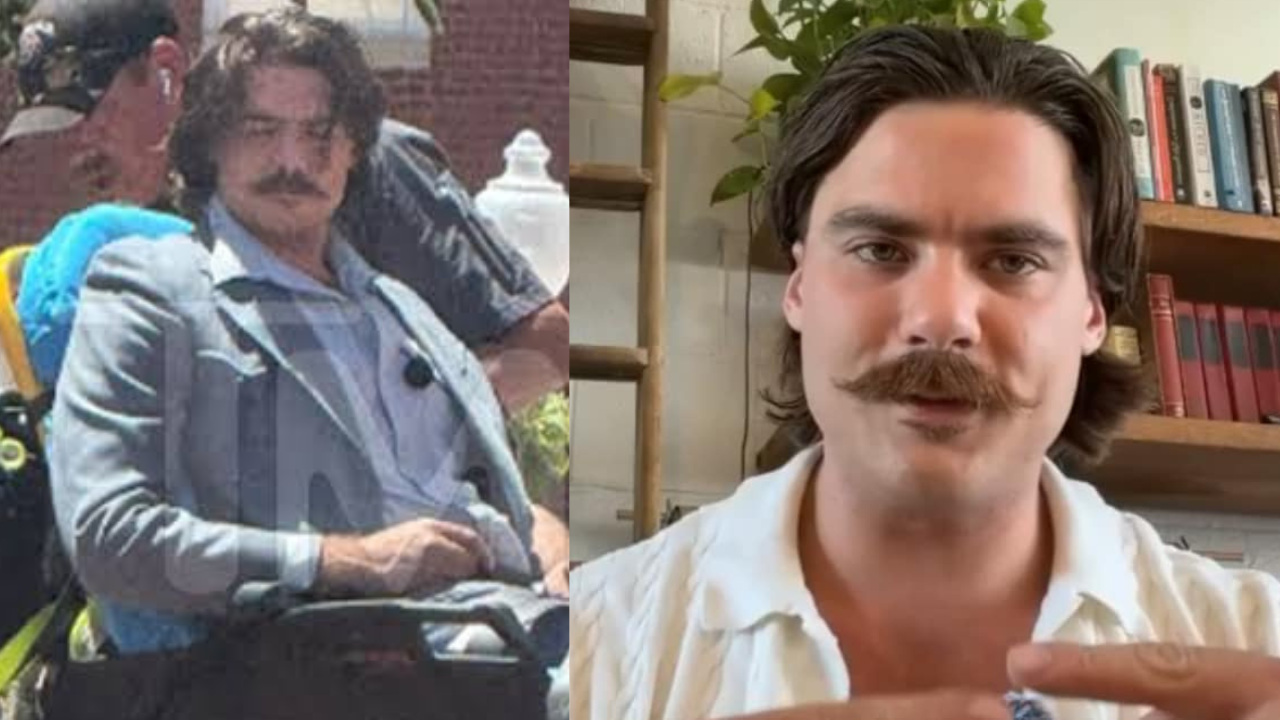
The screen glow is a cold, clinical blue that doesn't care about your sleep schedule. It was late on a Tuesday when the first notification pinged—the kind of sound that usually signals a meme from a cousin or a grocery store discount. But this was different. This was the sound of a reputation being dismantled in real-time.
A screenshot was moving through the digital undergrowth like a brushfire. It looked legitimate. It had the right fonts, the familiar blue headers of Facebook, and a timestamp that felt chillingly immediate. The post, allegedly from "Chud The Builder"—a local personality known for his rough-around-the-edges construction content—was a tirade of vitriol. It surfaced just hours after a tragic shooting at a courthouse, a moment when the community’s nerves were already frayed to the snapping point.
The words in that screenshot were ugly. They were racist, inflammatory, and served as a direct insult to a grieving city. Within sixty minutes, the image had been shared four thousand times. By morning, the man behind the persona was a pariah.
But there was a problem.
The post didn't exist. It never had.
The Architecture of a Lie
We live in an era where seeing is no longer believing, yet our brains haven't quite caught up to the deception. To understand how a man like Chud—born Charles—found himself staring at a digital effigy of his own life, you have to understand the ease of the "Inspect Element" tool.
Imagine a stage play. The actors are speaking their lines, the lights are set, and the audience is watching. Now imagine a person in the front row has a remote control that can change the words coming out of the actor's mouth, but only for the people sitting in that one specific chair. If that person takes a photo of the stage at that exact moment, they have "proof" of a play that never actually happened.
That is the essence of the modern viral hoax. By right-clicking on a browser, any amateur can change the text of a verified account's post, swap the date, and rewrite history. They don't need to be a hacker. They just need a grievance and a "Print Screen" button.
The "Chud" screenshot was a masterclass in this low-tech deception. It utilized a common psychological exploit: the "confirmation bias" loop. People were already angry about the courthouse shooting. They were looking for a villain, a place to park their outrage. When the screenshot appeared, it fit a narrative. It didn't matter if the pixels were slightly off or if the metadata was missing. It felt true, and in the kingdom of social media, feeling is the law of the land.
The Invisible Stakes of the Refresh Button
Consider the hypothetical life of a construction worker who relies on local contracts to feed his family. Let's call him Mike. Mike sees the post. He’s disgusted. He’s worked with Chud before, but now? He cancels the subcontract. He tells his neighbors. The ripple effect isn't just a number on a screen; it’s a mortgage payment that doesn't get made. It’s a kid’s tuition that gets deferred.
When the fact-checkers finally arrived on the scene, the damage was already structural.
Investigators looked for the "digital footprint." On the internet, everything leaves a trail—a cache, a log, a breadcrumb. If a post is deleted, there are still ghosts of it in the server logs or third-party archives. But in the case of the "racist Facebook updates," there were no ghosts. There was only a void.
The screenshot claimed the post was live for three hours. In that timeframe, a personality with Chud’s following would have generated thousands of native interactions—likes, angry reacts, and comments that would have been archived by search engine crawlers. None were found. The font in the screenshot was also a fraction of a millimeter off-set, a tell-tale sign of a manual overlay.
The truth was boring. The lie was cinematic.
The Cost of the Correction
Why do we fall for it?
Because we are wired for stories, not for spreadsheets. A spreadsheet tells us that according to Facebook's transparency logs, no such data packet was sent from Charles’s IP address on the day in question. A story tells us that a "bad man said a bad thing during a tragedy."
The human brain processes a shocking image in roughly 13 milliseconds. A nuanced correction—one that explains the technicalities of browser manipulation and the absence of server-side records—takes minutes to read and even longer to internalize. We are fighting a high-speed war with low-speed armor.
Charles spent the week after the shooting fielding death threats. He posted videos of his empty "Manage Posts" log. He showed his screen. He pleaded with his followers to look at the lack of evidence. But the internet doesn't like to be told it was fooled. To admit the screenshot was fake is to admit that our own outrage was manipulated, and that is a bitter pill for anyone to swallow.
Statistically, a lie travels six times faster than the truth on major social platforms. By the time the "Debunked" labels were applied to the viral images, the original hoax had already reached its peak saturation.
The Digital Scar Tissue
We often talk about "clearing" a name as if it’s a dry-cleaning process. You drop the reputation off, it gets scrubbed, and you pick it up as good as new.
It doesn't work that way.
Even after the evidence proved the screenshot was a fabrication—a digital collage created by a malicious actor—the search results for "Chud The Builder" remained stained. The top results weren't his craftsmanship or his community service; they were the headlines about the "racist update scandal," even if the word "debunked" was attached.
This is the hidden tax of the digital age. We are building our identities on a foundation of shifting sand, where a single person with a basic understanding of a web browser can rewrite our character in the eyes of the world.
The courthouse shooting was a real tragedy with real victims. The fake post was a secondary parasite, feeding off that grief to create more chaos. It reminds us that the most dangerous weapon in a crisis isn't always the one held in a hand; sometimes, it’s the one held in a pocket, glowing blue, waiting for us to click "Share" without looking at the seams.
We are left standing in the debris of a conversation that never should have happened, looking at a man who was tried and convicted by an algorithm before the facts could even lace up their boots.
The ghost of the post still lingers. It lives in the "I heard something about him" whispers and the hesitant handshakes of new clients. It is a reminder that in the modern world, a lie doesn't have to be true to be permanent. It just has to be fast.