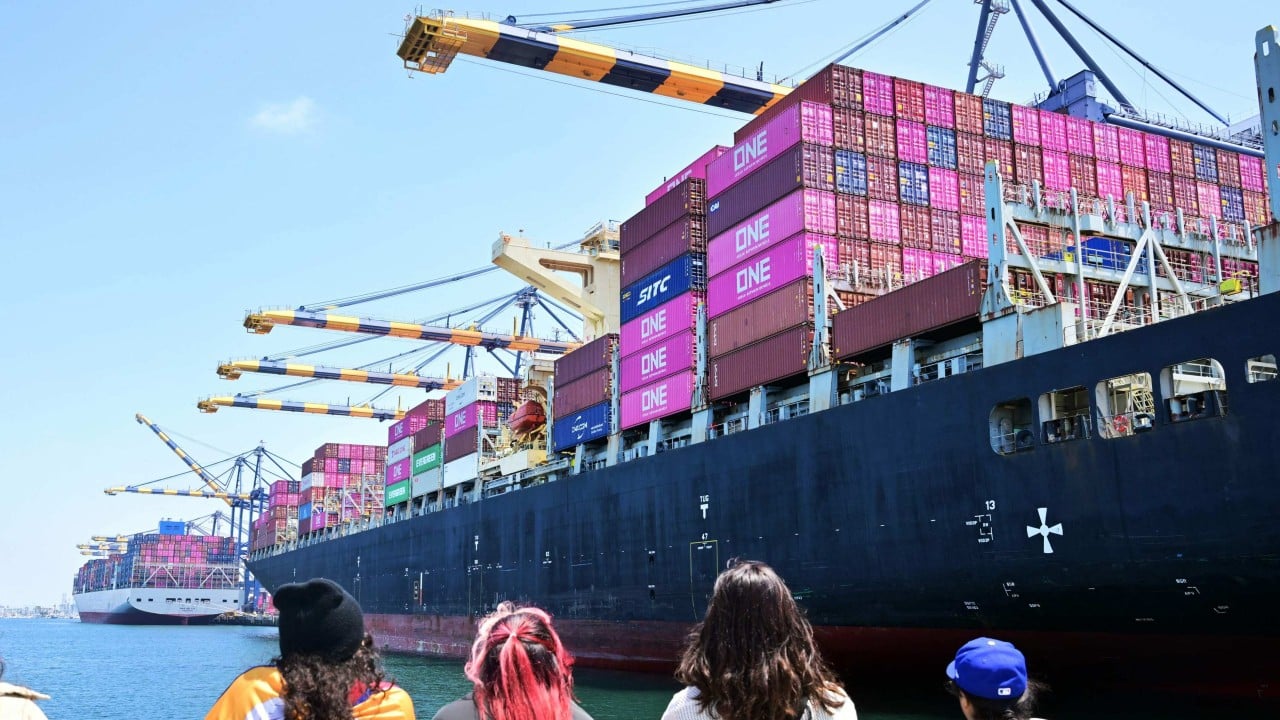
The US Department of Justice’s indictment of seven Chinese maritime executives and four shipping firms exposes the structural vulnerabilities of global supply chains to collusive price-fixing. Maritime shipping operates under a unique regulatory framework where immense capital expenditure requirements meet highly volatile demand shocks. When these market forces intersect, the incentive to form covert cartels shifts from a tactical advantage to an existential strategy for market dominance.
To analyze the impact of this federal prosecution, we must look past the headlines and dissect the operational mechanics of ocean freight collusion, the economic incentives driving container cartels, and the structural friction of cross-border enforcement.
The Triad of Maritime Collusion Mechanics
Ocean freight cartels do not operate through simple handshake agreements. They require sophisticated operational coordination to artificially restrict supply, manipulate capacity, and enforce internal discipline among co-conspirators. The federal charges outline an enforcement mechanism that relies on three distinct operational pillars.
1. Capacity Suppression through "Blank Sailings"
In a perfectly competitive market, ocean carriers adjust capacity based on marginal cost and spot-market demand. In a cartelized structure, carriers artificially suppress capacity by coordinating "blank sailings"—the intentional cancellation of a scheduled blank voyage. By systematically removing vessels from specific trade lanes (such as East Asia to the US West Coast), the conspirators create an artificial deficit in available Twenty-Foot Equivalent Units (TEUs). This deficit shifts the aggregate supply curve to the left, forcing spot-market freight rates upward regardless of underlying macroeconomic demand.
2. Information Asymmetry and Uniform Surcharges
The core of the illicit coordination relies on establishing uniform pricing baselines. Cartel participants utilize non-public communication channels to align on Bunker Adjustment Factors (BAF)—the fuel surcharges passed to shippers—and Currency Adjustment Factors (CAF). By standardizing these ancillary fees, the executives eliminate price competition on the variable components of a freight rate, effectively establishing a price floor that guarantees profitability even if base ocean freight rates fluctuate.
3. Market Allocation and Bid Rotation
To prevent internal cheating—a chronic instability in any cartel—the indicted firms established strict territorial boundaries and client allocation protocols. During major corporate procurement cycles, the co-conspirators engaged in bid rotation. Firm A would submit an intentionally inflated bid to a major retailer, ensuring that Firm B secured the long-term contract at a predetermined, non-competitive rate. This structural manipulation insulates the cartel from market correction by neutralizing the competitive bidding process.
The Economic Cost Function of Maritime Anti-Trust Violations
The damage inflicted by a maritime shipping cartel extends far beyond the balance sheets of logistics providers. Because ocean freight is the foundational layer of international trade, artificial rate inflation compounds across every subsequent stage of the global supply chain.
The economic reality of this cartel can be modeled by analyzing the bullwhip effect of inflated logistics costs:
- Upstream Input Cost Inflation: Manufacturers relying on just-in-time inventory models experience immediate margin compression when TEU spot rates are artificially inflated. These costs are rarely absorbed by the importer.
- Downstream Consumer Pass-Through: Due to the inelastic demand for critical consumer goods and industrial components, these inflated logistics premiums operate as an invisible tariff, ultimately paid by the end consumer.
- Capital Allocation Distortion: When shipping firms generate supra-normal profits through collusion rather than operational efficiency, capital is misallocated. Instead of investing in decarbonization or port infrastructure, capital is diverted to maintaining cartel discipline and funding legal defense reserves.
The systemic risk is intensified by the high concentration of the global shipping industry. The top ocean carriers are organized into three massive global alliances. While these alliances operate under legal antitrust immunity for technical and operational cooperation, the proximity of executive leadership creates an environment ripe for illicit parallel behavior. The line between legal capacity management within an alliance and illegal price-fixing across alliances is exceptionally thin.
Jurisdictional Arbitrage and the Enforcement Bottleneck
The indictment of foreign executives highlights a profound systemic challenge in international antitrust enforcement: the friction between domestic legal jurisdiction and sovereign boundaries.
The US Department of Justice can issue indictments and secure asset forfeitures within US territories, but executing arrest warrants against foreign nationals residing in non-extradition states presents an operational dead end. The indicted executives remain shielded by geopolitical boundaries, converting their domestic jurisdictions into safe havens for corporate non-compliance.
This creates a distinct asymmetry in enforcement. While the four indicted shipping firms face crippling financial penalties, exclusion from US ports, and the potential seizure of maritime assets, the human architects of the conspiracy often evade personal criminal liability. The strategy for state-backed or foreign-domiciled firms becomes a cold calculation of risk-adjusted returns: do the supra-normal profits generated by the container cartel outweigh the cost of losing direct access to the US market?
Furthermore, data retrieval in cross-border antitrust investigations is severely constrained. When incriminating communications, pricing spreadsheets, and ledger entries reside on servers located outside the host country's jurisdiction, regulatory bodies must rely on Mutual Legal Assistance Treaties (MLATs). These treaties are notoriously slow, bureaucratic, and subject to geopolitical posturing, allowing cartel participants ample time to obfuscate data trails.
Defensive Supply Chain Architecture for Importers
Shippers and logistics managers cannot rely solely on regulatory bodies to guarantee a competitive marketplace. To mitigate exposure to potential cartel activity and artificial capacity constraints, procurement strategies must shift from transactional cost-optimization to structural resilience.
Diversify Across Non-Alliance Carriers
Relying exclusively on the major ocean alliances exposes a supply chain to systemic capacity manipulation. Bypassing the primary networks by allocating a fixed percentage of volume to independent regional carriers or niche non-vessel operating common carriers (NVOCCs) creates an operational hedge. If an alliance implements coordinated blank sailings, the independent volume remains insulated.
Transition to Index-Linked Container Freight Contracts
Fixed-rate long-term contracts offer a false sense of security; when spot market prices drop significantly below contract rates, carriers often fail to honor space allocations, prioritizing higher-paying spot cargo instead. Conversely, when cartels artificially inflate spot rates, contract shippers face sudden "premium surcharges" to secure equipment. Utilizing contracts tied directly to independent third-party freight indices ensures that pricing reflects true market equilibrium rather than collusive coordination.
Implement Dual-Port Sourcing Strategies
Cartels optimize their capacity manipulation on high-volume, highly concentrated trade lanes—specifically the routes into the Ports of Los Angeles, Long Beach, and New York/New Jersey. By rerouting a portion of inbound freight through secondary entry points or utilizing intermodal corridors through Canada or the Gulf Coast, shippers reduce their dependence on the primary bottlenecks where cartel capacity restrictions are most effective.
The Strategic Outlook for Global Freight Markets
The aggressive prosecution of these eleven entities signals a definitive shift in antitrust enforcement priorities. For decades, maritime regulators exercised a degree of leniency, viewing carrier cooperation as a necessary mechanism to stabilize a volatile, capital-intensive industry. That era of regulatory tolerance has ended.
Corporate risk profiles must be adjusted immediately to account for a multi-jurisdictional enforcement environment where the US DOJ, the European Commission, and Asian antitrust regulators increasingly share intelligence and coordinate enforcement actions. Shipping lines can no longer assume that local regulatory approval shields them from extraterritorial reach.
The immediate operational fallout will manifest as an acute restructuring of ocean carrier alliances. As the threat of criminal liability penetrates the executive suite, carriers will be forced to decouple their shared digital booking platforms and limit the scope of their operational data sharing. The reduction in data visibility will increase operational friction, potentially leading to short-term inefficiencies in slot-chartering and container positioning.
Logistics executives must treat this legal action not as an isolated compliance event, but as a structural reordering of maritime power dynamics. The companies that thrive in this next cycle will be those that dismantle their reliance on static, long-term carrier relationships and build dynamic, multi-modal supply chains capable of routing around artificial market distortions in real time.

