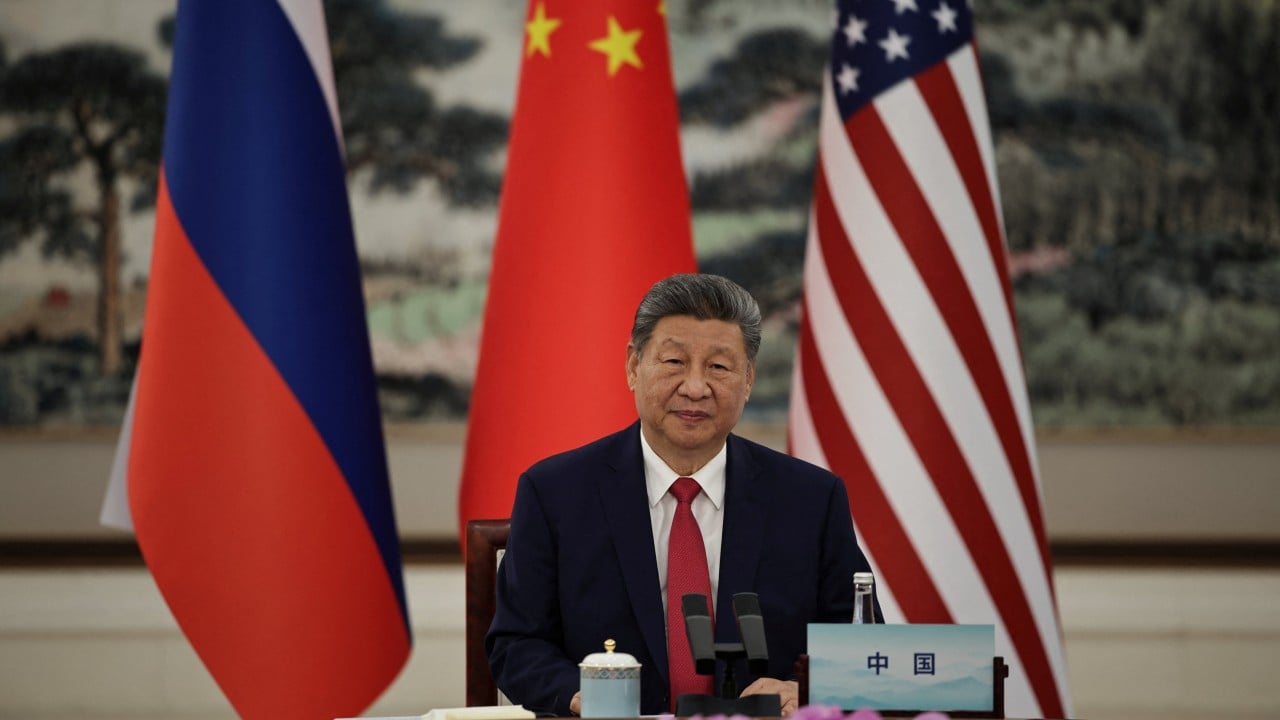
A trilateral peace declaration among China, Russia, and the United States operates not as a simple treaty, but as a high-stakes multi-variable equilibrium problem. Analyzing any theoretical or proposed joint statement between Beijing, Moscow, and Washington requires stripping away diplomatic rhetoric to examine the underlying structural incentives, verification mechanisms, and enforcement deficits. Without binding enforcement architectures, a joint declaration serves primarily as a signaling mechanism to stabilize great-power competition rather than a permanent resolution of conflicting geopolitical interests.
The Structural Architecture of Trilateral Diplomacy
Bilateral agreements rely on direct reciprocity. Introducing a third major power alters the payoff matrix entirely, shifting the dynamic from a two-player Prisoner's Dilemma to a complex three-body problem where coalitions can form, fracture, and realign simultaneously.
In a trilateral context involving Washington, Beijing, and Moscow, the primary structural challenge is asymmetry of interests. Each actor enters the negotiation with distinct security priorities, economic vulnerabilities, and domestic political constraints. A declaration "towards peace" typically functions as an initial framework agreement—a diplomatic instrument designed to establish baseline rules of engagement before tackling intractable territorial or ideological disputes.
The Three Pillars of Great-Power Declarations
To evaluate the viability of any trilateral peace framework, analysts must deconstruct the text into three operational components:
- Declaratory Principles: Broad commitments to sovereignty, territorial integrity, non-aggression, and adherence to the United Nations Charter. These clauses carry low immediate cost and high ambiguity, allowing each signatory to interpret the language for domestic audiences.
- Risk-Reduction Mechanisms: Concrete protocols aimed at preventing inadvertent escalation. These include military-to-military communication hotlines, advance notification of missile launches, and rules of behavior for naval and air encounters in contested zones.
- Verification and Compliance Regimes: The technical and institutional apparatus required to confirm that signatories are adhering to their commitments. This is the point where most ambitious diplomatic frameworks fail, as national security establishments resist intrusive inspections.
The Incentive Matrix and Asymmetry of Interests
Understanding why these three powers would sign a joint declaration requires mapping their respective cost functions. No major power signs a peace framework out of altruism; they sign when the marginal cost of continued unrestrained competition exceeds the expected utility of unilateral action.
Washington's Strategic Calculus
For the United States, managing two near-peer competitors simultaneously stretches military readiness, defense industrial capacity, and diplomatic bandwidth. A trilateral framework offers Washington a mechanism to compartmentalize disputes, reduce the probability of a two-front crisis, and re-establish strategic stability guardrails that eroded following the collapse of Cold War arms control treaties. The primary risk for American policymakers is legitimizing spheres of influence or alienating regional allies who view a great-power concert with suspicion.
Beijing's Economic and Geopolitical Priorities
China's primary objective in a trilateral setting is securing a stable external environment to sustain domestic economic growth and technological advancement. Beijing consistently favors multilateral frameworks that position it as a responsible global stakeholder and an indispensable mediator. By participating in a trilateral peace declaration, China elevates its diplomatic parity with the United States while avoiding binding constraints on its own regional ambitions or military modernization programs.
Moscow's Leverage and Security Guarantees
Russia approaches trilateral diplomacy from a position focused on regime security, recognition of great-power status, and restructuring the European security architecture. For Moscow, a joint declaration with Washington and Beijing validates its role as an equal pole in a multipolar order. Russia seeks explicit constraints on alliance expansion near its borders and relief from economic sanctions, trading tactical de-escalation for long-term strategic concessions.
Verification Deficits and the Enforcement Bottleneck
The central flaw in high-level diplomatic declarations is the gap between stated intent and verifiable execution. In international relations theory, specifically offensive realism, states cannot be certain about the future intentions of other states. Because intentions can change overnight, rational actors base their security planning on capabilities rather than promises.
When a trilateral declaration lacks rigorous verification protocols, it creates an asymmetric compliance trap. Democratic systems with transparent legislative oversight and free media face higher domestic and international costs for violating public agreements. Authoritarian systems with centralized information control can obscure military deployments, dual-use technology transfers, or covert operations more easily.
This dynamic produces three specific operational bottlenecks:
- Attribution Ambiguity: Modern conflict increasingly occurs in the gray zone—cyber operations, information warfare, economic coercion, and proxy engagements. A standard peace declaration rarely defines clear thresholds for what constitutes a violation in non-kinetic domains.
- Dual-Use Technology Verification: Distinguishing between civilian and military advancements in artificial intelligence, quantum computing, and hypersonic propulsion is technically difficult. Signatories can adhere to the letter of a peace declaration while accelerating capabilities that undermine strategic stability.
- Third-Party Spoilers: A declaration signed by Washington, Beijing, and Moscow does not bind smaller regional actors. Allies or client states may take independent actions that drag the major powers back into confrontation, testing the resilience of the trilateral commitment.
Historical Precedents and Structural Analogies
Evaluating a modern trilateral declaration requires examining how similar multi-polar frameworks functioned historically. While no exact parallel exists for the current configuration of nuclear-armed economic superpowers, two historical models illustrate the mechanics of great-power accommodation.
The Concert of Europe Model
Following the Napoleonic Wars, major European powers established a system of periodic congresses to manage disputes and preserve the balance of power. The system succeeded for several decades because the participants shared a common interest in preventing systemic war and domestic revolution. The Concert collapsed when the underlying distribution of power shifted and individual states concluded they could achieve more through unilateral revisionism than through collective restraint. A modern trilateral declaration faces the same vulnerability: it holds only as long as the power balance remains relatively static.
Cold War Strategic Arms Limitation
During the 1970s, the United States and the Soviet Union pursued detente, resulting in the Helsinki Accords and the Strategic Arms Limitation Talks. These agreements did not end ideological competition or proxy wars, nor did they establish permanent peace. Instead, they created a predictable framework for managing nuclear rivalry. The inclusion of China in the 1970s triangular diplomacy demonstrated how playing two rivals against each other could extract concessions, but it also showed that triangular relationships are inherently unstable, as any two parties fear collusion by the other two.
Operationalizing De-Escalation
If a trilateral declaration is to move beyond symbolic diplomacy, it must transition from broad principles to granular operational protocols. Without institutional follow-through, the declaration becomes a dead letter within months of signing.
Step 1: Establishing Permanent Crisis Communication Channels
The immediate priority following any joint declaration is technical integration of crisis communication systems. Political hotlines between heads of state are insufficient during fast-moving tactical incidents. Operational effectiveness requires direct, redundant links between regional theater commanders, maritime operations centers, and space situational awareness hubs. These channels must undergo regular, scheduled testing to ensure functionality during periods of heightened tension.
Step 2: Defining Non-Kinetic Red Lines
Traditional peace frameworks focus on kinetic military movements—troop deployments, naval exercises, and airspace violations. Modern strategic stability requires explicit boundaries regarding critical infrastructure. Signatories must establish mutual restraint agreements prohibiting cyber intrusions against nuclear command-and-control systems, civilian power grids, and financial clearinghouses. Defining these assets as off-limits reduces the risk that a localized cyber skirmish escalates into a strategic confrontation.
Step 3: Institutionalizing Working Groups
A one-off summit produces headlines, not stability. The declaration must mandate standing technical working groups focused on narrow, solvable problems. Separating strategic nuclear stability, maritime safety, and artificial intelligence governance into distinct tracks prevents a breakdown in one area from collapsing the entire diplomatic architecture. Progress in lower-stakes technical tracks builds institutional momentum and familiarity among mid-level bureaucrats and military officers.
Limitations of Trilateral Frameworks
Analysts and policymakers must recognize the hard limits of a trilateral peace declaration. Diplomatic documents cannot resolve fundamental clashes of national interest or incompatible political systems.
First, a trilateral framework cannot substitute for deterrence. Peace declarations succeed when backed by credible military capabilities that make aggression prohibitively expensive. If any signatory views the declaration as a signal of waning resolve from its competitors, the agreement will accelerate rather than deter opportunistic behavior.
Second, domestic political cycles introduce severe time-inconsistency problems. Commitments made by one administration in Washington can be reversed or abandoned by a subsequent administration, creating skepticism in Beijing and Moscow regarding the durability of American promises. Conversely, leadership transitions or internal succession crises within authoritarian regimes can produce sudden shifts in foreign policy posture with little external warning.
Third, economic decoupling and technological competition operate on structural tracks that diplomatic declarations rarely alter. Even if the three powers sign a comprehensive statement on peaceful coexistence, supply chain restructuring, export controls on advanced semiconductors, and competition for critical minerals will continue to generate friction.
Strategic Execution for Policy Analysts
To accurately assess the real-world impact of any China-Russia-US trilateral peace declaration, ignore the preamble and audit the annexes. Focus analytical resources on three concrete indicators over the first 180 days post-signing: the frequency of scheduled military-to-military working group meetings, measurable reductions in unsafe aerial and maritime intercepts in contested waters, and the survival of the agreement through the first major regional proxy crisis. If the signatories fail to establish functional verification protocols and crisis communication links within that six-month window, treat the declaration strictly as a tactical pause designed to buy time for further strategic competition.