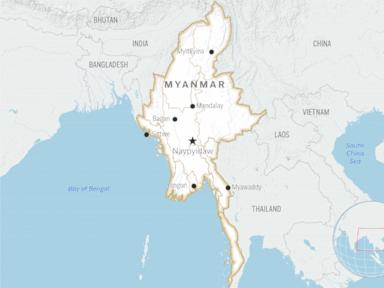
Counting seized bases in Myanmar's civil war mistakes tactical real estate for strategic control. When the State Administration Council (SAC) announced on November 10, 2026, that its columns had overrun a National Unity Government (NUG) Special Region Military Command headquarters and ten satellite outposts along the Bago-Mon border, standard wire reports treated the event as a straightforward territorial reversal. That framing misses the operational mechanics driving the conflict. In asymmetric mountain warfare, fixed jungle headquarters are consumable infrastructure, while logistics corridors, artillery range, and manpower regeneration rates determine who holds the initiative.
Deconstructing the six-day operation from November 3 to November 8 across Kyaikhto Township in Mon State and Shwegyin Township in Bago Region exposes how the military junta is applying concentrated force to relieve pressure on its central transport arteries. At the same time, it reveals the structural vulnerabilities of decentralized opposition networks when they transition from mobile guerrilla units to static command nodes.
The Operational Mechanics of the Bago-Mon Push
Standard news coverage reduces the November offensive to a tally of eleven captured installations and a list of seized materiel—rifles, vehicles, drones, and computers. To understand why the junta committed mobile columns to this specific terrain at the onset of the dry season, analysts must map the geography of the Sittaung River valley and the Dawna-Bilauktaung mountain chain.
The operation staged out of Theinzayat, a garrison town sitting directly on the Yangon-Mawlamyine highway and rail corridor. For over two years, joint units of the Karen National Liberation Army (KNLA) and the NUG's People's Defense Forces (PDF) used the forested ridges straddling Kyaikhto and Shwegyin as an elevated launchpad to interdict junta supply convoys moving between Yangon and southeastern Myanmar. By pushing northeast along the mountainous route from Theinzayat, SAC infantry columns executed a textbook spoiling attack designed to push opposition mortar and drone teams beyond effective range of the coastal plain.
The sequence of the assault demonstrates a deliberate phased approach rather than an opportunistic raid:
- Shaping via Aerial Attrition: Six weeks prior to the ground incursion, on September 24, 2026, regime fighter jets struck the NUG's Special Region communications and command post, killing six personnel, including prominent Myanmar Air Force defector Nay Win Aung. This strike degraded the facility's signal intelligence and coordination capacity before ground troops ever left their staging bases.
- Perimeter Stripping: Between November 4 and November 7, advancing columns systematically cleared four temporary KNLA outposts screening the approaches in Kyaikhto Township. Removing these forward observation screens blinded the main headquarters to the speed and axis of the junta's advance.
- Core Exploitation: By November 8, SAC forces overran the primary NUG Special Region Military Command compound and the remaining satellite camps. Seizing computers and communications hardware—the primary intelligence prize of any headquarters raid—allowed regime intelligence to map local PDF supply caches, courier routes, and unit rosters.
Three Structural Drivers Behind the Junta's Tactical Resurgence
Surface-level reporting attributes isolated regime gains to sudden momentum shifts. In reality, the November 2026 Bago-Mon operation reflects three quantifiable structural adjustments made by Naypyidaw between 2024 and late 2026.
1. Conscription-Driven Force Regeneration
Following the catastrophic territorial losses of late 2023 and 2024, the SAC faced an acute infantry deficit that prevented it from holding static outposts while simultaneously fielding mobile strike columns. The enforcement of the People's Military Service Law in early 2024 altered the manpower equation. By late 2026, the military had inducted well over 140,000 conscripts—more than 70 percent through coercive mobilization. While conscript units suffer from low morale and high desertion rates when deployed independently, they serve a specific organizational function: backfilling rear-area garrisons and static checkpoints along the Yangon-Mawlamyine corridor. This frees veteran light infantry divisions to conduct focused, six-day offensive sweeps into contested hills.
2. Geopolitical Insulation on the Northern Front
Warfare in Myanmar operates as a connected system of fronts; pressure relieved in one theater immediately transfers combat power to another. Throughout 2025 and 2026, diplomatic and economic pressure from Beijing forced key northern ethnic armed organizations—specifically elements of the Three Brotherhood Alliance—into fragile ceasefires or localized stand-downs along the Chinese border. Without the existential threat of coordinated armored and drone offensives descending from northern Shan State toward Mandalay, the SAC general staff reallocated aviation fuel, artillery shells, and strike units to southern theaters like Bago, Mon, and Kayin states.
3. The Vulnerability of Fixed Resistance Infrastructure
As the anti-junta coalition matured from dispersed urban cells into brigade-sized formations, it built permanent administrative and command centers to manage taxation, recruitment, and joint operations. This institutionalization created a classic counterinsurgency vulnerability. Guerrilla forces survive through dispersion and mobility; fixed headquarters require perimeter defense, generator power, and vehicle access, all of which generate thermal, visual, and electromagnetic signatures. Once the SAC combined commercial drone reconnaissance with precision airstrikes, static jungle bases became liability traps rather than force multipliers.
Evaluating the Information Asymmetry
Any rigorous assessment of the Bago-Mon clash must separate verified battlefield facts from state propaganda and resistance spin. Because independent journalists cannot freely access active combat zones in Kyaikhto or Shwegyin, analysts rely on cross-referencing hostile reporting streams.
- Confirmed Facts: Both junta state media (CINCDS) and local PDF fighters interviewed by independent outlets such as The Irrawaddy confirmed that the NUG Special Region Military Command headquarters fell on November 8, 2026. Photographic evidence released by regime channels showed troops occupying timber-and-tarpaulin structures matching the terrain of the Bago-Mon border. Furthermore, the September 24 airstrike on the same facility is independently corroborated by both NUG statements and local reporting.
- Unverified Claims: The exact number of resistance casualties, the operational utility of the captured drones and computers, and whether all ten satellite bases were active military installations or abandoned seasonal shelters remain unverified. State media routinely inflates tactical counts by classifying empty logistics huts or temporary resting points as distinct "bases."
- Educated Hypotheses: The rapid collapse of the perimeter between November 4 and November 8 strongly suggests an ammunition or air-defense deficit among the defending PDF and KNLA units, combined with an orderly withdrawal once artillery and air strikes made the ridgeline untenable. When outgunned resistance units abandon fixed camps, they preserve manpower at the cost of physical infrastructure.
The Cost Function of Holding Mountain Terrain
Seizing a jungle headquarters and holding it are two entirely different military problems. In military operations research, the cost function of territorial occupation rises exponentially when the occupier lacks local population support and faces contiguous hostile terrain.
To capture the Kyaikhto-Shwegyin command posts, the SAC massed mobile columns for a six-day push supported by close air support. However, once those columns halt and establish defensive perimeters on the captured ridges, the tactical polarity reverses. Every liter of diesel, box of 81mm mortar rounds, and ration pack required to sustain a garrison in the Bago-Mon hills must travel up narrow, forested tracks from Theinzayat.
This creates an immediate logistical bottleneck for the military:
- Ambush Exposure: Supply convoys moving along single-lane mountain roads become predictable targets for improvised explosive devices and standoff drone drops by the very KNLA and PDF units that dispersed into the surrounding canopy.
- Troop Dispersion: Between May and November 2026, the junta claimed the recapture of roughly two dozen towns and major positions nationwide out of more than a hundred previously lost. Each recaptured node requires hundreds of troops to garrison. Stretching conscript-heavy battalions across isolated mountain outposts dilutes combat power and recreates the exact static vulnerability that allowed resistance forces to overrun hundreds of junta bases in 2023 and 2024.
- Operational Signal Compromise: While the loss of computers at the NUG headquarters forces the resistance to rotate encryption keys, relocate command cells, and audit compromised networks, it does not destroy the underlying recruitment base or the KNLA's parallel administrative structures in neighboring Karen State.
Strategic Forecasts and Operational Imperatives
The fall of the Bago-Mon Special Region headquarters signals an intensification of dry-season fighting across southern Myanmar rather than a decisive collapse of the southern resistance. Over the next ninety days, battlefield dynamics in Mon, Bago, and Kayin states will follow three predictable trajectories.
First, the SAC will attempt to replicate the Theinzayat template along other critical economic corridors, prioritizing highways, cross-border trade routes to Thailand, and power grid infrastructure over remote rural townships. Expect short, high-intensity combined-arms sweeps lasting five to ten days, preceded by targeted aerial strikes on suspected command nodes.
Second, NUG and KNLA commanders must abandon fixed, centralized regional headquarters within artillery or tactical aviation range of major river valleys. Command-and-control architecture must shift back to distributed, mobile cells operating on a strict 48-to-72-hour displacement cycle, separating administrative logistics from active combat coordination so a single raid cannot yield both physical terrain and digital intelligence.
Third, the decisive metric to watch between December 2026 and April 2027 is not the number of jungle camps the junta claims to capture, but whether SAC supply convoys can traverse the Yangon-Mawlamyine highway without armored escorts. Until the military can secure continuous, uncontested logistics along the coastal plain, overrunning mountain headquarters remains an expensive exercise in temporary displacement.