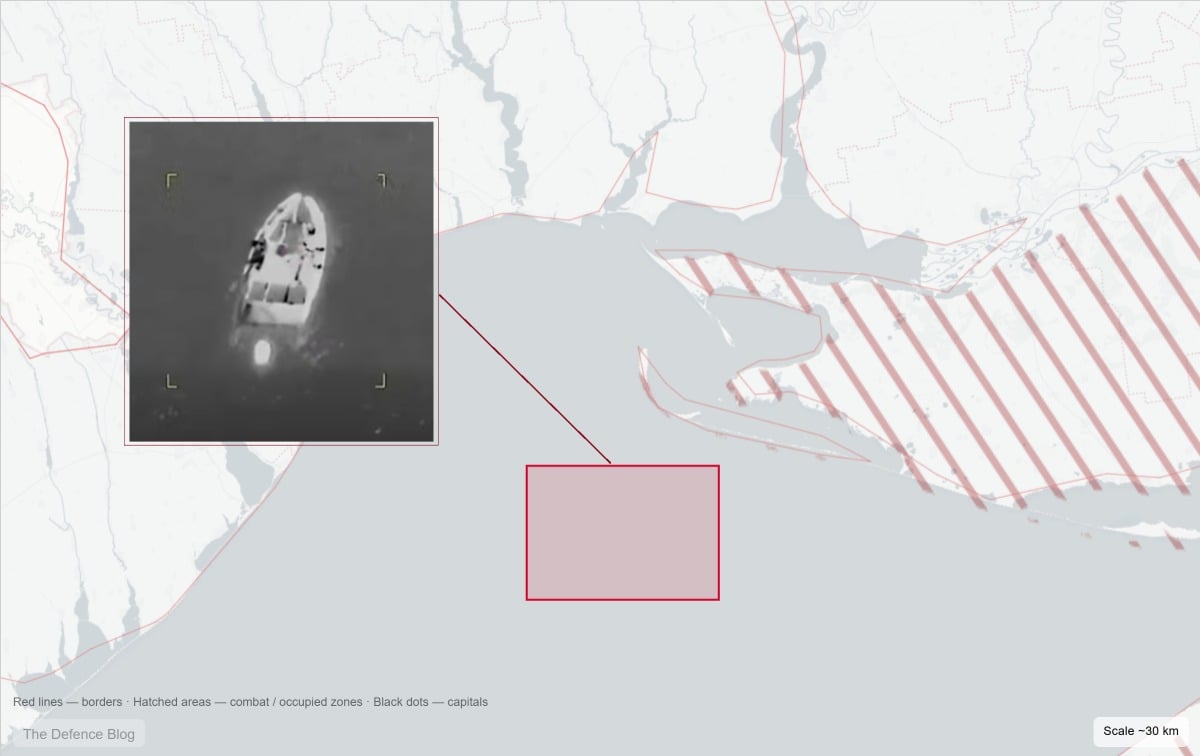
The destruction of three Russian Unmanned Surface Vehicles (USVs)—commonly called drone boats—by Ukrainian Bayraktar TB2 Unmanned Aerial Vehicles (UAVs) provides a stark data point for modern naval doctrine. While early coverage framed this engagement as a simple tactical victory, a rigorous operational assessment reveals a deeper structural friction: the shifting unit economics and kinetic asymmetries governing littoral (near-shore) combat zones.
This engagement demonstrates that the primary bottleneck in autonomous maritime deployment is no longer range or payload capacity, but rather the structural vulnerability of uncrewed surface vessels to medium-altitude, precision-guided aerial platforms when operating outside a comprehensive air-defense umbrella.
The Three Pillars of Tactical Asymmetry
To quantify why this engagement unfolded with zero friendly casualties and maximum target neutralization, the encounter must be broken down into three distinct operational variables.
1. The Sensor-to-Shoot Horizon
A surface-bound drone boat operates under a severe geometric limitation: the radar and electro-optical horizon. For an asset riding low in the water to reduce its radar cross-section, the maximum line-of-sight detection range against other surface assets or low-altitude threats is severely restricted by the curvature of the Earth.
Conversely, a Bayraktar TB2 operating at an altitude of 15,000 to 20,000 feet commands an expansive sensor field. The aircraft's electro-optical payload can identify, track, and laser-designate a high-speed surface target from dozens of kilometers away, well before the surface vessel can generate a tracking solution or deploy passive countermeasures.
2. Kinetic Energy Vectors
The physics of the engagement inherently favor the aerial platform. The Ukrainian forces utilized laser-guided micro-munitions, such as the MAM-L or MAM-C, which rely on a gravity-assisted glide path.
- MAM-L Weight: ~22 kg
- MAM-C Weight: ~6.5 kg
Because these munitions do not require heavy rocket motors to achieve lift, their structural weight is dedicated almost entirely to the warhead and guidance systems. The drone boats, traveling through a dense fluid medium (water), face immense hydrodynamic drag, meaning they must expend considerable energy to execute evasive maneuvers. The kinetic energy vector of a gravity-dropped bomb accelerating downward eliminates the speed advantage of a fast-attack craft.
3. Electronic Warfare and Command Link Resilience
Unmanned surface assets rely heavily on satellite communications (SATCOM) or direct line-of-sight radio links to stream telemetry back to operators. An aerial drone positioned at a high angle relative to the target can observe the physical positioning and intercept or jam localized communications lines more effectively. In this specific engagement, the absence of Russian electronic warfare assets capable of disrupting the TB2’s command loop created an uncontested operational environment for the Ukrainian operators.
The Cost Function of Autonomous Maritime Interdiction
A critical error in standard defense analysis is focusing strictly on hardware replacement costs. To understand the true strategic impact, we must analyze the total operational cost function.
$$\text{Total Cost} = C_{\text{hardware}} + C_{\text{logistics}} + C_{\text{opportunity}}$$
While a Bayraktar TB2 represents a multi-million dollar asset, its ordnance costs are remarkably low. A single MAM-L munition costs a fraction of a standard anti-ship cruise missile like the Neptune or Harpoon. By utilizing low-mass, high-precision munitions to eliminate three Russian USVs, Ukraine achieved an exceptionally favorable cost-exchange ratio.
The loss for the Russian forces extends beyond the physical hulls of the drone boats. The operational cost includes the specialized testing, localized launch logistics, and the loss of intelligence-gathering or kinetic capabilities that those three assets were deployed to achieve. When air superiority or air denial is not established over the deployment zone, the cost function of operating surface drones escalates exponentially due to a near-zero survival probability.
Operational Vulnerabilities in Russian USV Design
The neutralization of these three vessels highlights clear design trade-offs that skewed toward vulnerability. The primary weakness stems from a failure to integrate passive automated defensive measures or localized anti-air capabilities.
Standard naval doctrine dictates that surface assets must possess layered defense systems. However, miniaturizing these systems to fit a small, uncrewed hull introduces massive weight, power, and thermal management penalties. A surface drone equipped with an active radar or short-range surface-to-air missiles requires a larger engine, which increases both its acoustic signature and its thermal profile.
Russia's choice to deploy these boats without such systems implies they were configured for low-cost, high-speed profile missions. This design choice assumes that low physical profile and high speed would protect them from detection—a hypothesis thoroughly disproven by modern multi-spectral aerial surveillance.
Strategic Shift in Black Sea Operations
This engagement forces an immediate recalculation of how littoral corridors are contested. Sea control can no longer be achieved purely through surface-to-surface or sub-surface dynamics. The presence of persistent, medium-altitude aerial platforms invalidates traditional fast-attack craft tactics.
The second limitation exposed by this strike is the geographic restriction placed on Russian naval operations. If Russian forces cannot guarantee localized air defense, their surface assets—crewed or autonomous—cannot reliably project power into the northwestern Black Sea. This creates a defensive bottleneck where Russian naval assets are confined to port zones or heavily defended bastions, ceding the initiative to dynamic, multi-domain Ukrainian forces.
Naval planners must recognize that the future of littoral defense requires a tightly integrated network where aerial platforms act as the primary hunters, neutralizing fast-surface threats before they can close within striking distance of high-value coastal infrastructure or transport shipping.