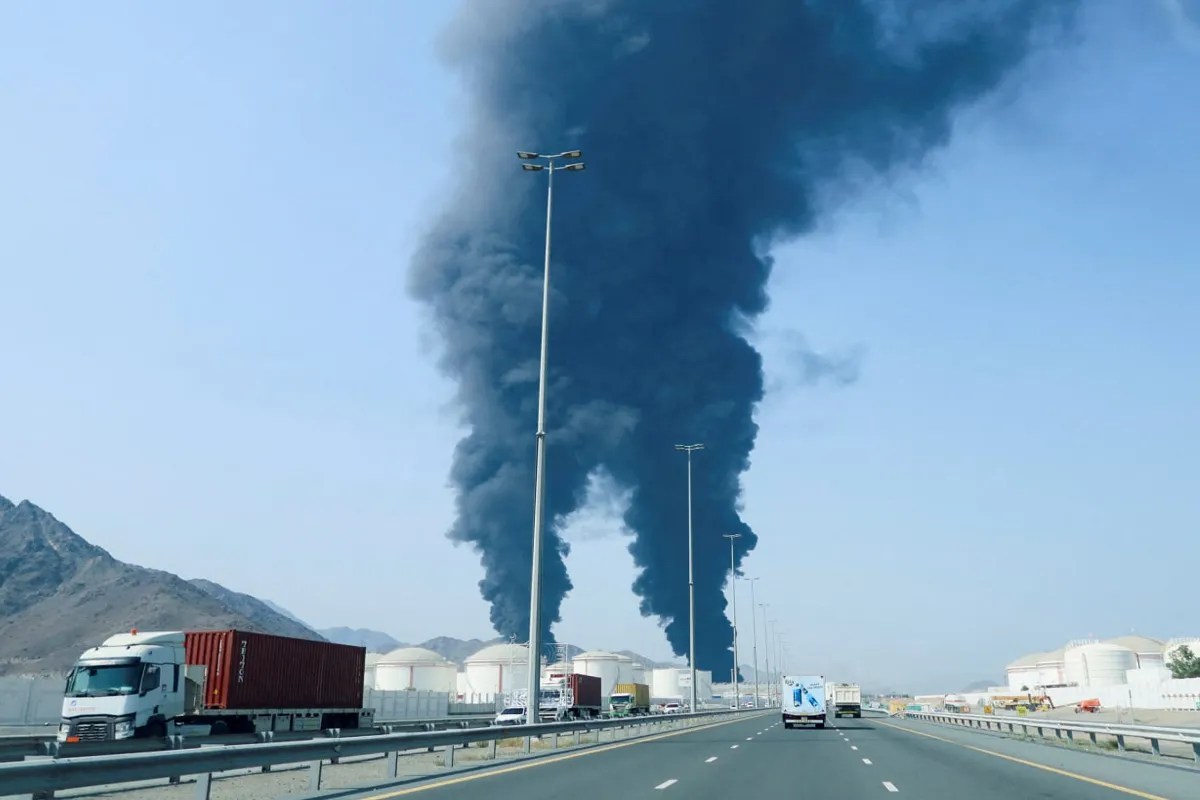
The physical security barrier surrounding modern nuclear infrastructure is no longer defined by concrete perimeters or localized anti-missile batteries. The drone strike on an ancillary electrical generator outside the inner perimeter of the Barakah Nuclear Power Plant in Abu Dhabi’s Al Dhafra region demonstrates a fundamental shift in asymmetric warfare: the targeting of non-nuclear systemic vulnerabilities to achieve high-leverage political and economic disruption. While the core radiological containment structures remained entirely unaffected, the incident exposes the fragile reality of critical infrastructure defense within contemporary kinetic conflict zones.
Understanding the operational reality of this strike requires separating sensationalized reporting from structural engineering and tactical design. Nuclear power plants are not uniform blocks of hazard; they are highly zoned industrial complexes where the distance between a component and the reactor core dictates its defensive redundancy and structural hardening. Recently making news recently: The Moscow Air Defense Bottleneck: Quantifying Third-Party Attrition in Deep Strike Operations.
Structural Hardening and Boundary Layering
The Barakah facility utilizes four South Korean-designed APR-1400 reactor units. These units are housed within robust containment buildings engineered specifically to withstand extreme external kinetic impacts, including direct commercial aircraft strikes. The defense-in-depth architecture splits the facility into distinct operational zones:
- The Inner Perimeter (The Nuclear Island): This zone contains the reactor pressure vessel, steam generators, and primary coolant loops. It is protected by reinforced concrete containment walls several feet thick, lined with steel.
- The Outer Perimeter (The Balance of Plant): This zone houses the secondary systems, including the main turbines, water treatment facilities, and primary electrical transformation systems.
- The Ancillary Infrastructure: This includes external switchyards, auxiliary backup generators, and administrative complexes located outside the primary security zones.
The strike hit an electrical generator situated in this third, outermost zone. By striking an asset outside the inner perimeter, the vector bypassed the primary concrete containment defenses. The immediate consequence was a localized, conventional industrial fire rather than any breach of radiological containment. Further insights on this are covered by Reuters.
The Redundancy Matrix and Safety Interventions
The Federal Authority for Nuclear Regulation (FANR) and the International Atomic Energy Agency (IAEA) confirmed that the facility’s essential systems maintained structural readiness. When an external generator fails or is compromised by an attack, a nuclear facility activates a pre-engineered matrix of power redundancies to ensure continuous cooling to the reactor core:
[Main Grid Connection] ---> Affected by External Disruption
          |
          v (Failure Trigger)
[Auxiliary External Generators] ---> Targeted/Compromised Zone
          |
          v (Automatic Isolation)
[Emergency Diesel Generators (EDGs)] ---> Inner Perimeter Activated
          |
          v
[Continuous Core Cooling Restored]
According to reports from the IAEA, at least one reactor unit automatically transitioned to emergency diesel generators (EDGs) to maintain power continuity. These internal EDGs are heavily fortified, isolated from the outer perimeter, and designed to run independently for days to prevent thermal escalation in the core. The failure of sensationalist analyses to distinguish between an external electrical fire and a core containment breach misrepresents the fundamental physics of modern nuclear safety systems.
Asymmetric Vector Mechanics and Interception Failures
The United Arab Emirates Ministry of Defence reported that the strike was executed via a three-drone formation entering from the country’s western border. While air defense systems successfully intercepted two of the vectors, the third reached its destination. This demonstrates the mathematical reality of modern saturation tactics:
$$P(\text{System Failure}) = 1 - (1 - P(\text{Single Vector Penetration}))^n$$
Where $n$ represents the number of coordinated vectors. As $n$ increases, or as low-signature profiles reduce the probability of detection, the statistical likelihood of a single asset penetrating an integrated air defense network increases. Low-altitude, low-radar-cross-section (RCS) unmanned aerial vehicles (UAVs) present distinct tracking challenges for standard long-range surface-to-air missile systems, which are optimized for high-altitude ballistic or cruise missile profiles.
The choice of target indicates a deliberate economic and psychological calculus rather than a failed attempt to cause a nuclear disaster. Striking an external energy supplier or generator sends a dual message to state actors:
- It demonstrates the capability to map and penetrate the wider airspace of a critical energy installation.
- It inflicts immediate capital expenditure damage and operational friction without triggering the global military retaliation that an actual radiological release would demand.
The strategy targets the investment profile of the nation. The Barakah facility represents a $20 billion transition asset designed to provide approximately 25 percent of the UAE's domestic baseload electricity. Disrupting its output forces a reliance on spot-market hydrocarbons, directly challenging the state’s economic diversification timelines.
Geopolitical Friction Points and the Sanction Bottleneck
The incident cannot be viewed in isolation from the broader maritime and regional conflict framework in the Persian Gulf. Following the outbreak of hostiles on February 28, the region has seen sustained kinetic exchanges involving drone and missile vectors targeting critical infrastructure, alongside parallel naval blockades restricting traffic through the Strait of Hormuz.
The enforcement of the UAE's strict "123 Agreement" with the United States prevents domestic uranium enrichment and reprocessing of spent fuel within the Emirates. While this framework maximizes global trust and mitigates proliferation concerns, it creates a structural supply-chain dependency. The facility relies entirely on imported fuel rods. A prolonged regional conflict that closes shipping lanes or targets infrastructure complicates the logistics of fuel delivery and spent-rod extraction, introducing a secondary layer of operational risk unrelated to direct kinetic damage.
The lack of an immediate, official attribution from Abu Dhabi reflects a calculated diplomatic strategy to manage escalation. While regional proxy forces have previously claimed operations against the facility during its construction phase, the deployment of long-range UAVs across Western borders indicates a highly organized command structure.
The structural limitation of defending such installations lies in the sheer scale of the auxiliary infrastructure required to run them. A state cannot encase miles of external switchyards, cooling channels, and secondary generators in three-foot-thick reinforced concrete. Consequently, the strategic defense priority must pivot from localized physical hardening to advanced, multi-layered electronic warfare, directed-energy interception systems, and proactive counter-UAS (Unmanned Aircraft Systems) blankets capable of neutralizing vectors tens of kilometers before they reach the facility's outer perimeter.