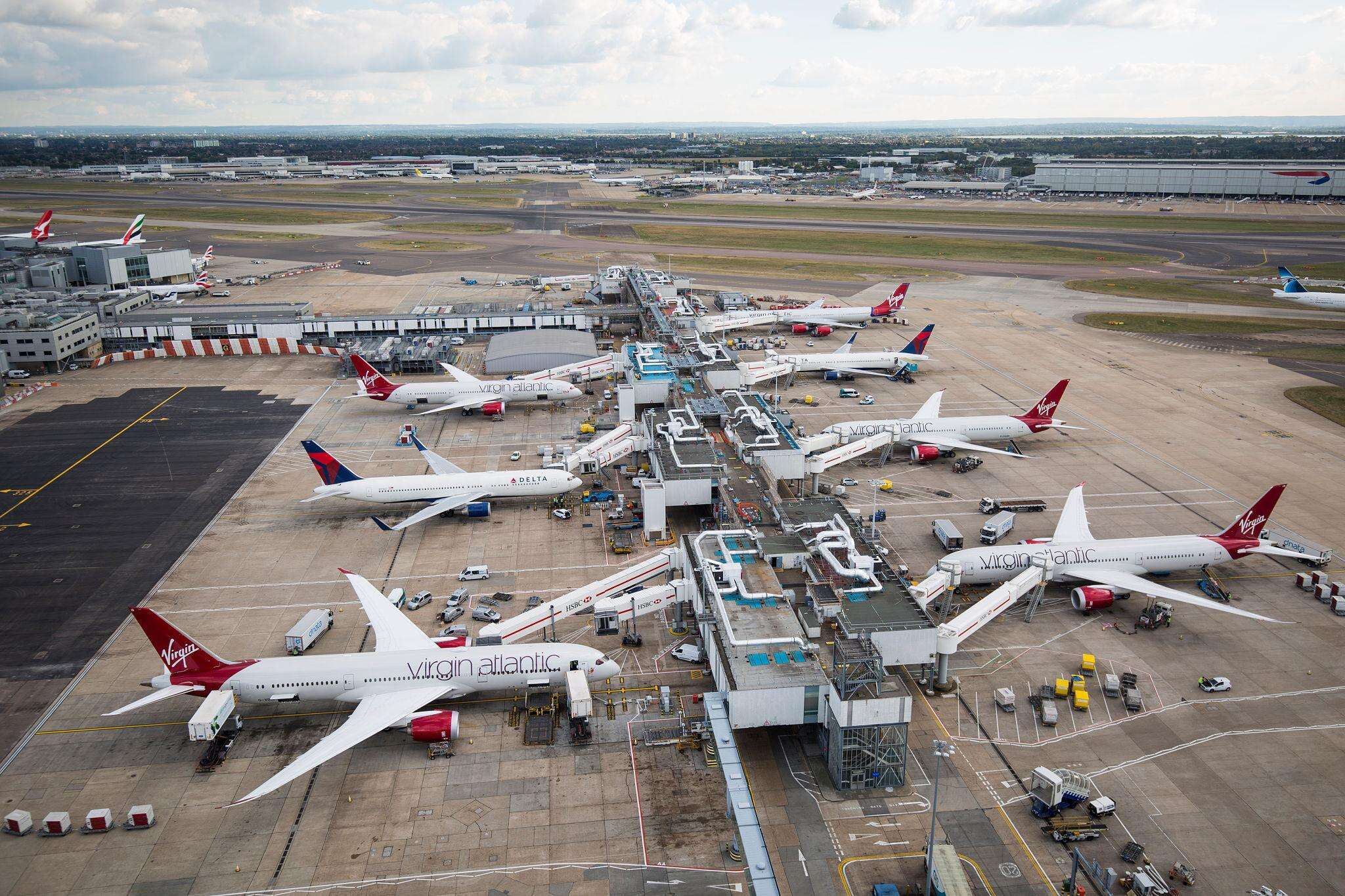
The operational collapse of London's primary aviation hubs during summer convective weather events is not a failure of individual airline scheduling, but an inevitable mathematical outcome of hyper-utilized runway infrastructure operating under rigid safety parameters. When severe thunderstorms transitioned from a record-breaking European heatwave across Southern England, flight tracking data captured more than 1,000 combined flight delays and over 200 cancellations across London Heathrow (LHR) and London Gatwick (LGW). While consumer-facing media focuses on passenger frustration and grounded aircraft, a structural analysis reveals that these disruptions are governed by deterministic constraints in airspace capacity, regulatory indemnity frameworks, and network-wide cascading loops.
To understand why a localized weather system paralyzes the UK's capital while leaving regional airports largely unaffected, operations must be analyzed through the mechanics of Air Traffic Management (ATM) and the structural capacity limits of the London terminal maneuvering area.
The Tri-Factor Capacity Compression Framework
Airspace capacity during a convective weather event is dictated by three interlocking variables that compress the maximum allowable movements per hour. When these variables shift simultaneously, the system drops below its operational equilibrium.
Tactical Airspace Redirection and Sector Slicing
Commercial aircraft cannot fly through mature cumulonimbus clouds due to severe turbulence, structural icing, and lightning hazards. Air traffic control (ATC) authorities, managed in the UK by National Air Traffic Services (NATS), must divert aircraft around these storm cells. This alters the predictable, pre-filed flight paths into highly irregular trajectories.
When multiple aircraft deviate into adjacent, unaffected airspace sectors, those sectors rapidly approach their sector capacity limits—the maximum number of aircraft a single controller can safely manage at one time. To prevent sector saturation, Eurocontrol and NATS impose flow management regulations, deliberately spacing out aircraft entries. This regulatory spacing manifests directly as ground delay programs at departure airports.
Runaway Separation Inflation
Under standard instrument meteorological conditions, aircraft are separated by strict distance or time intervals to avoid wake turbulence. Convective activity introduces wind shear and microburst hazards near the airfield, forcing ATC to transition from standard separation to increased tactical spacing.
At Heathrow, which operates at roughly 98% of its theoretical physical runway capacity under clear skies, any inflation in the required separation distance immediately creates an unrecoverable backlog. If the arrival rate drops from 45 aircraft per hour to 30, the airport accumulates a deficit of 15 aircraft every hour. Because the runway asset is constrained, there are no vacant operational slots later in the day to absorb this surplus, resulting in multi-hour delays that roll forward across the entire schedule.
Ground Operations Interruption and the Ramp Freeze
The physical manifestation of a thunderstorm directly at the hub introduces a binary operational stoppage known as a ramp freeze. When lightning strikes are detected within a critical radius (typically 3 to 5 nautical miles) of the airport, ground handling policies mandate that all ramp operations cease immediately to protect personnel.
- Ground refueling is halted due to combustion risks.
- Baggage loading and unloading operations are suspended.
- Aircraft pushback tugs are locked down.
During a ramp freeze, arriving aircraft may successfully land but cannot deplane, trapping passengers on the tarmac for hours. This creates a secondary bottleneck: occupied gates cannot receive subsequent arriving flights, forcing ATC to hold aircraft in airborne stacks or divert them to alternate airfields once fuel reserves hit final reserve fuel margins.
The Asymmetrical Burden of LHR and LGW
Data from Eurocontrol confirms that during major convective events over Southern England, heavy delays are heavily concentrated at Heathrow and Gatwick, while regional airports experience minimal disruptions. This divergence is explained by infrastructural architecture and airline fleet composition.
Heathrow relies on two parallel runways operating in segregated mode (one exclusively for arrivals, one for departures), meaning any reduction in acceptance rates causes immediate airborne holding. Conversely, Gatwick is the busiest single-runway airport in the world, leaving it with zero structural redundancy. A 10-minute ground delay at Gatwick disrupts a tightly packed sequence of low-cost carrier turnarounds.
The variance in airline business models further dictates how this disruption is managed:
- Network Network Carriers (e.g., British Airways at Heathrow): Rely heavily on hub-and-spoke models. A delay on an inbound short-haul flight from Venice breaks the connection for passengers transferring to long-haul flights. The carrier face an optimization problem: delay the long-haul departure (risking downstream gate delays globally) or leave the passengers behind (incurring re-routing and care costs).
- Point-to-Point Carriers (e.g., easyJet at Gatwick): Rely on high aircraft utilization, with frames flying up to six sectors a day with 30-minute turnarounds. A two-hour delay on sector one compounds linearly across the day. By sector five or six, the crew risks exceeding their legally mandated Flight Duty Period (FDP) limits. This forces pre-emptive cancellations to reset the network for the following operational day.
The Compensation Exemption and Economic Friction
A points of friction between stranded passengers and airlines during weather disruptions is the statutory definition of extraordinary circumstances. Under UK Air Passenger Rights regulations (retained from EU261/2004), airlines are legally exempt from paying direct cash compensation for delays exceeding three hours if the disruption is caused by factors outside their operational control.
Air traffic control restrictions triggered by adverse weather are universally classified as extraordinary circumstances. Because NATS or Eurocontrol mandates the slot restrictions, the airline bears no liability for the delay itself. However, this exemption does not absolve carriers from their strict duty of care. Under the framework, airlines remain financially liable for:
- Providing hotel accommodation for overnight delays.
- Organizing alternative transport to the final destination at the earliest opportunity.
- Providing meals and refreshments proportional to the waiting time.
This creates an economic asymmetry. While airlines avoid direct compensation payouts, a prolonged multi-hub disruption generates millions in unbudgeted operational expenses through hotel block bookings, stranded aircraft repositioning costs, and the consumption of reserve crew standby hours.
The Network Recovery Matrix
When a severe weather event subsides, air traffic systems do not instantly return to baseline. The recovery phase requires solving a complex multidimensional puzzle where aircraft, crew, and physical gates must be realigned.
[Convective Weather Interruption]
               │
               ▼
┌──────────────────────────────┐
│  Airspace Capacity Dropped   │
└──────────────┬───────────────┘
               │
               ▼
┌──────────────────────────────┐
│  Downstream Slot Allocation  │
└──────────────┬───────────────┘
               │
               ▼
┌──────────────────────────────┐
│  Frame / Crew Displacement   │
└──────────────┬───────────────┘
               │
               ▼
┌──────────────────────────────┐
│  Airport Curfew Constraints  │
└──────────────────────────────┘
The primary barrier to rapid recovery is frame and crew displacement. An aircraft delayed in Venice cannot operate its subsequent outbound leg from Gatwick, stranding the passenger cohort waiting at the departure gate. Simultaneously, flight crews running behind schedule may exhaust their legal duty hours mid-route, requiring a replacement crew to be deployed from standby pools.
This recovery friction is further exacerbated by nighttime airport curfews. Both Heathrow and Gatwick operate under strict nocturnal noise quotas, heavily restricting movements between 23:30 and 06:00. When day-long weather delays push dozens of flights into these curfew hours, airport operators face a zero-sum choice: grant emergency dispensations to clear the backlog (drawing political ire from local communities) or force airlines to cancel flights and divert aircraft to uncurfewed regional hubs, prolonging the disruption into the next operational cycle.
To mitigate the accelerating frequency of these climate-induced capacity crunches, the aviation industry cannot rely on static schedule padding. The strategic mandate requires a transition to dynamic, data-driven slot allocation mechanisms. Carriers must systematically lower runway utilization targets during high-probability convective windows, trading a marginal reduction in peak-hour revenue for system-wide structural resilience.


:max_bytes(150000):strip_icc():focal(999x0:1001x2)/taylor-swift-albums-1-93026ca98408417097660e117a10a6a9.jpg)