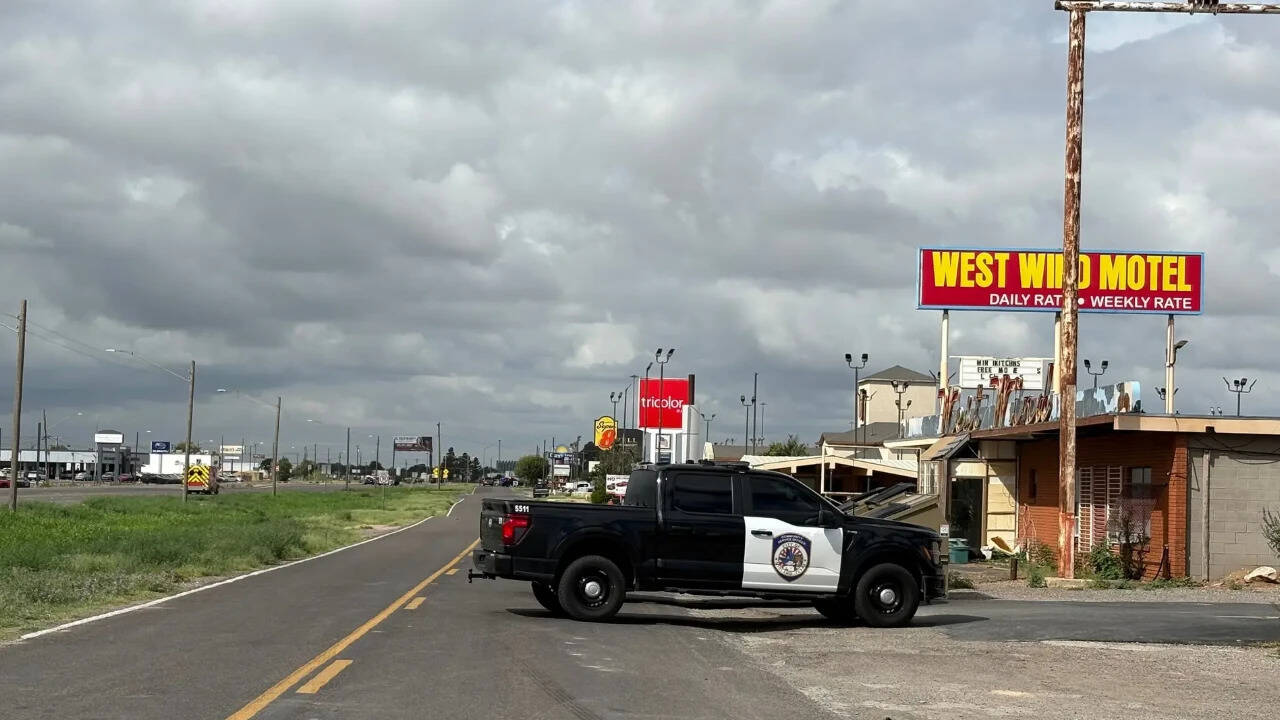
The containment of a violent active threat inside an urban or industrial perimeter represents one of the most volatile friction points in modern law enforcement operations. When a suspect transitions from evading capture to executing a mass casualty event, the strategic objectives of responding units must instantly pivot from investigative apprehension to aggressive kinetic containment. The lethal kinetic incident on June 12, 2026, in Midland, Texas, underscores the systemic vulnerabilities inherent in high-velocity active threat response, specifically highlighting how latent systemic gaps in multi-jurisdictional suspect tracking can escalate into multi-milieu urban violence.
Analysis of the operational sequence reveals that the incident was not a spontaneous mass shooting, but rather the terminal phase of a continuous, multi-day threat cycle. By dissecting this sequence into distinct structural phases—the Failure of Initial Interdiction, the Open-Area Rampage Phase, and the Barricade and Containment Phase—we can isolate the tactical friction points and structural mechanics that dictate the outcomes of high-risk law enforcement standoffs.
The Operational Timeline and Threat Cycle
The tactical failures and eventual containment operations follow a definitive chronological structure. Isolating these inflection points demonstrates how a localized traffic stop can expand into a regional mass casualty event over a 40-hour period.
+-----------------------------+
| Phase 1: Initial Interdiction| -> June 10, 11:23 PM: Traffic stop on Anetta Drive
| (Failure of Capture)        |    Suspect fires rifle at officer; evades cordon
+-----------------------------+
               |
               v
+-----------------------------+
| Phase 2: Open-Area Rampage  | -> June 12, 8:00 AM: Random firing at vehicles
| (Kinetic Escalation)        |    1 fatality (city employee), 10 injuries sustained
+-----------------------------+
               |
               v
+-----------------------------+
| Phase 3: Standoff & Border  | -> June 12, 10:00 AM - 12:30 PM: Perimeter established
| (Barricade & Verification)  |    SWAT breaches; Unmanned systems confirm suspect deceased
+-----------------------------+
Phase 1: The Failure of Initial Interdiction
The active threat cycle initiated on Wednesday, June 10, 2026, at approximately 11:23 p.m. Officers from the Midland Police Department attempted a routine traffic interdiction in the 4800 block of Anetta Drive. The subject, subsequently identified as 45-year-old Victor Mata Villarreal of Odessa, fled several blocks before halting his vehicle in the 4700 block of Comanche Drive.
Upon exiting the vehicle, Villarreal deployed a rifle, discharging multiple rounds directly at a police officer before fleeing into the surrounding terrain on foot. Despite an immediate local cordon and an exchange of gunfire, responding units failed to secure a definitive visual lock or maintain containment, allowing the suspect to dissolve into the local environment. The targeted officer survived without injury and was standardly placed on administrative leave, but the operational outcome was an uncontained, highly armed fugitive wanted for attempted capital murder of a peace officer.
Phase 2: The Open-Area Rampage
Approximately 32 hours after evading the initial perimeter, the threat profile escalated from passive evasion to active, indiscriminate mass violence. On Friday, June 12, 2026, at 8:03 a.m., emergency dispatch received the initial reports of active gunfire in the southwestern industrial corridor of Midland, specifically near the intersection of Industrial Avenue and West Wall Street.
Villarreal utilized an open-area movement strategy, moving through multiple sectors of the city while firing randomly at civilian vehicles driving past. The primary target selection criteria appeared entirely indiscriminate, optimized purely for maximum psychological and physical disruption within a high-transit zone. During this fluid movement phase, 11 civilian casualties were generated. Ed Scott, a municipal employee for the City of Midland, sustained fatal trauma. Ten additional individuals sustained non-fatal gunshot wounds before local law enforcement could re-establish physical contact with the shooter.
Phase 3: Barricade and Containment
Faced with rapidly converging law enforcement elements, the suspect altered his tactical posture from mobile assault to a static, defensive barricade strategy. Villarreal took refuge inside an abandoned commercial building—identified as a shuttered veterinary facility—located within the 4600 block of West Wall Street, adjacent to Business 20 and Eisenhower Drive.
By 8:15 a.m., local units had established an outer perimeter, effectively halting the suspect’s forward progression but shifting the operational problem to a high-risk barricade resolution scenario. The ensuing standoff lasted approximately four hours. A combined force of roughly 100 tactical and patrol assets, including local police, the Texas Department of Public Safety, and special agents from the Federal Bureau of Investigation, consolidated on the scene.
Witnesses noted a sustained barrage of at least 40 gunshots during the intense containment phase. Rather than risking high-casualty close-quarters battle maneuvers inside an unmapped, abandoned structure, tactical command deployed heavily armored vehicles to breach the perimeter fencing and introduced unmanned ground vehicles (robots) and aerial drones into the interior space. At approximately 11:30 a.m., remote telemetry provided visual confirmation that Villarreal was deceased inside the structure, bringing the active phase of the operation to a close without further injuries to first responders.
Trauma Triage and Surge Capacity Mechanics
The survival rate of mass casualty events relies heavily on the structural resilience and surge capacity of regional trauma networks. In mid-sized municipalities like Midland, which has a population base of approximately 140,000, a sudden influx of double-digit ballistic trauma patients tests the upper limits of local emergency infrastructure.
Midland Memorial Hospital served as the primary destination for the casualties. The institutional response followed an established surge protocol designed to maximize survival while protecting the facility from potential secondary attacks.
- Security Lockdown Demarcation: Immediately upon notification of an active mass casualty event, the hospital instituted a strict lockdown protocol on its Emergency Department. This measure mitigates the risk of a secondary shooter penetrating the care facility or an ongoing threat following victims into the triage zone.
- Surgical Resource Allocation: Nine trauma patients were received and triaged simultaneously. The clinical breakdown reveals the severity of the wounding patterns:
- Acute Surgical Intervention Group: Four patients presented with high-acuity injuries requiring immediate operative management to control internal hemorrhage and stabilize systemic vital signs. By Friday afternoon, three had successfully transitioned to post-operative recovery, while one remained in surgery.
- Stable Observation Group: Five patients were assessed, stabilized within the emergency department, and deemed sufficiently out of acute danger to be systematically discharged or transferred to lower-acuity units later that afternoon.
The survival of all nine hospitalized victims highlights the efficacy of immediate tactical triage and the availability of uncommitted surgical suites during the initial golden hour of trauma resuscitation.
The Structural Mechanics of the Failure of Capture
To understand why a known, high-risk suspect was able to transition from an armed fugitive to a mass shooter within a 40-hour window, we must evaluate the structural mechanics of law enforcement evasion. The failure to capture Villarreal during the Wednesday night pursuit stems from two main systemic variables: urban terrain complexity and the lack of automated tracking networks.
The Terrain Disadvantage
The initial exchange of gunfire occurred in a residential and semi-commercial transition zone in Midland. When a suspect abandons a vehicle and flees on foot into a dark, unlit sector, the search geometry immediately shifts in favor of the evader. A single human target moving through a complex matrix of fences, outbuildings, and industrial alleys creates an exponential expansion of the required clearing area. For an area search to succeed, responding units must establish an air-tight inner perimeter within minutes of the flight. If the perimeter contains even minor gaps, the suspect can escape the immediate search zone, turning a tactical containment problem into a long-term investigative tracking problem.
Information Lag and Public Reporting Vulnerabilities
The transition between Phase 1 and Phase 2 highlights a dangerous reliance on passive community intelligence rather than active tracking. Following the Wednesday night shooting, regional law enforcement pushed out digital alerts to local residents identifying Villarreal as an armed and dangerous fugitive. However, the system lacked continuous tracking capabilities.
On Friday morning, a civilian bystander spotted Villarreal crossing a street from the Scottish Delight Motel to a local gas station. Although the citizen immediately contacted emergency dispatch, the information lag—even when measured in a window under five minutes—permitted the suspect to initiate his kinetic assault before patrol units could arrive to execute an arrest. This highlights a fundamental vulnerability in fugitive tracking:
$$\text{Information Lag} = T_{\text{Sighting}} - T_{\text{Arrival}}$$
If $\text{Information Lag}$ exceeds the time required for a suspect to transition from concealment to engagement, the law enforcement posture remains permanently reactive.
The Evolution of Regional Mass Casualty Threats
The June 12, 2026, incident cannot be evaluated in isolation. It must be viewed as part of a recurring threat pattern within the Permian Basin region, an industrial hub defined by rapid economic cycles, transient worker populations, and a high density of firearms.
+-----------------------------------------------------------------------+
|                       PERMIAN BASIN THREAT MATRICES                    |
+-----------------------------------------------------------------------+
| FEATURE               | 2019 MIDLAND-ODESSA RAMPAGE | 2026 MIDLAND INCIDENT     |
+-----------------------+-----------------------------+---------------------------+
| Primary Vector        | Highly Mobile (Vehicular)   | Hybrid (Mobile to Static) |
| Target Selection      | Indiscriminate Highway      | Open-Area to Barricade    |
| Operational Footprint | Multi-Jurisdictional        | Localized Industrial      |
| Casualties            | 7 Fatal / 24 Wounded        | 1 Fatal / 10 Wounded      |
+-----------------------------------------------------------------------+
The historical reference point for this region is the 2019 Midland-Odessa mass shooting, where a terminated energy sector worker killed seven individuals and wounded 24 others during a multi-city vehicular rampage. Comparing the 2019 incident with the 2026 event reveals a distinct shift in the tactical operational profile.
The 2019 attack relied on a highly mobile strategy, with the shooter firing from a moving vehicle across a 30-mile transit corridor between two municipalities. This approach severely complicated law enforcement efforts to establish a fixed perimeter, as the target coordinates changed faster than police units could deploy spikes or roadblocks.
In contrast, the 2026 event utilized a hybrid operational profile. Villarreal began with a localized mobile assault but quickly transitioned into a static, defensive posture within a single industrial block. While this hybrid method still resulted in tragic losses, it allowed law enforcement to quickly deploy a tight physical perimeter. This containment effectively isolated the threat, keeping the casualty count well below the numbers seen in the 2019 vehicular rampage.
Advanced Tactical Interdiction and Technological Mitigation
The resolution of the Friday morning standoff highlights a major shift in modern tactical doctrine: the prioritization of technological mitigation over manual building clearing in high-risk barricade scenarios.
                                 [Outer Perimeter Established]
                                               |
                                               v
                                   [Armored Vehicle Breach]
                                               |
                                               v
                       +-----------------------+-----------------------+
                       |                                               |
                       v                                               v
         [Unmanned Ground Vehicles]                        [Aerial Drone Systems]
         - Micro-sonars                                    - Thermal imaging
         - Optical payloads                                - Structural interior maps
                       |                                               |
                       +-----------------------+-----------------------+
                                               |
                                               v
                                  [Biometric Verification]
                                               |
                                               v
                               [Threat Neutralized / Resolution]
When a suspect is heavily armed, has demonstrated a willingness to target law enforcement, and is barricaded inside a commercial structure, standard infantry-style room clearing introduces unacceptable levels of risk. Inside a structure like an abandoned veterinary clinic, the layout features multiple blind corners, tight corridors, and hidden spaces that favor a defensive shooter.
To manage this risk, tactical command deployed a structured technological escalation sequence:
- Mechanical Breaching: Armored units were used to knock down exterior barriers and windows, creating entry points that bypassed traditional fatal funnels like doors and entryways.
- Unmanned Ground Vehicles: Robots equipped with optical payloads and micro-sonar were sent through the breaches. These systems mapped the internal space in real time, searching for tripwires, improvised defensive barriers, and the exact position of the suspect.
- Aerial Drone Systems: Micro-drones with thermal imaging flew through upper-level openings, tracking heat signatures inside the unlit structure.
This combination of tools allowed command staff to get clear visual confirmation of the suspect's status without sending a single officer past the threshold. By the time the unmanned systems located Villarreal's body at 12:30 p.m., the operational space was fully mapped. This allowed teams to safely enter, verify his identity, and clear the building with minimal risk to personnel.
The lingering challenge for modern law enforcement is closing the operational gap between initial evasion and subsequent mass violence. When an individual fires on an officer and escapes into an urban environment, they become a high-risk liability. To prevent future incidents of this nature, agencies must build out tighter real-time data networks. This includes deploying automated license plate readers across jurisdiction lines, integrating predictive route mapping for fugitives, and setting up rapid-response tracking teams trained to deploy before a suspect can pivot from flight to active assault.