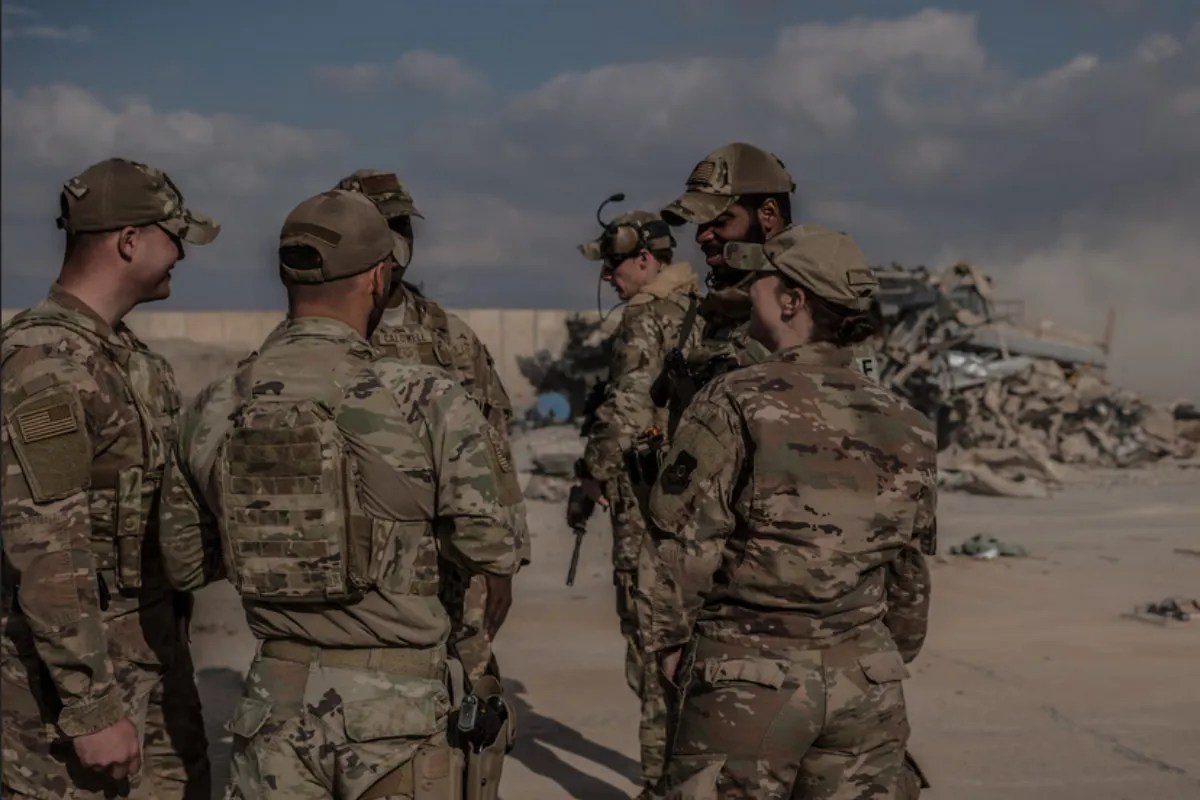
Foreign policy analysis suffers from a severe lack of imagination. Whenever the conversation turns to an American military exit from Iraq, Washington think tanks and regional desk officers instinctively reach for the exact same tired script. The chorus sings a predictable tune: American boots leave, Tehran steps into the vacuum, Shia militias consolidate absolute rule, and the region falls under unmitigated Iranian hegemony.
It is a lazy consensus. And it is entirely wrong.
For decades, analysts have treated proxy networks as frictionless extensions of state willpower. They assume that removing the external superpower adversary frees local armed factions to operate with total impunity, cementing a permanent axis of influence. This perspective ignores the messy, brutal reality of state collapse, internal friction, and the laws of imperial overreach. Far from strengthening Iran's regional position, an American withdrawal in Iraq removes the very external pressure cooker that keeps disparate factions unified, exposing internal fractures that Tehran lacks the economic and political capacity to manage.
To understand why the conventional wisdom fails, you have to look past the rhetoric of resistance and examine the raw mechanics of power in a post-intervention state.
The Glue of External Adversity
Military interventions create strange unifying dynamics. For over two decades, the persistent presence of foreign troops in Iraq provided every armed faction, political bloc, and militia leader with a singular, convenient focal point. Whenever internal corruption crippled public services, whenever unemployment soared, or whenever sectarian grievances boiled over, political elites in Baghdad and militia commanders in the provinces had a readymade scapegoat.
The occupier is the ultimate political umbrella. As long as American forces remain stationed on Iraqi soil, every local failure can be attributed to foreign interference. Every economic hardship is blamed on sanctions or military pressure. Every governance crisis is conveniently framed as an ongoing battle of national liberation.
Remove that external friction, and the umbrella vanishes.
Without an occupying force to rail against, militias lose their primary ideological justification. They are forced to transition from insurgent resistance movements to governing authorities. That transition is where armed groups go to die. Governing requires delivering electricity, managing water scarcity, balancing budgets, and providing civil administration. You cannot shoot a failing sewage system with a rocket-propelled grenade.
When the external enemy is gone, the public spotlight turns inward. The population no longer judges militias by their anti-American posturing; they judge them by whether the lights stay on. And by that metric, the militant networks are catastrophically unequipped to rule.
The Myth of Monolithic Control
Another foundational flaw in the conventional narrative is the assumption that Iraq's Shia political and military sphere is a uniform, synchronized apparatus directed from Tehran.
This view erases history, theology, and raw geopolitical ambition. Iraq is not Lebanon, where a single dominant proxy organization operates within a comparatively fragile state structure. Iraq is a vast, complex nation with competing power centers, deep-rooted nationalist traditions, and fierce internal rivalries.
Within the Iraqi Shia political sphere, the ideological friction between the Najaf religious seminary and the political-religious doctrine emanating from Qom is profound and persistent. Grand Ayatollah Ali al-Sistani and the traditional Najaf establishment have long championed a nationalist, sovereign Iraqi identity that resists foreign clerical tutelage. While numerous armed groups receive backing, training, and weaponry from Iran, their leaders are Iraqi nationalists first, regional actors second.
When American forces depart, the necessity for a united front against a common adversary dissolves. Inter-militia rivalry for control of state contracts, border checkpoints, ministry budgets, and illicit trade routes will instantly intensify. Without Washington acting as the gravitational anchor of security policy, Baghdad’s internal power struggle will not stabilize under Iranian management; it will fracture into violent competition.
Iran does not possess the financial resources or the administrative finesse to arbitrate complex internal disputes among heavily armed Iraqi factions once the overarching threat of US intervention is gone. Tehran’s influence has always thrived in the gray zone of asymmetric instability, not in managing the messy, expensive reality of domestic state stabilization.
The Economic Dead Weight of Empire
Imperial ambition is exceptionally expensive. In the fantasy world of geopolitical commentators, superpowers and regional heavyweights can project power indefinitely without breaking their own domestic banks.
Look at Iran's internal ledger. The country is buckling under severe structural economic crises. Decades of international sanctions, systemic corruption, severe water shortages, crumbling infrastructure, and rampant inflation have pushed the Iranian population to the brink of despair. Protests over basic living standards erupt with regularity, met by brutal state suppression.
Maintaining an expansive foreign proxy network across Iraq, Syria, Lebanon, and Yemen requires staggering sums of capital, subsidized fuel, and constant military resupply. When an economy is bleeding internally, funding foreign militias becomes an unsustainable luxury.
As long as the United States maintains a military footprint in the region, the Iranian regime can justify domestic austerity to its own citizens through the existential framing of a permanent regional war. The security state thrives on external threat narratives. But if American forces withdraw, the justification for pouring billions of dollars into foreign adventures while domestic hospitals lack medicine and schools lack supplies becomes increasingly indefensible to a restive public.
Tehran cannot afford to rebuild Iraq even if it wanted to. The Iraqi state requires tens of billions of dollars in infrastructure investment, reconstruction capital, and foreign direct investment to function. Iran cannot provide this. China moves with transactional caution, and Western capital remains hesitant due to security and corruption risks.
Left alone to shoulder the burden of a broken state, Iran will find that its Iraqi allies are not assets, but financial black holes.
The Iraqi Street Has Spoken
Foreign policy wonks routinely ignore the sentiment of the population living through the conflict. For years, massive protest movements across southern Iraq have made their position abundantly clear with chants echoing through the squares: "Iran, out, out! Iraq remains free!"
The Iraqi youth who grew up in the shadow of post-2003 instability do not view Iranian-backed militias as liberators. They view them as corrupt enforcers who siphon national wealth, suppress civil liberties, and murder activists with impunity. The armed factions have weaponized state institutions, turning ministries into personal patronage networks while ordinary citizens face grinding poverty in a country sitting on vast oil reserves.
An American military withdrawal strips away the last rhetorical shield these militias possess. When protesters flood the streets demanding jobs, clean water, and an end to militia dominance, the security forces can no longer wave the banner of anti-imperial resistance to justify cracking down on their own people. The ideological mask slips entirely.
When the mask slips, legitimacy evaporates. A militia that relies on coercion rather than consent can hold territory by force for a time, but it cannot achieve domestic stability. The sheer volume of pent-up resentment among the Iraqi populace guarantees that a post-withdrawal environment will see intensified domestic pushback against overreaching armed factions.
Instead of consolidating power, Iran's allies will find themselves pinned between a failing state they cannot manage and a hostile public they cannot pacify.
Redefining Regional Influence
To make accurate predictions about Middle Eastern security, we must stop viewing regional politics through the outdated lens of zero-sum superpower competition. The presence of a few thousand American logistical and advisory troops in Iraq does not magically hold the Iraqi state together, nor does their departure hand the keys of Mesopotamia to Tehran on a silver platter.
Power in the modern Middle East is decentralized, volatile, and increasingly constrained by domestic economic gravity.
When the American military eventually recalibrates its footprint and withdraws combat forces from Iraq, the immediate aftermath will not be a triumphant march of Iranian dominance. It will be an unmasking of structural fragility. The alliances will strain under the weight of resource competition. The theological divides will widen. The economic pressures will bite harder. And the domestic anger of a population sick of being a proxy chessboard will boil over.
The conventional narrative got it backward. An American exit does not strengthen Iran's allies; it strips away their excuses, exposes their incompetence, and invites internal collapse.
Stop looking for the victor in the departure lounge. Look for the cracks in the foundation.


