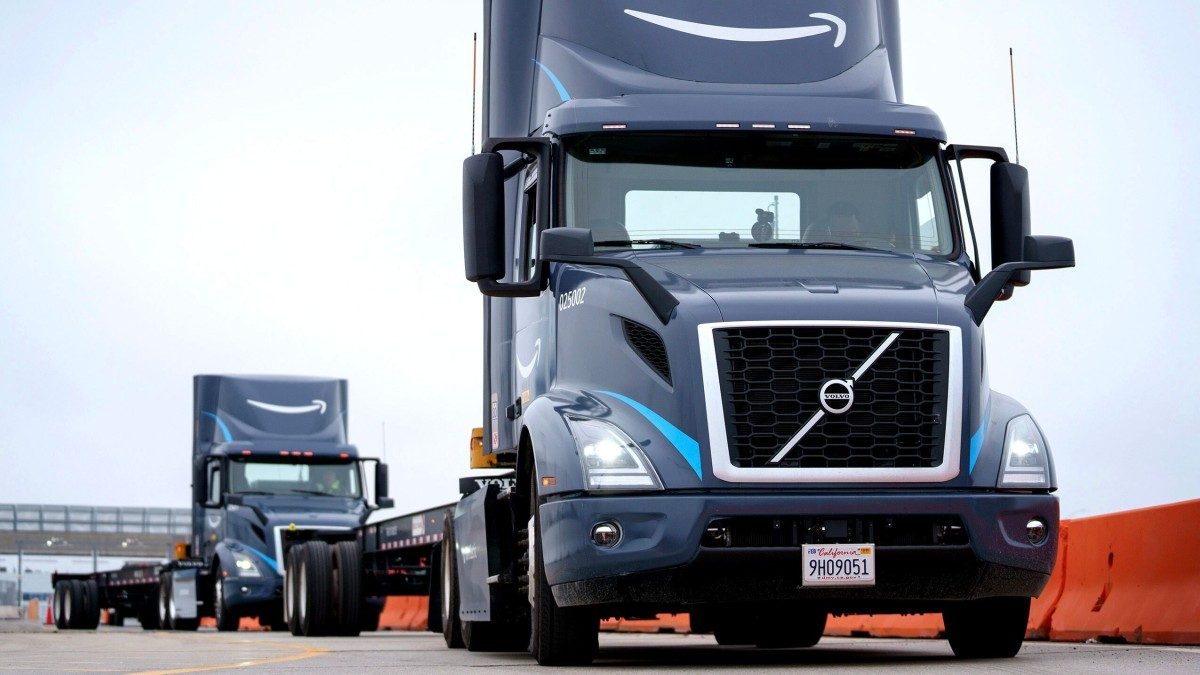
Amazon just announced another fleet expansion with Einride. The press releases are glowing. The stock market nods in approval. The "green" pundits are busy celebrating the death of the internal combustion engine.
They are all looking at the wrong map.
Adding a few hundred heavy-duty electric vehicles (EVs) to a logistics network that moves billions of packages is not a climate strategy. It is a marketing expense disguised as an infrastructure investment. The narrative suggests we are witnessing a "freight decarbonization" revolution. The reality is a high-voltage distraction that ignores the physics of energy density and the inconvenient math of the power grid.
The Weight Penalty Nobody Wants to Calculate
The dirty secret of heavy-duty EV trucking is the battery. Specifically, its weight.
In the world of freight, weight is money. Every pound of battery you add to a truck is a pound of cargo you cannot carry. A Class 8 electric truck requires a battery pack weighing between 8,000 and 12,000 pounds to achieve a meaningful range. This isn't just a minor inefficiency; it is a fundamental disruption of logistics economics.
When you lose 25% of your payload capacity to accommodate a lithium-ion anchor, you don't just "go green." You increase the number of trucks needed to move the same amount of goods.
The Math of Diminishing Returns:
- Standard Diesel Truck: 80,000 lbs Gross Vehicle Weight (GVW).
- Electric Truck: 82,000 lbs GVW (including a 2,000 lb federal allowance).
- Cargo Capacity: Reduced by several tons due to battery mass.
If Amazon needs 1.2 electric trucks to do the work of 1 diesel truck, the "decarbonization" benefits begin to evaporate under the heat of manufacturing emissions, tire wear (which is significantly higher on heavier EVs), and the sheer volume of extra vehicles on the road.
The Grid is the Bottleneck, Not the Truck
Industry insiders talk about "vehicle readiness" because it’s easy. It’s a hardware problem. But the real crisis is "grid readiness."
Charging a fleet of Einride trucks at an Amazon fulfillment center requires a power draw equivalent to a small city. We are talking about megawatt-level charging. Most distribution centers were built for light bulbs and conveyor belts, not for fueling the equivalent of ten locomotives simultaneously.
I have seen companies dump millions into EV pilots only to realize the local utility provider needs five years and a massive capital injection just to upgrade the substation. Amazon’s "bets" on Einride aren't scaling anytime soon because the copper in the ground cannot handle the load. Until we stop obsessing over the truck and start obsessing over the transformer, these announcements are nothing more than localized experiments.
The Lithium Myth and the Upstream Disaster
We need to stop pretending that an electric truck has zero emissions. It has zero tailpipe emissions.
The carbon debt incurred by mining the cobalt, nickel, and lithium for a heavy-duty battery is astronomical. You have to drive that truck for years just to break even with the diesel engine it replaced. In many regions where the electrical grid is still dominated by coal or natural gas, you aren't eliminating carbon; you are just moving the tailpipe to a power plant in a different zip code.
"The true cost of a 'green' fleet is paid in the Democratic Republic of Congo and the lithium flats of Chile long before the truck ever pulls into a Seattle warehouse."
The "lazy consensus" assumes that because the truck is quiet and doesn't smell like sulfur, it's inherently better for the planet. A rigorous lifecycle analysis often tells a more complicated, darker story.
Why Einride is the Perfect Accomplice
Einride isn't selling trucks; they are selling a software-led "as-a-service" model. This is brilliant for Amazon because it allows them to offload the massive depreciation risk of first-generation EV technology.
Today’s battery technology will be obsolete in four years. If Amazon owned these trucks outright, they’d be holding billions in stranded assets. By partnering with Einride, they get the PR win of the "electric revolution" without the long-term liability of owning the hardware. It’s a financial hedge, not an environmental breakthrough.
The Real Question We Aren't Asking
Instead of asking, "How do we make trucks electric?" we should be asking, "Why are we still moving this much weight via truck?"
If Amazon were serious about decarbonization, the conversation would be about rail integration and autonomous "micro-hubs" that reduce the need for heavy-haulage entirely. But rail isn't sexy. Rail doesn't have a sleek, driverless-ready cab that looks good on a LinkedIn carousel.
We are trying to force a 20th-century logistics model into a 21st-century energy constraint. It’s a square peg in a round hole, and we’re using a battery-powered hammer to force it in.
The Actionable Pivot for Logic-Driven Leaders
If you are a logistics lead or a fleet manager, stop chasing the "all-electric" headline. It is a trap that will bleed your Opex dry.
- Focus on Hybrid Hydrogen: For heavy-duty long-haul, hydrogen fuel cells offer the energy density lithium can’t touch. They don’t carry the same weight penalty, and refueling takes minutes, not hours.
- Audit Your Utility First: Do not sign a lease for an EV fleet until you have a signed agreement from your power provider. You don't want a fleet of $400,000 paperweights sitting in your lot because the grid can't charge them.
- Prioritize Efficiency Over Electrification: A 10% increase in load optimization across a diesel fleet does more for the planet today than five electric trucks doing "last-mile" runs for the cameras.
The industry is currently intoxicated by the "tech-bro" version of environmentalism. It’s an aesthetic of progress that ignores the structural reality of how energy is moved and stored. Amazon is a master of optics. Don't mistake their PR budget for a viable blueprint for the rest of the world.
Stop buying the hype and start weighing the batteries.