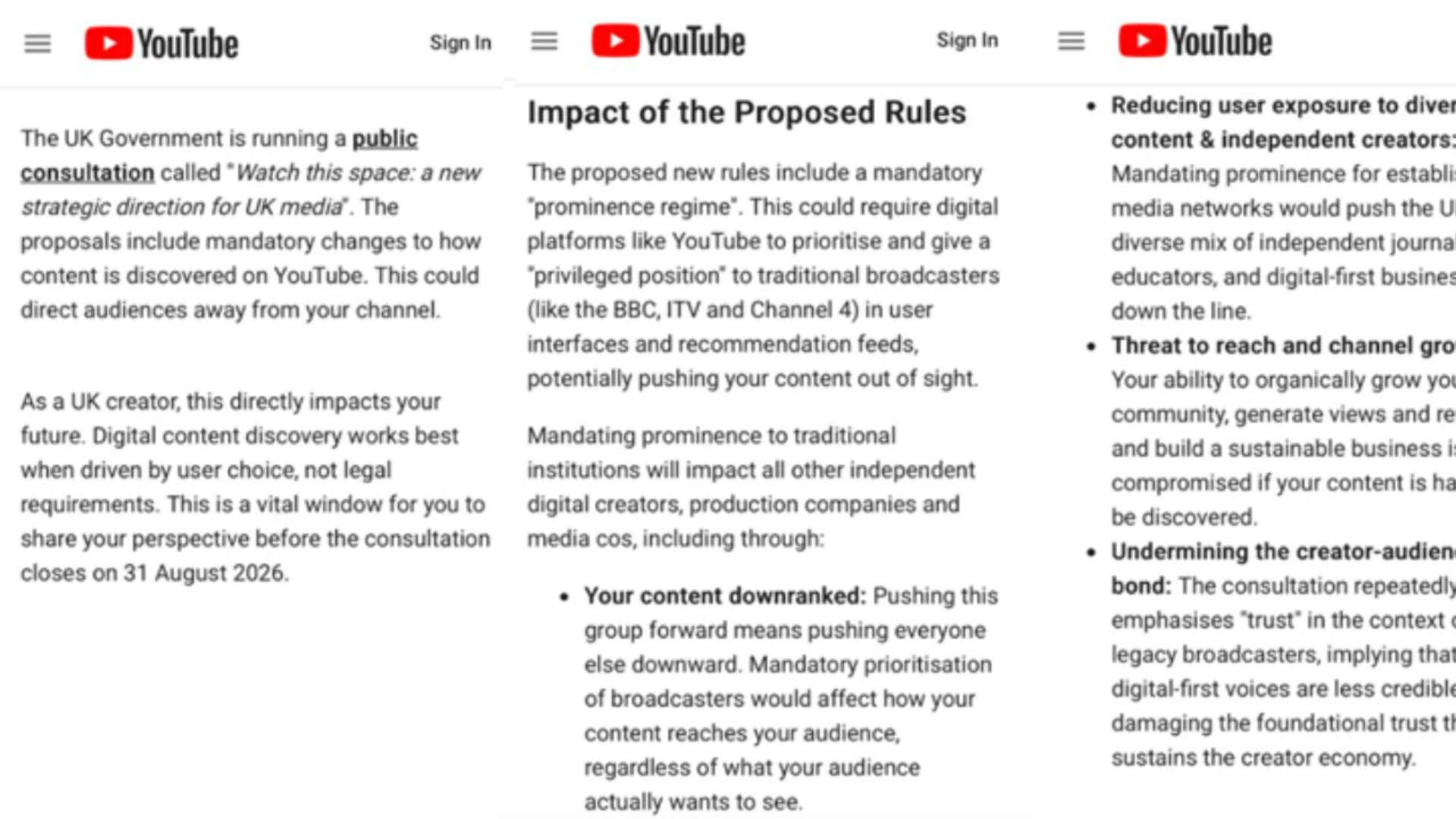
A direct intervention into the structural logic of digital distribution algorithms is underway in the United Kingdom. The Department for Culture, Media and Sport's public consultation, "Watch this space: A new strategic direction for UK media," outlines a framework intended to alter how recommendation engines process and rank digital video content. This initiative introduces a statutory mechanism requiring algorithmic platforms—specifically YouTube and TikTok—to provide preferential prominence to Legacy Public Service Broadcasters (PSBs) such as the BBC, ITV, Channel 4, and Channel 5.
The policy introduces a structural modification to platform economics. By forcing the optimization of a state-selected class of content providers, the proposed regulation disrupts the native economic feedback loops governed by user retention, click-through rates (CTR), and session duration metrics. Analyzing this friction requires moving past hyperbole to evaluate the precise architectural mechanics, the platform response vectors, and the operational externalities imposed on independent content creators.
The Mechanics of Structural Algorithmic Intervention
To understand how the proposed mandate operates, the baseline mechanics of a modern digital distribution engine must be mapped. Content recommendation platforms rely on multi-stage ranking pipelines designed to maximize user engagement metrics.
The baseline algorithmic function can be modeled as a system optimizing a scoring function:
$$S_{c, u} = f(E_{c, u}, R_c, C_u)$$
Where:
- $S_{c, u}$ is the final recommendation score for a piece of content $c$ given to user $u$.
- $E_{c, u}$ represents historical engagement variables (historical watch history, shared demographic behavior, specific topic affinities).
- $R_c$ represents content-level performance signals (average view duration, completion rate, instantaneous click-through velocity).
- $C_u$ represents contextual features (device type, time of day, localized regional trends).
The UK government's proposed prominence mandate introduces a mandatory weighting factor, or an exogenous multiplier ($M_p$), applied explicitly to designated public service broadcast content:
$$S_{c, u}' = M_p \cdot f(E_{c, u}, R_c, C_u)$$
Where $M_p > 1$ if content $c$ belongs to an officially recognized PSB, and $M_p = 1$ for all independent or non-PSB content creators.
The Content Re-ranking Bottleneck
This mathematical intervention alters the final re-ranking layer of the recommendation funnel. Even if an independent piece of journalism or commentary possesses superior performance signals ($R_c$) and higher user affinity ($E_{c, u}$) relative to a competing PSB video, the state-mandated multiplier artificially inflates the position of the PSB content within the user interface. This mechanism creates a structural bottleneck in user acquisition channels, systematically altering the organic distribution of consumer attention.
Platform Defense Dynamics: The Capital Allocation Threat
The assertive counter-campaign launched by YouTube under the #KeepYouTubeYours banner is a structural defense mechanism intended to preserve platform utility and protect underlying advertising business models. Platforms operate as multi-sided marketplaces matching user attention with advertiser demand using optimized content streams.
A forced increase in the visibility of a specific sub-set of creators introduces two distinct architectural risks for global platform operators:
- Retention Rate Degradation: Forcing less contextually relevant content into a user’s feed lowers instantaneous click-through rates and aggregate session watch time. Because platform revenue models rely on ad-impression density per user session, artificial optimization for non-engagement criteria directly threatens top-line platform revenue within that geographic territory.
- Engineering Vector Divergence: Maintaining localized codebases with distinct algorithmic constraints increases technical debt. If every sovereign jurisdiction mandates its own proprietary, politically determined visibility multipliers, the efficiency of centralized machine learning infrastructure degrades. Platforms must allocate significant engineering resources to maintain regional compliance layers rather than core product iteration.
By issuing direct, system-wide notifications warning creators that the state framework will require putting "some channels above others," YouTube executes a classic collective action strategy. It leverages its creator ecosystem to apply pressure back onto regulatory bodies during the consultation window, highlighting the clear operational trade-offs of the policy.
Operational Impact and the Independent Creator Cost Function
The downside risks of this regulatory shift fall disproportionately onto mid-tier, independent digital video creators who rely on organic algorithmic discovery rather than institutional brand recognition.
Zero-Sum Screen Real Estate
The digital viewport—whether a mobile screen or a connected television interface—is a finite canvas. If the top coordinates of a recommendation feed are statutorily reserved for legacy public service channels, independent content is displaced downward.
+-----------------------------------+
|  [PSB Slot 1: BBC News] (Mandated)|
+-----------------------------------+
|  [PSB Slot 2: Channel 4] (Mandated)|
+-----------------------------------+
|  [Independent Creator] (Displaced)|
+-----------------------------------+
This structural displacement results in a measurable drop in impression share, precipitating a cascading decay across the creator business model:
- The Discoverability Churn: Lower initial feed positioning reduces top-of-funnel impressions. Fewer impressions lead to a lower absolute volume of views, suppressing subscriber growth curves.
- The Content Monetization Squeeze: Because automated programmatic ad revenue functions as a linear product of monetizable views, diminished impression share contracts operating margins.
- Production Capital Flight: As margin compression takes hold, independent entities face a structural deficit in their ability to self-fund investigative research, high-fidelity production equipment, and specialized editorial staff.
This interaction reveals the core flaw in the regulatory premise: an initiative designed to elevate "authoritative and trusted news" introduces an asymmetric financial burden on independent alternative networks, narrowing the diversity of the domestic media ecosystem.
The Structural Trade-Offs of Democratic Information Curation
The legislative push reflects a fundamental philosophical shift in state media policy: transitioning from a laissez-faire approach driven by consumer demand to an active, protectionist stance favoring institutional media.
Defenders of the policy framework argue that market forces alone fail to adequately calculate the positive externalities of regulated public service broadcasting. PSBs operate under statutory requirements for strict editorial accuracy, structural impartiality, and localized civic programming. In an online environment vulnerable to deliberate algorithmic manipulation by foreign intelligence actors or hyper-optimized engagement slop designed to exploit emotional volatility, institutional visibility acts as a stabilizing civic infrastructure.
The counter-argument, articulated by critics and political figures like Reform UK leader Nigel Farage, categorizes the intervention as a mechanism for state-directed speech optimization. By artificially inflating legacy media distribution while simultaneously introducing social media bans for specific cohorts—such as the under-16 restrictions scheduled for 2027—the state effectively consolidates control over the digital presentation of information. This creates a dual-track information economy where institutional platforms receive state-backed structural advantages while alternative networks are relegated to secondary distribution channels.
Strategic Playbook for Platforms and Independent Media Networks
The consultation window closes with platforms and creators facing a clear operational reality: the baseline rules of sovereign digital distribution are being rewritten. Navigating this shift requires distinct tactical adaptations for both digital platforms and independent media networks.
Platform Compliance Engineering
Platforms will likely avoid blunt censorship mechanisms or uniform algorithmic degradation across the board. Instead, look for engineering teams to isolate the mandated prominence requirements to explicit "News and Current Affairs" tabs or localized home-screen carousels rather than allowing the exogenous multiplier ($M_p$) to degrade the hyper-optimized core recommendation feeds. This preserves maximum user retention while satisfying the baseline legal letter of the prominence mandate.
Independent Media De-platforming Mitigation
Independent organizations cannot rely exclusively on organic third-party distribution channels that are vulnerable to regulatory capture. To hedge against structural discoverability decay, independent creators must execute three immediate operational adjustments:
- Audience Ownership Diversification: Shift top-of-funnel algorithmic audiences immediately toward direct-to-consumer distribution channels, specifically self-hosted subscription platforms, RSS-based audio networks, and managed email infrastructure.
- Cross-Jurisdictional Optimization: Format and tag digital assets to optimize discoverability in geographic territories outside the jurisdiction of the UK media mandate, counteracting localized impression losses.
- Algorithmic Arbitrage: Pivot content strategy toward high-intent search queries rather than relying solely on home-feed recommendations, utilizing specific search engine optimization (SEO) frameworks to bypass the re-ranking multipliers applied to browse feeds.