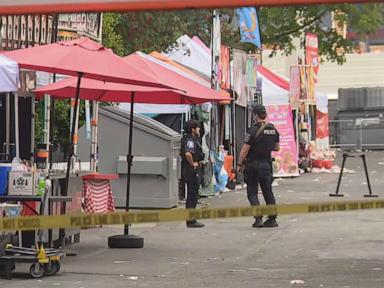
The scent of kettle corn usually hangs heavy in the air at Seattle Center during a food festival. It is a sweet, sugary anchor to summer, the kind of smell that promises nothing more complicated than a messy afternoon and a sticky seat on the grass. People wander with plastic forks in hand. They laugh. They argue about which vendor has the best tacos. They believe they are safe because they are surrounded by strangers.
Then, the rhythm of the day fractured.
Two lives ended in the time it takes to draw a sharp breath. Five others now carry the weight of shrapnel and trauma, their lives redirected in an instant.
I know how that sound changes a person. It is not like the movies. It isn't a sharp bang-bang that rings out with cinematic clarity. It is a dull, intrusive thud that stops the heart before the brain even registers what is happening. The silence that follows is thicker than the noise that preceded it. It is the silence of a crowd trying to process the impossible.
Consider a hypothetical bystander—let's call him Elias. He is sitting on a bench near the fountain, watching his daughter chase a pigeon. He has a paper napkin in his lap. He is thinking about his commute home. When the first shot rings out, Elias does not think of political policy or public safety debates. He thinks of the distance between his hand and his daughter’s shoulder. He thinks of the weight of her body as he pulls her beneath the bench. He thinks, not today.
The data tells us there were seven victims. It tells us two died. It catalogs the age, the gender, the location, the official response from city authorities who are now shuffling through security protocols and asking why the metal detectors weren’t enough. But data is a cold comfort to Elias, who is currently shivering in a patrol car, watching the red lights of emergency vehicles paint the pavement.
We try to pin these events down. We want to believe that if we identify the motive, we have mastered the chaos. We demand answers from officials. We pore over maps of the festival grounds, looking for the security gap, the unlocked gate, the moment the oversight occurred. We treat these tragedies like mechanical failures in a machine that we assume is otherwise perfectly engineered.
But this is not a machine. It is a public space.
Public spaces are the messy, beautiful, dangerous bedrock of our society. They rely on a social contract that is increasingly fragile. We gather because we are hungry for the presence of others, but we are haunted by the realization that we are also gathered in the line of fire. It is a cognitive dissonance we live with every day. We go to the grocery store, the concert, the food festival, all while knowing, deep in our marrow, that the world is no longer as predictable as the weather report.
The officials will talk about incident reports. They will hold press conferences. They will talk about the deployment of resources and the timeline of the police arrival. This is their job. It is their way of imposing order on a nightmare. But the real story is not in the official press release. It is in the way the city holds its breath tonight. It is in the way thousands of people in Seattle are currently looking at their own calendars, wondering if the next event—the next birthday party, the next street fair—is worth the risk.
There is a hollow ache in the realization that a festival meant to celebrate the bounty of a community became a site of mourning. We lose more than just lives in these moments. We lose the assumption of belonging. When we are forced to treat our neighbors as potential threats, the communal fabric frays.
I remember sitting in a park after a similar event years ago. Every time a car backfired, the entire lawn went rigid. We were not individuals anymore; we were a nervous system, reacting in concert to a threat that wasn't there. It is exhausting to live in that state of perpetual readiness. It steals the joy from the sun. It makes the taste of the food bitter.
Yet, we keep showing up.
Why? Because the alternative is a walled-off life. The alternative is silence.
The investigators are doing their work. They will sift through the debris and the digital breadcrumbs, looking for the catalyst that turned a Saturday afternoon into a tragedy. They will find the "why," or they will fail to find it, and we will be left with the same uneasy feeling that life is inherently precarious.
The sun is setting over the Space Needle now. The yellow tape is still fluttering in the breeze. Tonight, there is a specific, quiet grief settling over Seattle, a heavy blanket that doesn't just cover the victims, but covers everyone who walked those paths today. We are left to navigate the wreckage of a normal day, staring at the empty space where the music should have been, trying to remember what it felt like to be a crowd instead of a congregation of survivors.