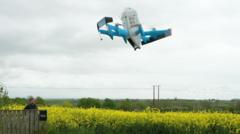
The fenlands of Cambridgeshire are not known for drama. They are known for horizontal lines, the smell of damp earth, and a silence so profound it feels heavy. But on a Tuesday that started like any other, that silence didn't just break. It hummed.
Richard, a resident of a small village near Cambridge, wasn't looking for a revolution. He was likely looking for his reading glasses or perhaps wondering if the kettle had boiled. He represents a specific kind of pioneer—the accidental kind. He didn't climb a mountain or plant a flag. He simply clicked a button on a screen.
Thirteen minutes later, a sound unlike any bird or plane descended toward his garden. It was the frantic, controlled buzz of sixteen propellers. A drone, adorned with the familiar Amazon arrow, lowered itself through the crisp English air. It didn't land. It hovered, dropped a small package containing an Amazon Fire TV and a bag of popcorn, and vanished back into the grey horizon.
With that single delivery, the distance between "someday" and "right now" vanished.
The Weight of Thirteen Minutes
We have spent decades building a world based on the friction of roads. We measure our lives in traffic jams, the wait for the postman’s van, and the frustrated refreshing of a tracking page that says "Out for Delivery" while the sun slowly sets. Logistics is usually a heavy, dirty business involving diesel fumes and tired drivers navigating narrow country lanes.
Amazon Prime Air changed the physics of that expectation. By utilizing the vertical space we usually ignore, they bypassed the gridlock of the A14.
Think about the math of a typical afternoon. You realize you’ve run out of a vital ingredient or a piece of tech has died just when you need it most. Usually, that’s a thirty-minute round trip to the shops, assuming you have a car and the will to use it. Now, consider the drone. It moves at 50 miles per hour. It doesn't care about roundabouts. It doesn't get stuck behind a tractor.
For the two customers involved in this initial UK trial, the experience wasn't just about getting a gadget. It was about the sudden, jarring realization that the sky is now a highway.
The Curious Crowd in the Garden
Word travels fast in a village. Before long, people weren't just passing by Richard’s house; they were stopping. They were staring at a patch of grass as if it were a holy site. "We had people come just to see it," an Amazon representative noted at the time.
There is something deeply human about that curiosity. We are a species that loves a spectacle, but we are also a species that fears the intrusion of the new. To the neighbors, that drone was a metallic hornet, a buzzing intruder in a place where the loudest sound is usually a distant lawnmower.
The drones used in this Cambridgeshire trial are autonomous. They don't have a pilot sitting in a darkened room with a joystick. They use GPS to find their way and "sense and avoid" technology to ensure they don't tangle with a chimney pot or a confused pigeon.
The stakes for Amazon are invisible but massive. If a drone clips a tree or, heaven forbid, a person, the dream of automated delivery dies in a flurry of litigation and public outcry. This isn't just about moving popcorn. It's about building a system of trust with a public that is notoriously protective of its privacy and its peace.
The Logistics of a Ghost Fleet
Behind the whimsey of a flying package lies a staggering amount of infrastructure. The fulfillment center in Cambridge isn't just a warehouse; it’s a launchpad.
Imagine the choreography inside. A customer orders. A robotic arm or a focused worker secures the item. The drone, sitting on a specialized track, receives its cargo. The doors slide open.
The drone lifts off.
It is a masterpiece of engineering, yet it feels like science fiction. These machines are designed to operate safely in 400 feet of airspace—well below the paths of commercial jets but high enough to be out of the hair of most hobbyists.
But the UK presents unique challenges. The weather is a fickle beast. Rain, wind, and the pervasive British mist are the natural enemies of lightweight carbon fiber and sensitive sensors. To make this work, Amazon had to prove to the Civil Aviation Authority (CAA) that their "ghost fleet" could handle the erratic nature of an English winter.
Why the Fens?
There is a reason this didn't start in the middle of London or the sprawling streets of Manchester. The fens provide a controlled, low-density environment. It is a laboratory with a view.
If you can master the delivery of a bag of popcorn to a flat, open garden in Cambridgeshire, you have a blueprint. But the leap from a rural village to a suburban cul-de-sac is a chasm. In a city, you have power lines, balconies, over-excited dogs, and the sheer density of human life.
The trial is small—just two customers to start, scaling to dozens, then hundreds. It is a slow-motion revolution. Amazon is playing the long game, betting that once the novelty wears off, the sheer convenience will win out over the aesthetic concerns of a buzzing sky.
The Invisible Stakes of Silence
We often talk about technology in terms of what it gives us. We get our items faster. We save a trip to the store. But we rarely talk about what it takes away.
There is a sanctity to the air above our homes. For centuries, that space was empty, save for the occasional bird or a passing cloud. By filling it with delivery craft, we are making a trade. We are trading a sliver of our quiet for a sliver of our time.
For Richard and his fellow pioneers, the trade seems worth it. There is a thrill in being the first. There is a story to tell at the pub. But as the trial expands, the conversation will shift from "Look at that amazing machine" to "Does it have to be so loud?" or "Is it watching me?"
Amazon has been careful to address the privacy concerns, stating the drones are focused purely on navigation and delivery. Yet, the skepticism remains. It is the friction between our desire for instant gratification and our instinctual need for a private sanctuary.
The Popcorn Prophecy
The bag of popcorn dropped in that Cambridgeshire garden is a symbol. It’s light. It’s trivial. It’s almost a joke. But the system required to move that bag of popcorn thirteen minutes across a county is the same system that could eventually move blood supplies, emergency medication, or the one missing part that keeps a local business from shutting down.
We are watching the birth of a new layer of civilization.
One day, we will look up and see a drone, and we won't stop what we're doing. We won't call the neighbors. We won't even point. We will simply hear the faint, high-pitched hum and know that someone, somewhere, just realized they forgot the milk.
The sky over the fens is quiet again for now. The drone has returned to its cradle, its batteries charging for the next thirteen-minute sprint. Richard has his TV stick. The popcorn is likely gone.
But the air feels different. It feels occupied. It feels like the future arrived on a Tuesday, whispered its name, and then went back to work.