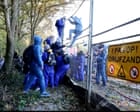
Around 100 masked protesters climbed over temporary metal fencing at a Microsoft construction site on Plimsollweg in Amsterdam's Sloterdijk district on November 6, 2026. They scaled a crane, set off flares, hung banners, and clashed with riot police wielding batons and pepper spray.
If you only skimmed the headlines, you might think this was just another routine climate demonstration. It wasn't.
The Amsterdam breach kicked off a coordinated two-day wave of roughly 85 actions across 15 European countries under the banner "Stop Dirty Data Centres". More importantly, it exposed a massive regulatory contradiction in the Netherlands. Amsterdam supposedly banned new data center builds from 2025 through 2030 to protect its strained power grid. Yet steel is still going up in Sloterdijk because legacy permits let tech giants slip right past the moratorium.
That gap between public policy and physical construction is driving real anger on the ground.
What Actually Happened on Plimsollweg
The demonstration started around midday in Sloterdijk, an industrial and office zone northwest of central Amsterdam. Organized by the Dutch activist group Geef Tegengas alongside anti-war and climate campaigners, the protest quickly escalated beyond the perimeter.
By 11:15 a.m., Amsterdam's mayor had already issued an order banning the demonstration involving the group. Police were deployed in heavy numbers before noon, yet roughly 100 people still managed to breach the temporary construction barriers. Several climbed a crane towering over the site to unfurl protest banners. Officers moved in with batons and pepper spray, making arrests and escorting demonstrators off the compound through the late afternoon.
Microsoft responded through Dutch broadcaster NOS with a standard corporate statement. The company acknowledged that the project stirs strong emotions and claimed to respect peaceful expression, while condemning actions that break the law or endanger worker safety.
Protesters weren't buying it.
"We won't accept Amsterdam being used for the creation of AI slop and the facilitation of genocide," said Roos Molenaar, an activist with Geef Tegengas. Another demonstrator, Timmer, told reporters at the scene that nobody needs the facility, pointing to AI warfare, surveillance, and environmental strain as reasons they plan to keep fighting until construction stops.
The Amsterdam Data Center Moratorium Loophole
Here's the part most international coverage glosses over, and it's the exact reason Dutch residents are furious.
Amsterdam's municipal government instituted a strict freeze on new data center developments and expansions running from 2025 to 2030. City officials knew their electrical infrastructure couldn't handle another wave of hyperscale server farms. In the Netherlands, grid congestion isn't a theoretical future problem. Thousands of businesses, housing developments, and schools sit on waiting lists just to get hooked up to power.
So how is Microsoft building a massive facility in Sloterdijk right now?
Grandfathered permits. Projects that secured zoning clearance and grid allocation before the moratorium took effect found legal pathways to proceed. To a local business owner told they can't expand their warehouse because the grid is full, watching a hyperscale AI facility rise down the road feels like a rigged game.
You don't need to support property trespassing to understand why that breeds resentment. When local housing gets delayed over megawatt shortages while tech companies build compute clusters for generative AI, public trust collapses fast.
Why European Protests Spread Beyond Climate Concerns
Look closely at the signs carried in Amsterdam, Warsaw, Berlin, Bristol, and Zagreb during the November 6–7 weekend. You won't just see carbon emission charts. The anti-data center coalition has merged several distinct grievances into one target.
Grid Strain and Local Displacement
Outside the Polish parliament in Warsaw on the exact same Friday, roughly 100 demonstrators held a banner reading, "Two data centers, 35 metres from our homes! Prime Minister Tusk, help!!!" Proximity, constant cooling noise, diesel backup generators, and land consumption are turning suburban and urban neighbors into overnight activists.
Labor Conditions on Construction Sites
Just days before the Amsterdam breach, a joint investigation by The Guardian and Investigate Europe uncovered dangerous working conditions for laborers building European data centers. Tight deadlines driven by the AI arms race are pushing subcontractors to cut corners on site safety, adding labor rights groups to the opposition.
Military Contracts and Surveillance Fears
Unlike older cloud facilities built mostly for banking or video streaming, 2026 hyperscale builds are explicitly tied to frontier AI models. Pro-Palestinian activists joined the Amsterdam action specifically over Microsoft's defense and cloud contracts, linking local infrastructure directly to overseas military operations.
Skepticism Toward AI Value
Notice how often the phrase "AI slop" showed up in quotes from Amsterdam protesters. Ten years ago, people accepted server farms because they powered hospitals, maps, and communication tools they actually used. Today, regular citizens see massive amounts of electricity and water going toward automated spam, deepfakes, and corporate cost-cutting—and they're questioning whether the trade-off makes any sense.
Why Tech Giants Keep Misreading This Backlash
I've watched infrastructure disputes play out across energy and telecom sectors for years, and tech companies are making the exact same mistake utility monopolies made in the 1970s. They treat local opposition like a public relations hurdle instead of a structural resource conflict.
Issuing a press release about "respecting peaceful opinions" while relying on pre-moratorium loopholes doesn't calm a neighborhood down. In fact, it accelerates organized pushback. Data Center Watch has already tracked at least 45 projects globally that have been deferred or stalled due to public protests and local regulatory tightening.
There's also a growing disconnect between national politicians chasing AI investment and municipal leaders dealing with physical limits. National governments love announcing multi-billion-euro tech commitments. Mayors and grid operators are the ones left explaining why transformers are overloaded and water tables are stressed.
Even critics of the protesters admit the underlying math is broken. Reddit threads dissecting the Amsterdam break-in were full of sharp debate—plenty of commenters pointed out the irony of debating data centers on servers hosted by AWS or Google Cloud, while others argued that shutting down builds in Europe just pushes them to countries with looser environmental rules. Both points have merit. Neither solves Amsterdam's grid bottleneck.
What Infrastructure Planners and Tech Teams Must Do Differently
If you're involved in siting, permitting, or advocating around digital infrastructure in Europe right now, pretending these protests are isolated stunts will cost you millions in delays. The playbook has changed.
- Stop hiding behind legacy permits. If a municipality passes a moratorium because the local grid is maxed out, pushing a grandfathered project through without transparent grid-offset agreements guarantees physical blockades and legal challenges.
- Mandate dedicated behind-the-meter power. New hyperscale builds shouldn't compete with housing or small businesses for existing substation capacity. Developers need to fund new transmission upgrades or co-located renewable generation before breaking ground.
- Enforce strict subcontractor audits. After the Guardian and Investigate Europe safety findings, labor regulators and journalists are watching every major build site in the EU. Direct general contractors must verify worker protections down the entire subcontracting chain.
- Publish real water and heat-reuse metrics. District heating partnerships—where server waste heat warms nearby Dutch homes—work well in theory, yet many projects treat them as optional press-release add-ons rather than binding permit conditions.
The Amsterdam fence breach wasn't an anomaly. Until tech companies match their compute ambitions with real grid investments and community accountability, construction sites across Europe will remain frontlines.
For raw footage of the perimeter breach and police response on Plimsollweg, watch Around 100 Protesters Break Into Microsoft Data Centre Site as Amsterdam Protest Escalates.